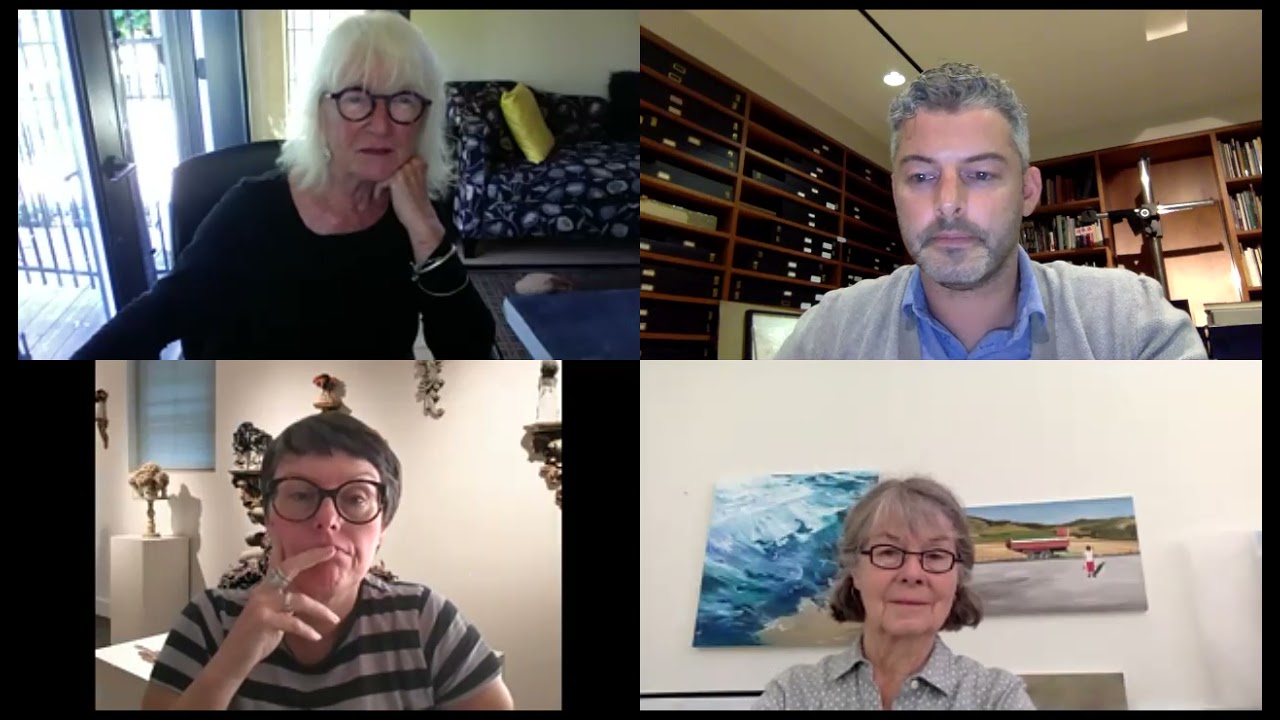
On August 24, 2021, the MacLaren Art Centre partnered with Jeanette Luchese of Be Contemporary to host an artist talk about their summer shows LUSH and 470 Days. Hosted by Tyler Durbano, each artist was asked to talk about their practice in relation to their personal experiences as a woman, collector and maker.
LUSH: Fabrications in Yarn and Fabric by Marlene Hilton Moore and Jill Price is a two-person exhibition investigating the social, cultural, and ecological implications of textiles from different perspectives.
A feast for the eyes from multiple vantage points, Marlene Hilton Moore’s photographic work, combined with sculpture, architecture, and artifacts, develops narratives based upon a woman, a dress, and a place. Visually weaving together encoded cultural messages that allude to personal social histories, Marlene brings together two series of work to create a continuum of her investigation into identify formation. Juxtaposing a pure white mannequin wearing an intensely embroidered dress with richly textured objects and a vivid historic interior from her body of work entitled Inside My Skin, Hilton Moore’s gallery installation is paired with photographs of Peonia Beauty, a series of images that reveal a dress of black taffeta peonies, a quixotic young woman, and textures of deteriorating architecture. While moving in and out of Marlene’s photos into the physical realm of the artist’s carefully hand-crafted objects and attire, Hilton Moore’s quotidian reality expands into a dance of authenticity and vision.
Hilton Moore shares, “The woman forms an intimate bond with her place and a visual story emerges. Fleeting glances, a pointed gaze and body language all reveal a distinctive identity. Accidental elements of light and motion also create unique moments that add to the resonance of each photograph.”
Across the room from Hilton Moore’s arrangement of sculptures and photos is a grouping of entanglements by Jill Price. Both absurd and playful, Price’s altered ready-mades, created from reclaimed yarn and porcelain figurines, point more to how materials in their various forms have a way of controlling, consuming, commodifying, and curating bodies in and out of cultural norms. Often covering much of the figurine’s white surfaces and heads that carry forward Euro-centric and patriarchal notions of femininity, beauty, etiquette and class, Price reconstructs found textiles into large assemblages of fibre to point to how we can’t see the messiness of all of that which is produced or attached to that which we consume. Price admits, “I have grown up deeply influenced by design and fashion. Now astutely aware of the social and ecological shadows attached to global chains of extraction, production, dissemination and discard, my entanglements of material excess and waste offer me a way to still create while partially unmaking myself from further consumption amidst ecological crisis.
Also discussed is an installation in BHCV GALLERY entitled 470 Days by Regina Williams. At the beginning of the Covid-19 shutdown, Regina Williams began a series of small collage and sculptural work. Getting lost in memory and speculation, Williams collages served as a cut and paste journey across time that became nostalgic as each fragment offered meaning and a mode of preservation. Williams confesses, “Isolation offered me the opportunity to explore, enjoy and reuse mountains of material that I have had stored for decades. Old postcards, stamps and photographs offered visual and written entry points into my ancestry.” Paired with another exploration into clay, Williams arrived at an abundance of quirky little figurines inspired by Rodin’s Burghers of Calais. Each about the size of a human hand, Williams caringly let these little people inhabit her days. Standing together and yet excruciatingly alone, each one appears to be looking up, down, backwards and or forwards; searching.
Proudly sponsored by HWISEL

Информация по комментариям в разработке