Speaker: Marina Diaz Michelena. INTA
Date: 2025-05-30
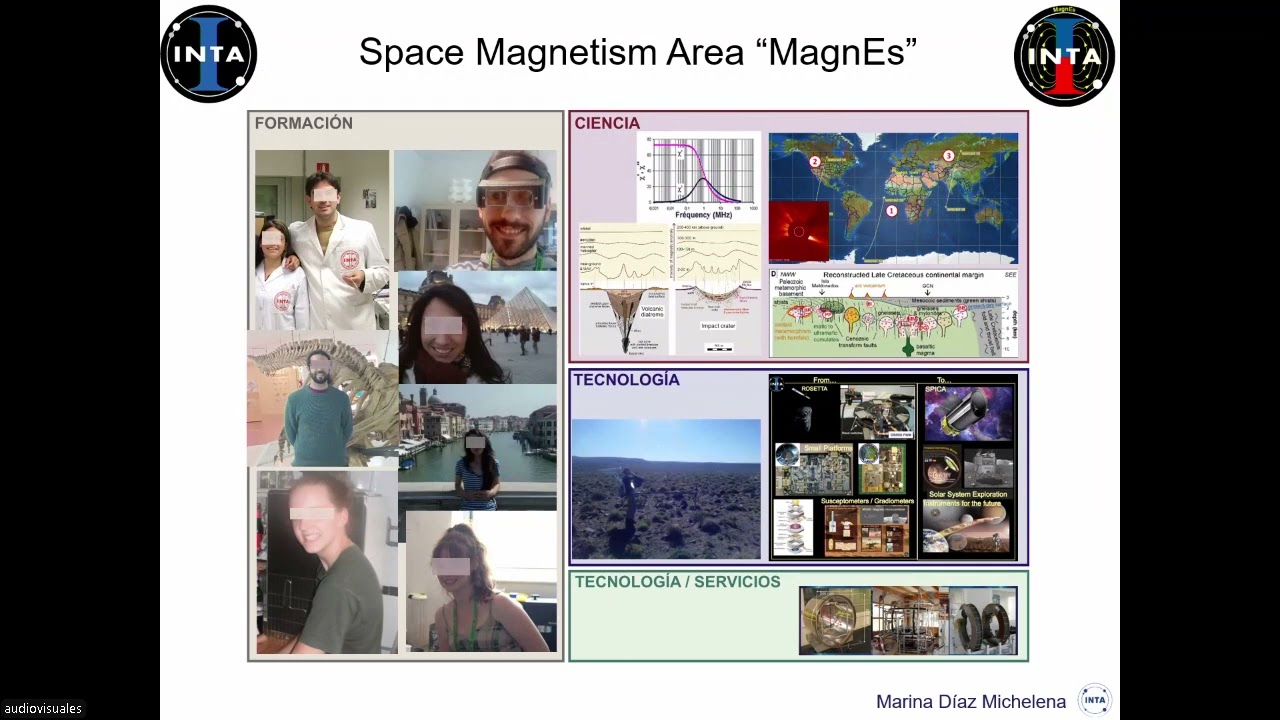
Abstract: Craters are typical features on the surface of planets. Their origin is diverse and comprises the impact of meteorites, explosive volcanism, sink holes, etc, all of them surface reshaping mechanisms that can be related in greater or lesser extent to the geodynamics of the bodies. Among the different processes, high energy cratering often implies a notable modification of the magnetization state of the rocks, which is recorded by their magnetic bearings. Later, the evolution in the different atmospheres might also change the magnetic properties of the minerals [1, 2]. Therefore, the magnetic investigations can be used to understand environmental features at the time when the event occurred as well as those that followed the formation event [3]. On Earth, volcanoes are continuously monitored both by remote sensing and in situ with parametric nets of sensors that permit their study along all their phases [4]. There are also several techniques devoted to the identification and study of impact craters. However, these techniques, mostly the ones that imply in situ and multiparametric measurements are not feasible in the planetary exploration context. One would expect that the upcoming era of exploration of Mars and the Moon would permit the establishment of nets of stations by the study features as well as high-resolution measurements with remote sensing platforms flying at low altitudes (10 – 100 m) like helicopters [5] or balloons. This work presents the technology developed at INTA Space Magnetism Area and several studies performed in terrestrial analogues that mimic those expected in the planetary exploration context. Acknowledgements: The field campaigns have been funded by the Spanish Government through the grants ESP2015-70184-R1, ESP2017-88930-R, PID2020-119208RB-I00 and RTI2018-099615-B-100, the aerial platforms for magnetometry, in MAGMA project with MAGMA NFQ Ventures. References: [1] Lillis et al. 2010. J. Geophys. Res 115: E07007; [2] Purucker, M.E. & Waaler, K.A. (2013): Crustal magnetism. Vol. 5: Geomagnetism. M. Kono (ed.), Elsevier.; [3] William, W.J. et al. 2013. Gravity and magnetic exploration. Cambr. Univ. Press, 502 p. [4] Hunt et al. 2013, Wiley. Online Library. DOI: 10.1029/RF003p0189.; [4] Fernández, J. et al. 2021, Sci Rep 11, 2540. DOI: 10.1038/s41598-021-82292-3; [5] Balaram, B., et al. 2018 AIAA Atmospheric Flight Mechanics Conference. DOI:10.2514/6.2018-0023. Keywords: High-resolution magnetometry, magnetic instrumentation, magnetic anomalies, volcanoes, impact craters.

Информация по комментариям в разработке