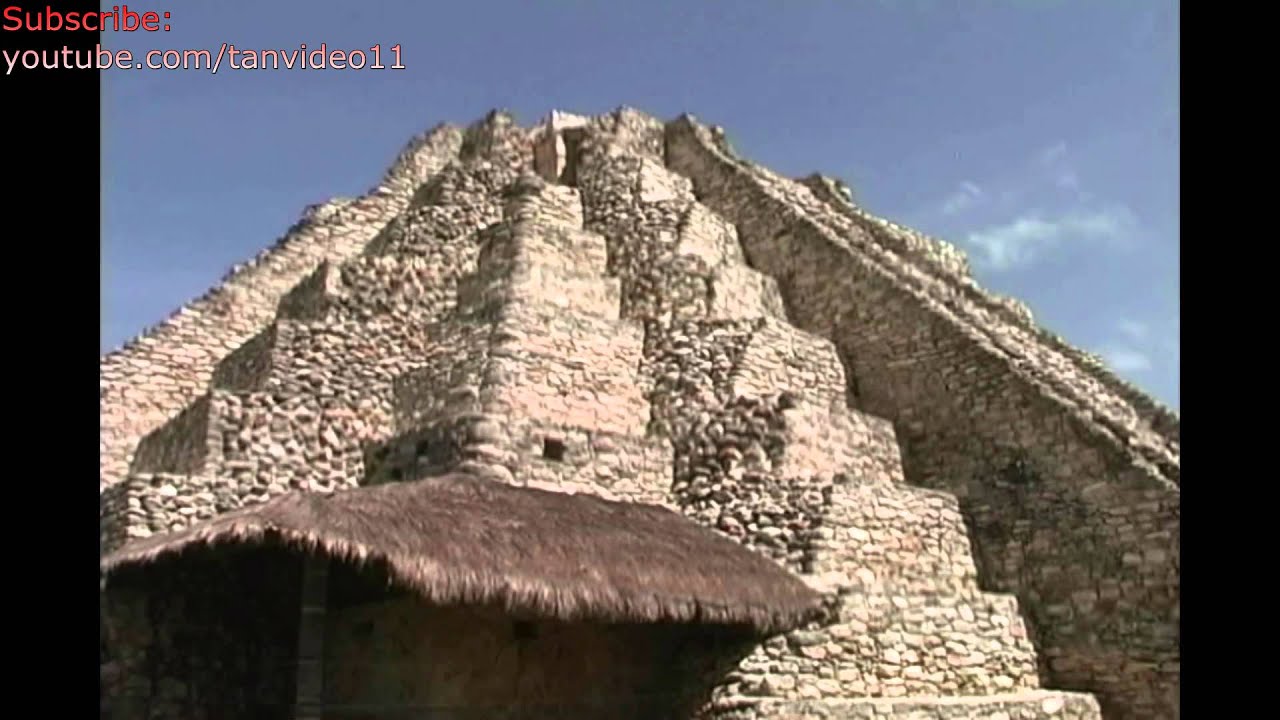
/ tanvideo11 - Mayapan (Màayapáan in Modern Maya), (in Spanish Mayapán) is a Pre-Columbian Maya site a couple of kilometers south of the town of Telchaquillo in Municipality of Tecoh, approximately 40 km south-east of Mérida and 100 km west of Chichen Itza; in the state of Yucatán, Mexico. Mayapan was the political and cultural capital of the Maya in the Yucatán Peninsula during the Late Post-Classic period from the 1220s until the 1440s.
Five years of intensive archeological investigations at Mayapan were conducted by the archaeologists of the Carnegie Institution in the 1950s, including A. L. Smith, Robert Smith, Tatiana Proskouriakoff, Edwin Shook, Karl Ruppert and J. Eric Thompson. Their work was published in a mimeographed series of Current Reports. The Current Reports have recently been republished in their entirety by the University of Colorado Press (John Weeks 2009). The final report was published by the Carnegie Institution as Mayapan, Yucatan, Mexico, by H. E. D. Pollock, Ralph L. Roys, A. L. Smith, and Tatiana Proskouriakoff (1962, Publication 619). Robert Smith also published a two-volume monograph on "The Pottery of Mayapan" in 1971 (Papers of the Peabody Museum of Archaeology and Ethnology 66, Harvard University).
In the early 1990s, Clifford T. Brown of Tulane University carried out excavations in the residential zones of Mayapan as part of his doctoral dissertation research. Several years later, the National Institute of Anthropology and History (INAH) began extensive architectural excavations and consolidation under the direction of archaeologist Carlos Peraza Lope. This work continues to the present and has resulted in the exposure and discovery of many important artifacts, murals, stuccoes, and architectural elements.
From 2001-2009, further investigations were begun at the site under the direction of Dr. Marilyn Masson from the State University New York at Albany, Carlos Peraza Lope of INAH, and Timothy S. Hare of Morehead State University. This "Economic Foundations of Mayapan" (PEMY) Project performed mapping, surface survey and collection, test-pitting, and horizontal excavation across the city. Major findings of this project include the identification of diverse occupational specialization among the city's commoners who worked as craftspersons, conscripted military personnel, farmers, and domestic servants. Great variation is now recognized in the types of work performed by commoners of different households and their degree of affluence.
Source: wikipedia.org

Информация по комментариям в разработке