Welcome to Art History in Quarantine! A weekly "live" class.
Class notes below:
Betty Friedman The Feminine Mystique
• “Each suburban wife struggles with it alone. As she made the beds, shopped for groceries, matched slipcover material, ate peanut butter sandwiches with her children, chauffeured Cub Scouts and Brownies, lay beside her husband at night- she was afraid to ask even of herself the silent question-- 'Is this all?”
Judy Chicago
• The establishment of the Feminist Art Program by Judy Chicago, California, in 1970
• Consciousness raising sessions
• Womanhouse, 1972
Linda Nochlin
• “The fact of the matter is that there have been no supremely great women artists, as far as we know, although there have been many interesting and very good ones who remain insufficiently investigated or appreciated; nor have there been any great Lithuanian jazz pianists, nor Eskimo tennis players, no matter how much we might wish there had been. That this should be the case is regrettable, but no amount of manipulating the historical or critical evidence will alter the situation; nor will accusations of male-chauvinist distortion of history. The fact, dear sisters, is that there are no women equivalents for Michelangelo or Rembrandt, Delacroix or Cézanne, Picasso or Matisse, or even, in very recent times, for de Kooning or Warhol, any more than there are Black American equivalents for the same.”
The Dinner Party
• Chicago’s most famous work, The Dinner Party (1974-9), a re-imagination of Leonardo da Vinci’s Last Supper (1495-98).
• The Dinner Party toured Europe and America, sensational. But there was one problem…
• In 1979, Alice Walker pointed out that only one out of the 39 plates was dedicated to a woman a colour: Soujourner Truth.
• Soujourner Truth was the first woman freed from slavery to win a case against a black man and win custody over her son
• She escaped slavery with her daughter in 1826 and she won the case in 1828 and became an important Abolitionist. She commissioned many photographs of herself which she turned into postcards and campaigned with to try and incite support for Abolition
• She is the most photographed American woman of the 19th century
• Her most important speech is called “Ain’t I a Woman?”
Aint I a Woman?
• This phrase, Aint I a Woman, became incredibly important to African-American woman feminists in the 1960s and 70s, because they felt like they were not treated like women, and therefore were excluded from the Women’s Rights Movement.
• “Black feminist theory labelled WLM supporters “housewife feminists”, as they concentrated overwhelmingly on the concerns of middle-class white women, forgetting that many black women, historically forced to work in slave fields, had never had the luxury of being considered housewives in the first place.”
African-American Feminist Art
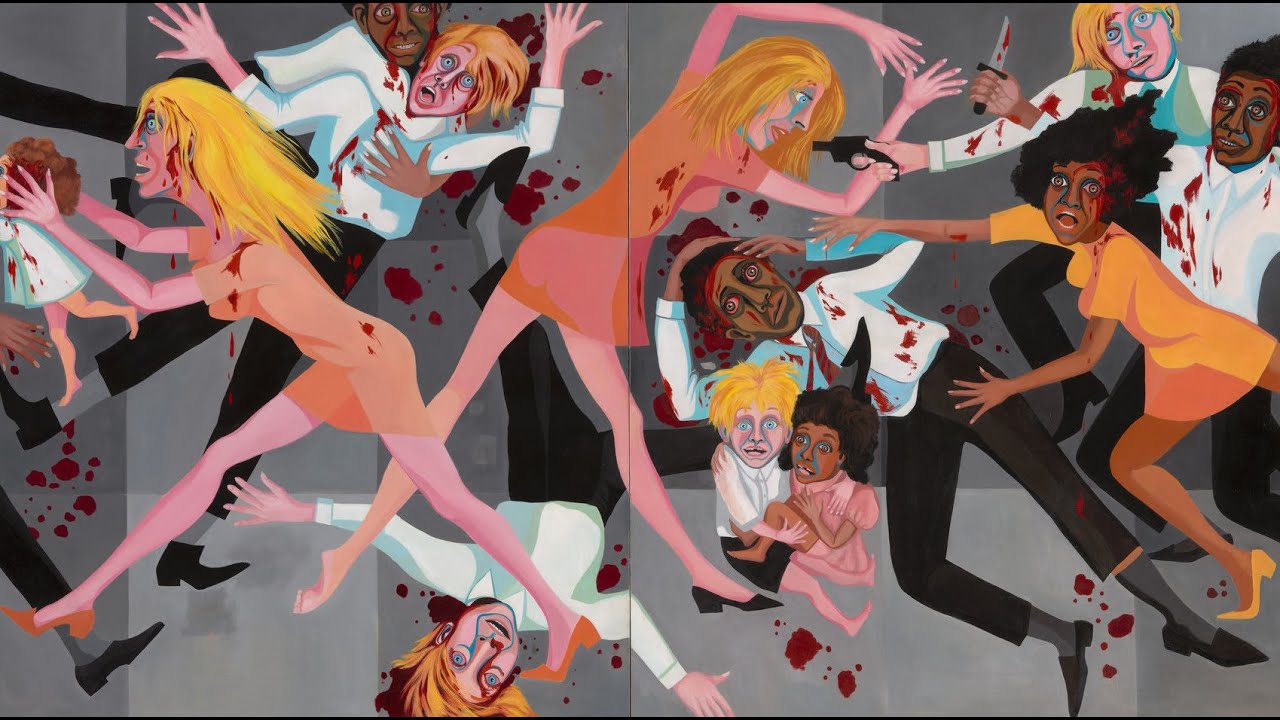
• Die is about race riots in the US and suggests no one is free, even if white and even if you’re a business person, well off.
• Angela Davis: “If they come for you in the morning, they will come for me in the night”
Native Americans / Wendy Red Star
• Originally taken by a white 19th century photographer when the crow native American tribe arrived in Washington for the PEACE DELGATION NEGOTIATIONS 1880
• The president was trying to build the Pacific Rail Road through ‘Crow’ territory
Wendy Crow Feminist Work
• Map of the Allotted Lands of the Crow Reservation, Montana—A Tribute to Many Good Women.
• “To appreciate it, a little history helps. In 1887, the U.S. government moved to divide up and allot all tribal land—giving it to men, despite the fact that the Crow (like many other tribes, Red Star notes) was a matriarchal society. The U.S. imposed a patriarchy, in other words. Red Star enlarged the 1887 allotment map and crowdsourced images of Crow women, attaching them to the old map.”
• “The colonial map represents the imposition of a patriarchal property structure that dispossessed the Crow of their land, and Red Star’s photographic repositioning of Crow women on their ancestral land symbolically re-establishes the original matrilineal system.”
“Sutapa Biswas first came to prominence as an artist in 1985, after graduating from the University of Leeds, when at the Institute of Contemporary Art, London, she exhibited two large artworks, Housewives with Steak-knives and The Only Good Indian…in a groundbreaking exhibition titled, The Thin Black Line, curated by her contemporary the artist LUBAINA HIMID, London. The exhibition was the first of its kind that included artworks by artists all of whom were British based women of African and Asian parentage, to be hosted in a major municipal British art gallery.”
Copyright: to the best knowledge of the author, all images are public domain or wikipedia commons, unless otherwise stated.
Disclaimer: please excuse factual errors or mistakes; this is a "live" class.

Информация по комментариям в разработке