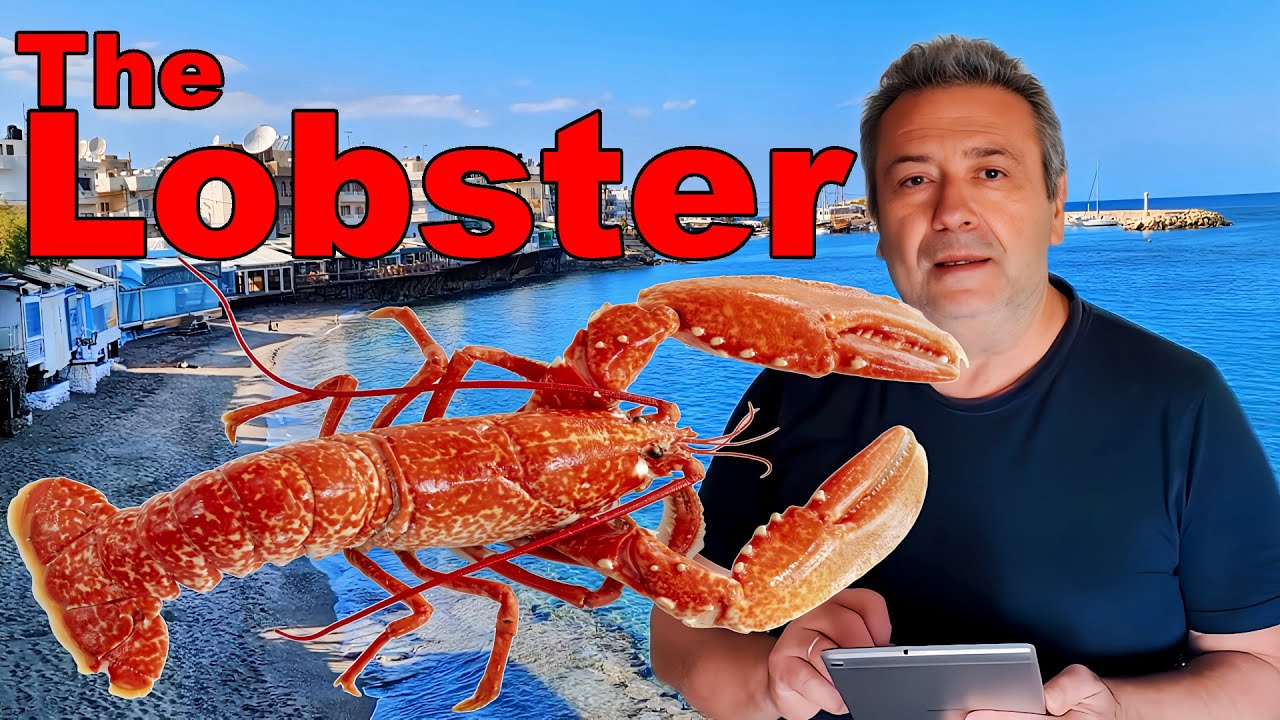
George Pitropogiannakis as Classics Illustrated Junior grandfather-storyteller presents "The Lobster: Nature’s Armored Survivor"!
In the Spring season in front of the most popular destination in Crete, picturesque Hersonissos.
Hersonissos is a lively coastal town on the northern coast of Crete, Greece. Known for its beautiful beaches, vibrant nightlife, and family-friendly attractions, it draws tourists from around the world. Visitors can enjoy water parks, archaeological sites, traditional villages, and local cuisine. The old village of Hersonissos offers a quieter, authentic Cretan atmosphere with charming tavernas and scenic views. Its convenient location near Heraklion makes it an ideal base for exploring the island. (This is the point on Google Maps 35°19'03.1"N 25°23'32.8"E)
Lobsters are fascinating marine crustaceans known for their distinctive appearance, complex behavior, and remarkable adaptability.
Physically, lobsters are instantly recognizable by their tough exoskeleton, large claws, long antennae, and segmented body. Their exoskeleton, made of chitin, provides essential protection from predators but must be shed and regrown during a process called molting. This process allows lobsters to grow, but it leaves them vulnerable for a period of time. Molting is also how lobsters regenerate lost limbs, a truly remarkable trait.
Lobsters come in various colors, from the common brown-green to rare shades of blue, yellow, or even albino white. These colors often change once they are cooked, turning a familiar bright red due to chemical changes in the pigments.
The most famous species is the American lobster (Homarus americanus), found in the North Atlantic from Canada to North Carolina. Another well-known species is the European lobster (Homarus gammarus), which has a similar body structure but differs slightly in color and habitat.
Despite their awkward walk and reputation for being slow, lobsters are agile swimmers when they need to escape danger. They move by rapidly curling and uncurling their tail, propelling themselves backward through the water. This escape mechanism is crucial in evading predators such as larger fish, octopuses, and humans.
Lobsters are omnivorous scavengers. Their diet consists of fish, mollusks, algae, and even other lobsters. They use their two claws for feeding: the larger crusher claw breaks shells, while the smaller pincher claw slices soft tissue. Interestingly, lobsters can be either right- or left-clawed, just like human handedness.
Socially, lobsters are solitary and territorial creatures. Males, in particular, may engage in fights to defend their area or compete for mates. Communication is mostly chemical: they release pheromones through their urine to signal aggression or mating readiness.
Lobsters have a surprisingly long lifespan, often living over 50 years in the wild. Some scientists believe they may not undergo typical aging (senescence) and instead die primarily from disease, injury, or fishing.
Economically, lobsters play a major role in coastal communities, especially in Maine, Nova Scotia, and parts of Europe. Lobster fishing is a regulated industry, with strict rules to preserve populations, such as minimum size limits, protection of egg-bearing females, and seasonal restrictions.
Culturally, lobsters have shifted from being considered a poor man's food to a luxury item. In colonial America, they were so abundant they were used as fertilizer or served to prisoners. Today, they are symbols of fine dining, often featured in gourmet dishes like lobster thermidor or lobster rolls.
In conclusion, lobsters are more than just a seafood delight—they are complex, resilient creatures with unique biology and an important role in marine ecosystems. Whether crawling along the seafloor or gracing a dinner plate, the lobster continues to fascinate and inspire admiration for the ocean’s strange and wonderful inhabitants.
Visit GPITRAL 12 educational YouTube channels and
Sykologos educational culture amateur Radio! https://onlineradiobox.com/gr/sykolog...
COSMOS ODYSSEY / @gpitral0cosmosodysseya911
Greek Audiobooks... / gpitral1
Music for Learning English / @gpitral2musicforlearningen568
Crete.... / sykologos
Greek Music on... / gpitral4
4 Kids on... / gpitral5
Sights ... / gpitral6
Radio on ... Έαρ / gpitral7
Learning English subtitles lyrics... / @gpitral8
e-Learning 4U... / @gpitral9e-learning4ufunmus45
Walking Tour Traveller... / @gpitral10
Fairy tales Stories English Audiobooks / @gpitral11

Информация по комментариям в разработке