Logo video2dn
  • Сохранить видео с ютуба
  • Категории
    • Музыка
    • Кино и Анимация
    • Автомобили
    • Животные
    • Спорт
    • Путешествия
    • Игры
    • Люди и Блоги
    • Юмор
    • Развлечения
    • Новости и Политика
    • Howto и Стиль
    • Diy своими руками
    • Образование
    • Наука и Технологии
    • Некоммерческие Организации
  • О сайте

Скачать или смотреть Accretion process at the Rapid Burster

  • ESA Space Science Hub
  • 2017-01-31
  • 5528
Accretion process at the Rapid Burster
ESAEuropean Space Agencysciencetechnologyspace scienceXMM-Newtonneutron staraccretionMXB 1730-335Rapid BursterX-rays
  • ok logo

Скачать Accretion process at the Rapid Burster бесплатно в качестве 4к (2к / 1080p)

У нас вы можете скачать бесплатно Accretion process at the Rapid Burster или посмотреть видео с ютуба в максимальном доступном качестве.

Для скачивания выберите вариант из формы ниже:

  • Информация по загрузке:

Cкачать музыку Accretion process at the Rapid Burster бесплатно в формате MP3:

Если иконки загрузки не отобразились, ПОЖАЛУЙСТА, НАЖМИТЕ ЗДЕСЬ или обновите страницу
Если у вас возникли трудности с загрузкой, пожалуйста, свяжитесь с нами по контактам, указанным в нижней части страницы.
Спасибо за использование сервиса video2dn.com

Описание к видео Accretion process at the Rapid Burster

The neutron star binary system MXB 1730-335, also known as the 'Rapid Burster', is a peculiar X-ray source, one of only two known to exhibit the elusive 'type-II' bursts. These bursts are sudden, erratic and extremely intense releases of X-rays that liberate enormous amounts of energy during periods otherwise characterised by very little emission occurring.

Observations of the Rapid Burster using three X-ray space telescopes - NASA's NuSTAR and Swift, and ESA's XMM-Newton - have revealed how the magnetic field regulates the accretion process before and during a type-II burst.

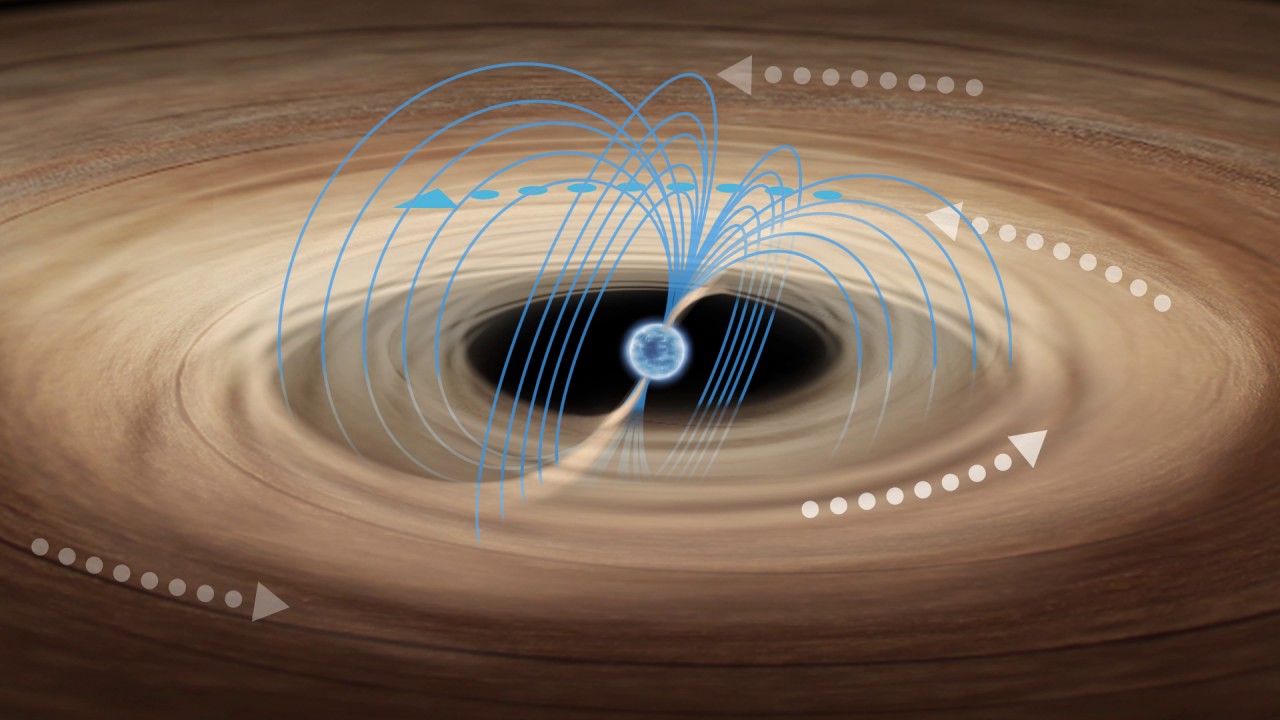
Before the burst, the fast spinning magnetic field of the neutron star (blue arrow) keeps the gas (white arrows) flowing from the companion star at bay, preventing it from reaching closer to the neutron star and effectively creating an inner edge at the centre of the disc. During this phase, only small amounts of gas leak towards the neutron star.

However, as the gas continues to flow and accumulate near this edge, it spins faster and faster, and eventually catches up with the spinning velocity of the magnetic field. The gas then hits the neutron star all at once, giving rise to the dramatic emission of type-II bursts.

Credit: ESA/ATG medialab

More information about this video can be found at http://sci.esa.int/xmm-newton/58752-a...

Комментарии

Информация по комментариям в разработке

Похожие видео

  • О нас
  • Контакты
  • Отказ от ответственности - Disclaimer
  • Условия использования сайта - TOS
  • Политика конфиденциальности

video2dn Copyright © 2023 - 2025

Контакты для правообладателей [email protected]