#psychology #bodylanguage #deceptiondetection #spotaliar #truthandlies
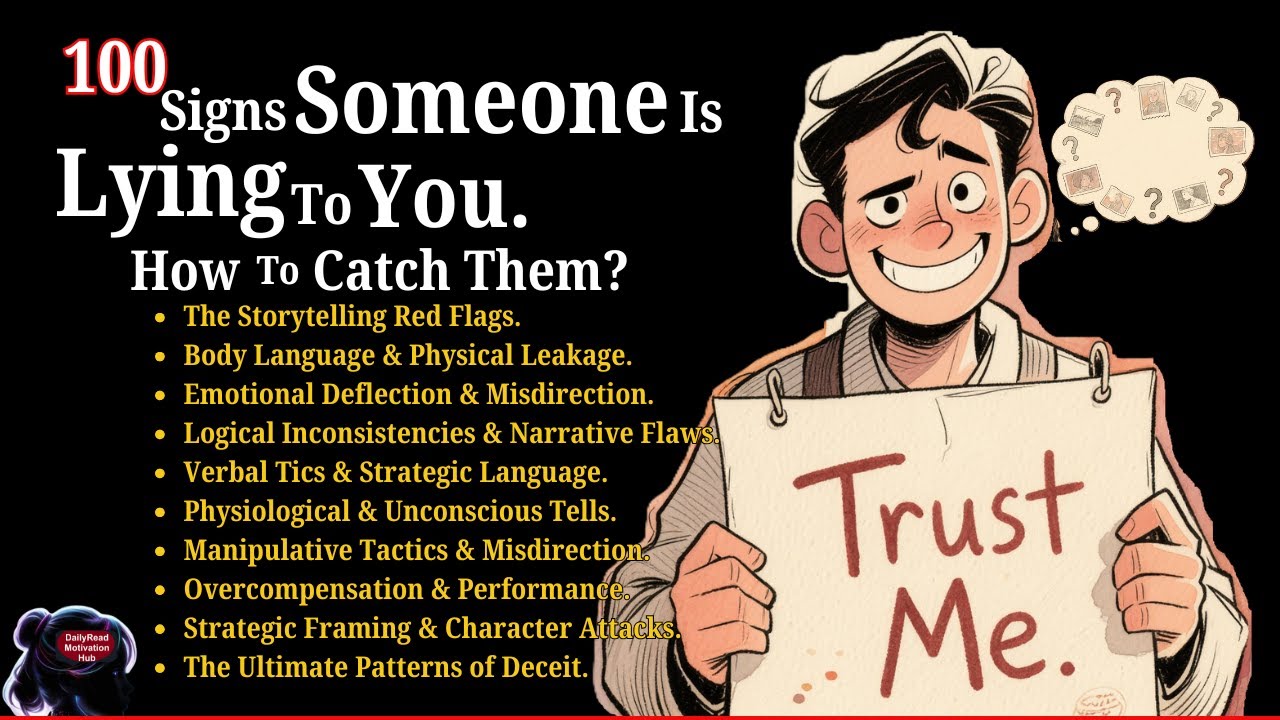
Think you can spot a liar? Most people rely on myths like "shifty eyes," but real deception detection is far more nuanced. This guide moves beyond pop psychology to explore 100 subtle, often counterintuitive signs of lying. Learn how cognitive load manifests in speech patterns, how stress leaks through micro-expressions and pacifying gestures, and how liars manipulate narratives and emotions. From elaborate over-explaining and non-denial denials to duping delight and emotional incongruence, we break down the complex behavioral science behind dishonesty to help you see through the facade.
===============================
Key Moments
00:00 Signs Someone Is Lying To You
00:37 The Storytelling Red Flags.
02:52 Body Language & Physical Leakage.
05:01 Emotional Deflection & Misdirection.
06:58 Logical Inconsistencies & Narrative Flaws.
09:01 Verbal Tics & Strategic Language.
11:18 Physiological & Unconscious Tells.
13:34 Manipulative Tactics & Misdirection.
15:49 Overcompensation & Performance.
17:57 Strategic Framing & Character Attacks.
20:08 The Ultimate Patterns of Deceit.
===============================
Summary
This comprehensive analysis dismantles the common folklore of lie detection, presenting a sophisticated framework based on psychology, linguistics, and behavioral analysis. True deception indicators are not singular "tells" but clusters of incongruence across three domains: verbal, nonverbal, and interpersonal.
Verbally, liars manage a high cognitive load, leading to speech filled with hesitations, repetitions, and overly controlled or convoluted sentences. They often craft stories that are emotionally barren, unnaturally rigid, and logically inconsistent, while relying on qualifying statements and non-denial denials. Their language may psychologically distance them from the event.
Nonverbally, the autonomic nervous system reacts to the stress of deception, causing pacifying gestures, changes in posture and eye contact, and physiological leakage like micro-expressions or altered breathing. Crucially, their body language often contradicts their words, and emotional displays appear timed poorly or fail to reach the eyes.
Interpersonally, deception is often accompanied by strategic manipulation. This includes defensive aggression, preemptive attacks, guilt-tripping, and love-bombing—all designed to control the conversation, evade questions, and dismantle the questioner's resolve. The liar may exhibit "duping delight" or a palpable sense of relief when the topic changes.
The final and most powerful sign is the holistic feeling of dissonance experienced by the observer. When words, emotions, body language, and baseline behavior fail to align, our subconscious intuition—processing these hundreds of data points—sounds the alarm. Effective lie detection is not about finding one magic bullet but about recognizing these pervasive patterns of incongruence and over-management across a person's entire presentation.
===============================
Sources and Credits
The APA on Detecting Deceptionhttps://www.apa.org/topics/psychology...
Paul Ekman Group on Micro Expressions https://www.paulekman.com/micro-expre...
FBI Law Enforcement Bulletinhttps://leb.fbi.gov/articles/featured...
Psychology Today
https://www.psychologytoday.com/us/bl...
ScienceDirect: Cognitive Load and Deception
https://www.sciencedirect.com/science...
===============================
Links
Support the channel with a Coffee, here: https://ko-fi.com/Dailyreadmotivationhub
🔔Subscribe & turn on notifications for more videos! @DailyReadMotivationHub
===============================
Videos Footage:
All video footage used is licensed through:
https://studio.youtube.com
https://studio.invideo.io
https://www.canva.com
https://www.pexels.com
https://pixabay.com
https://www.storyblocks.com
https://app.leonardo.ai/
Audio & Music
https://studio.youtube.com
https://studio.invideo.io
===============================

Информация по комментариям в разработке