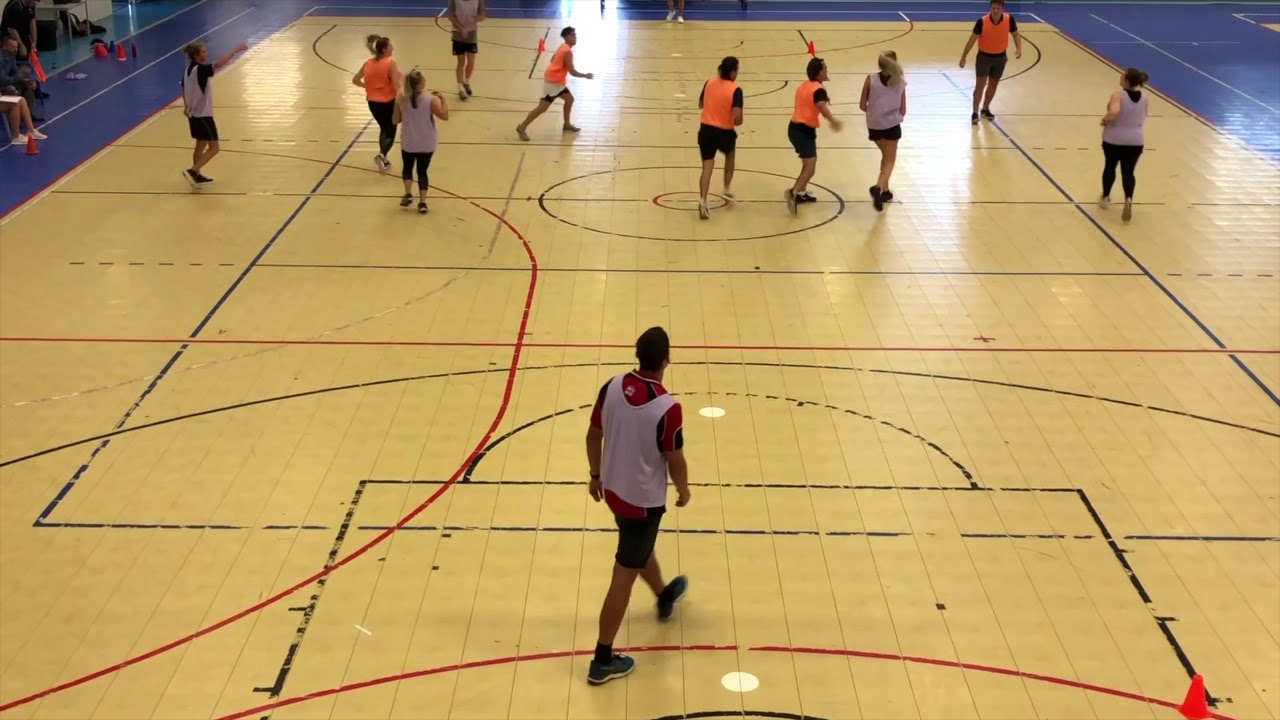
This video demonstrates how the purple team utilise a successful collective strategy with and without possession (Forrest, 2014). It can be observed that the purple team have created a team action rule, whereby they complete a forward facing, inbound, front position, both with and without possession. This is advantageous, as the purple team had the ability to reduce the rate of successful game play within the goal third of the opposition team, and favourably provide an effective play space when in possession (Forrest, 2014). This style of play, known as a screen, is effective as the defence become intimidating and had the ability to push the attacking team further away from their goal. This can be observed within excerpt 1, as Brandon, Renee, Piper and Nathan created a force ratio through a screen, blocking out three members of the purple team, acting as a barrier between the goal (Forrest, 2014). Bateman (2006) highlights the importance of employing such tactics and strategies in play, as it overall maximises the effectiveness of a teams coherent performance.
The purple team maintained in-bound positioning with and without possession allowing them to create more opportunities within game play, and force the opposition to make errors based on force ratio (Forrest, 2014). The success of this strategy allows the purple team to navigate the court of play without possession, as they are pushing their opposition into the left side of the court, forcing them to play the ball predominately on one side (Forrest, 2014). This is seen when the purple team force seven passes on the left side of the court. A study by Lola, Tzetzis, & Zetou (2012) correlates with the effectiveness of this, by claiming that when a team understands the principles of the game being played, and the ability to be aware of the tactics within play, then they can perform efficiently, confidently and successfully, maximising their opportunity to utilise on court advantages.
When Josh is finally able to play the ball to the right hand side of the court, a thoughtless pass is offloaded to Nathan, whereby he takes an unsuccessful shot at goal. This can be seen as Josh encountered cognitive overload(Howard & Walton, 2015). This was seen due to the multiple means of stimulus around him causing uncertainty during play, as not only were the purple team applying invasive pressure over every pass, but the orange team became cluttered, forcing Josh to make a decision about how he could individually devise a strategy to offload the ball to the right side of the court (Howard & Walton, 2015, & Gréhaigne et al., 2005). Evidently within the footage, it can be observed that the success of this strategy is a direct result of the state of equality being broken down between the two teams, as the yellow team successfully exhibited the principle of mobility, as the ratio of players in each play is positively skewed to the purple team (Gréhaigne et al., 2005).
References:
Bateman, J.M. (2006). An analysis of the patterns of play from the centre and back line pass of work class international netball teams. University of Wales Institute Cardiff
Forrest, G. (2014). Grammar of Games: Definition of Terms, Retrieved on 8th of May 2019 from https://moodle.uowplatform.edu.au/plu...
Gréhaigne. J R, Richard, J.F. and Griffin. (2005). Teaching & Learning Team Sports and Games. Routledge Falmer, New York.
Howard, S, & Walton, R. (2015). Educational Psychology: Foundations of Learning and development. AUS, David Barlow Publishing.
Lola, A. C., Tzetzis, G. C., & Zetou, H. (2012). The Effect of Implicit and Explicit Practice in the Development of Decision Making in Volleyball Serving. Perceptual And Motor Skills, 114(2), 665-678. doi:10.2466/05.23.25.PMS.114.2.665-678.

Информация по комментариям в разработке