Alexander Veprik (1899-1958)
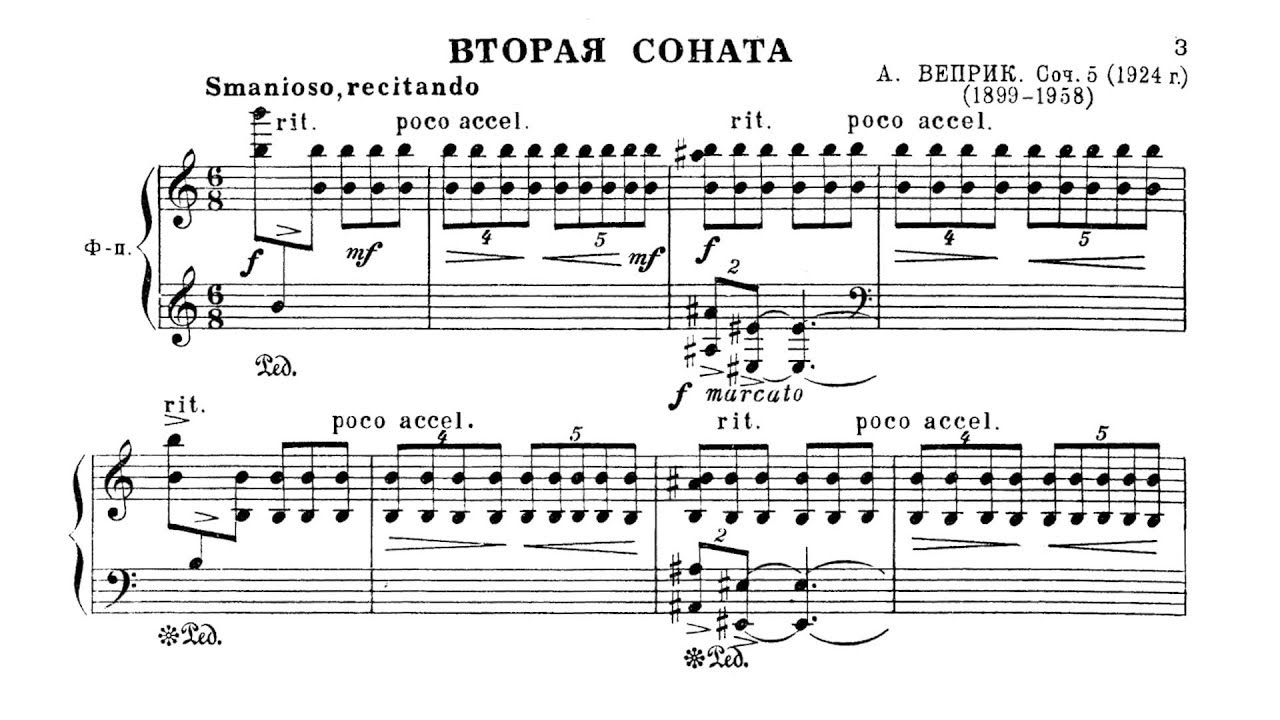
Piano Sonata No. 2, Op. 5
Composed in 1924
Performed by Jascha Nemtsov
http://www.musica-judaica.com/disco.htm
***
“Alexander Veprik represents the second generation of the New Jewish School: he was still a child when the Society for Jewish Folk Music came into existence. At that time Veprik's family had fled to Germany to escape the pogroms. He was admitted to the Leipzig conservatory as a child prodigy, but the outbreak of the First World War interrupted his studies. He only resumed his education in 1919 in St. Petersburg, then called Petrograd. His teacher at the conservatory there was Alexander Shitomirsky, a founding member of the Society for Jewish Folk Music. From 1922 to 1928, Veprik published twelve compositions in various genres using the Jewish idiom as the basis of an entirely modern musical language.
Veprik was one of the most active members of the Moscow Society for Jewish Music. He belonged to its Board of Directors, and was thus compelled to watch the painful process of its dissolution at first hand. Already by 1929, the Society was compelled by the bureaucracy to organize "agit-prop" events instead of their usually artistically demanding concerts. At the same time, they came under massive attack by the press, defamed as "reactionary" and "anti-Soviet". In this atmosphere of growing terror, Jewish composers had a good reason to fear for their lives. Many of them sought to improve their situations by producing ideologically acceptable works. In Veprik's case, this strategy met with considerable success in the 1930's.
After 1938, however, his name disappeared completely from concert programs. In 1943, he was dismissed, together with several other Jewish professors, from Moscow's Conservatory of Music. Finally, in 1950, Veprik entered the Gulag, charged as a "composer of Zionist music", among other things, to be released only four years later, now severely ill.
Young Alexander Veprik developed an original structure system in his Second Piano Sonata. This one-movement composition is constructed strictly on the linear principle. Although the form and the tonal relationships follow the classical main subject design, the tonal orientation nevertheless, is not European but Jewish modi. Two elements dominate the Sonata: animatedly pulsing repetitions of notes derived from the cantillation of biblical texts, and a leitmotif which is found in many liturgical melodies and religious songs (for example, "El jiwneh Hagalil" end with it). The two elements are frequently combined. Their four-fold development in the thematic elaboration which is driven by the tremendous force (fortissimo trionfante) marks the climax of the Sonata. With the leitmotif, which strongly asserts itself, this composition ends, too. Its mood of tension, sometimes even explosive, is moulded by the ecstatic declamation in the melody, whereas the background, with its expansive, functionally vague harmonies and long pedal-points, embodies the balancing, static aspect of this music.”
Jascha Nemtsov. Liner notes for ACROSS BOUNDARIES: DISCOVERING RUSSIA 1910-1940, VOL. 2: THE NEW JEWISH SCHOOL, Jascha Nemtsov, EDA Records EDA 14-2, 1999, compact disc.

Информация по комментариям в разработке