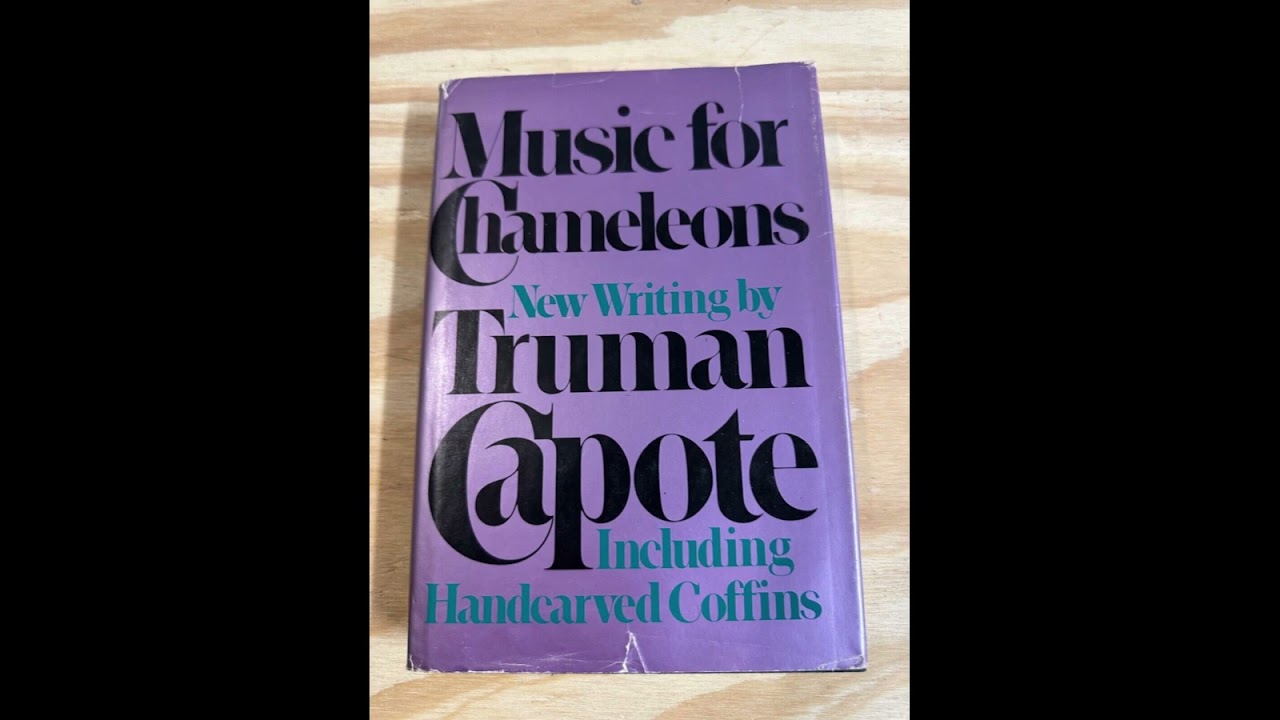
"Music for Chameleons" by Truman Capote is a collection of short stories and reportage that reveals the complexities of human nature through Capote’s distinct style, which blends journalistic precision with literary flair. The collection is a fascinating exploration of diverse characters and situations, often capturing the tension between appearance and reality, as well as the vulnerability of the human condition.The title story, "Music for Chameleons," exemplifies Capote's talent for revealing the hidden layers of people’s lives. It features a mysterious and somewhat eerie setting, with a protagonist who appears to be a man caught between worlds. Through a combination of vivid descriptions and dialogue, Capote brings to life an unsettling atmosphere where truth is elusive and identity remains fluid, akin to a chameleon constantly shifting its color. This exploration of identity and deception is a recurring theme in the collection, as Capote dives deep into the psyches of his characters, unraveling their inner lives in unexpected ways.Capote's style throughout the book is marked by a keen sense of observation, presenting characters with rich detail. In stories like "The Thanksgiving Visitor," the interactions between characters are imbued with emotional depth, revealing the intricacies of human relationships, particularly in the context of social expectations and personal desires. The writing is poignant, often highlighting moments of grace or disillusionment that subtly hint at the larger forces at play in society and the individual psyche.The collection includes several works that blur the lines between fiction and non-fiction. In "Handcarved Coffins," Capote recounts a chilling real-life murder mystery with the same narrative flair he brings to his fiction. The precision with which he details the events, coupled with his ability to immerse the reader in the emotional landscape of the case, demonstrates his mastery of the journalistic genre. Capote’s interest in the dark, unsettling aspects of humanity shines through, as he examines the motivations behind crime, betrayal, and loss. His approach to reportage, infused with personal insight, gives his nonfiction pieces the same emotional resonance as his fiction, creating a hybrid form that is uniquely his own.Underlying the stories in "Music for Chameleons" is Capote’s exploration of the fragility of human existence. Many of the characters in these stories are on the fringes of society or are engaged in morally ambiguous activities, yet Capote portrays them with empathy, showing their vulnerability and the forces that shape their choices. Whether it is the tragic figure in "A Tree of Night" or the enigmatic characters in "Mojave," Capote’s characters are often caught in situations that challenge their sense of self. In each story, there is a tension between what is real and what is imagined, between what is seen and what remains hidden, leaving the reader to question the nature of truth itself.In addition to his exploration of human nature, Capote also delves into the complexities of art and creativity. Through characters who are artists, writers, or performers, he reflects on the role of art in shaping personal identity and expressing the human experience. In the story "The Model," Capote paints a portrait of an artist's struggle with perception and reality, exploring the relationship between creator and subject. The artist in this story, much like Capote himself, grapples with the act of creation and the challenges of translating inner experiences into external forms."Music for Chameleons" also captures Capote’s fascination with the theme of mortality. Many of the stories address death, not just as an event but as a psychological state that affects the living. Through vivid imagery and nuanced prose, Capote invites readers to confront their own fears and desires surrounding mortality. His characters are often portrayed as being in a state of flux, caught between life and death, innocence and experience, hope and despair. This duality is emblematic of Capote’s broader themes, which explore the contradictions inherent in human nature.Ultimately, "Music for Chameleons" stands as a testament to Capote’s skill as a writer who could not only entertain but also provoke deep reflection. The stories in this collection, whether grounded in fact or fiction, are united by Capote’s deft hand in crafting narratives that are both compelling and thought-provoking. His ability to blur the lines between genres and create vivid, complex characters makes this collection an enduring example of his literary genius. Capote’s exploration of identity, morality, and the human condition remains as relevant today as when the book was first published, inviting readers to engage with the complexities of life in all its contradictions.

Информация по комментариям в разработке