Title: Measuring Functional Independence, Depression, and Cognition in Adults with Deafblindness: Feasibility and Score Analysis
Authors: Shirley Dumassais, Hamidreza Aminparvin, Atul Jaiswal, Tosin Ogedengbe, Meredith Prain, Ricard Lopez and Walter Wittich.
Affiliated with Université de Montréal, Able Australia, and the European Deafblind Network
Purpose: Deafblindness, the combination of vision and hearing impairments, presents unique challenges that can impact daily functioning, mental health, and cognition. However, there is currently limited empirical research examining how effectively existing assessment tools capture the experiences of this population. Therefore, this study aims to evaluate the feasibility and applicability of commonly used standardized clinical measures in assessing functional, emotional, and cognitive outcomes in adults with deafblindness.
Methodology: This study is part of a larger project to create better tools for assessing people with deafblindness, using a framework called the International Classification of Functioning, Disability and Health, or ICF.
In this fourth phase of the project, we worked with adults with deafblindness from different parts of the world, based on the World Health Organization’s regions.
Two clinical researchers, either an occupational therapist or a speech-language pathologist, administered three widely used and freely available tools:
1. The Lawton-Brody Instrumental Activities of Daily Living Scale, which looks at daily life activities
2. The Center for Epidemiologic Studies Depression Scale, which assesses depression
3. The Mini-Mental State Examination, which is used to check cognitive abilities like memory and problem-solving
The study included 29 participants recruited from multiple regions across the World Health Organization with any level of combined hearing and vision loss.
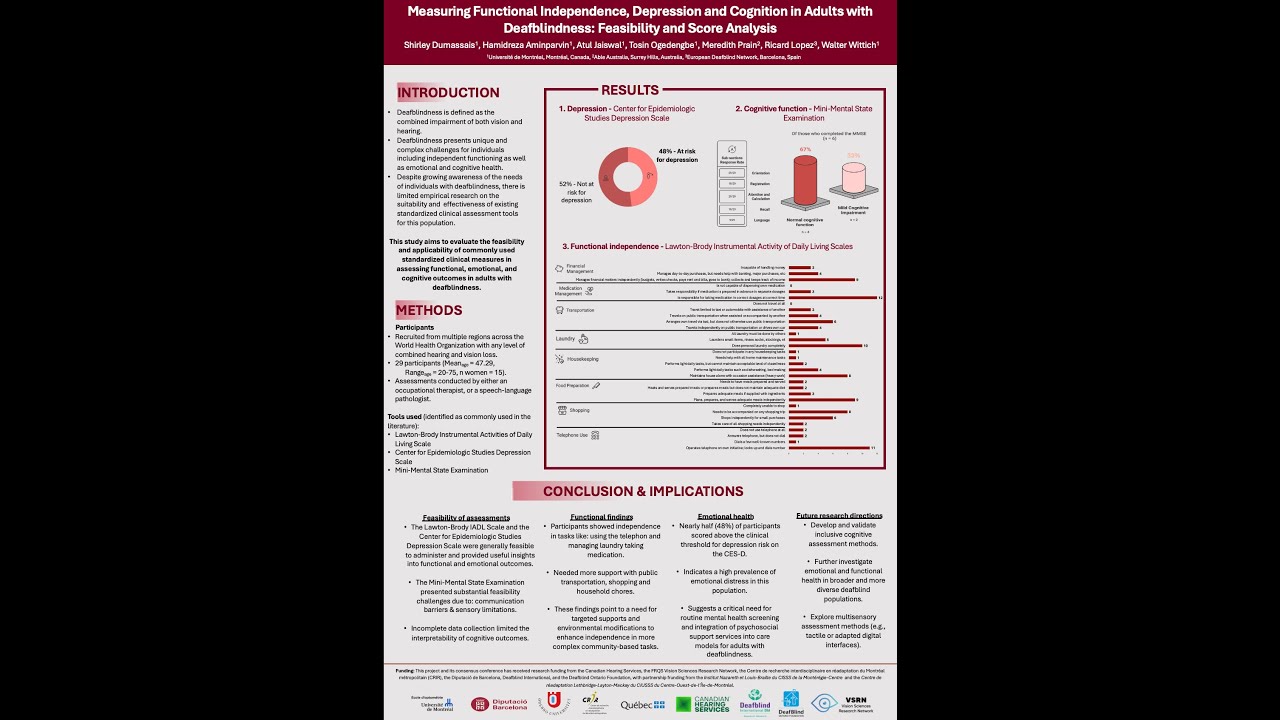
Results: Regarding activities of daily living, participants demonstrated higher levels of functional independence in activities such as using the telephone, managing laundry, and taking medication. However, tasks related to public transportation, shopping, and daily household chores, required greater assistance and support. As for depression, 48% of our sample indicated a high risk for clinical depression. Reporting scores on cognitive function is challenging with our sample as not all participants could successfully complete some of the sub-tasks of the Mini-Mental State Examination such as the sentence writing task and the object naming task. Only 6 participants fully completed the Mini-Mental State Examination. Of these participants and based on their cognitive test scores, four presented with normal cognitive function while two exhibited mild cognitive impairment.
Conclusion and implications: Some tools, like the Lawton-Brody Instrumental Activities of Daily Living Scale and the Center for Epidemiologic Studies Depression Scale, worked well and offered useful insights into daily functioning and emotional health. However, the Mini-Mental State Examination was harder to use because of communication and sensory limitations, leading to missing data on cognition.
Functionally, participants were independent in some tasks like using the phone and taking medication but needed more help with complex tasks like public transportation and shopping. This highlights a need for better support and adapted environments.
Emotionally, nearly half were at risk for depression, emphasizing the importance of regular mental health screening and access to psychosocial services.
Future research should develop accessible cognitive tools, broaden studies to include more diverse participants, and explore multisensory testing methods.

Информация по комментариям в разработке