Learn how to easily copy all rows excluding the header from one sheet to another using VBA in Excel. Follow our step-by-step guide for a seamless process.
---
This video is based on the question https://stackoverflow.com/q/64977665/ asked by the user 'Christian Lance' ( https://stackoverflow.com/u/14679086/ ) and on the answer https://stackoverflow.com/a/64990605/ provided by the user 'Tim Williams' ( https://stackoverflow.com/u/478884/ ) at 'Stack Overflow' website. Thanks to these great users and Stackexchange community for their contributions.
Visit these links for original content and any more details, such as alternate solutions, latest updates/developments on topic, comments, revision history etc. For example, the original title of the Question was: How to copy all rows except for the header with VBA
Also, Content (except music) licensed under CC BY-SA https://meta.stackexchange.com/help/l...
The original Question post is licensed under the 'CC BY-SA 4.0' ( https://creativecommons.org/licenses/... ) license, and the original Answer post is licensed under the 'CC BY-SA 4.0' ( https://creativecommons.org/licenses/... ) license.
If anything seems off to you, please feel free to write me at vlogize [AT] gmail [DOT] com.
---
How to Efficiently Copy All Rows Except for the Header with VBA
VBA (Visual Basic for Applications) is an incredible tool for automating tasks in Excel, but sometimes users encounter specific challenges. One common problem is the need to copy all rows from one sheet to another while excluding the header. This may sound straightforward, but it requires attention to detail to ensure the transition is seamless. If you're looking to streamline this process, you’re in the right place!
The Problem: Copying Rows Without the Header
Imagine you need to transfer data from one sheet to another. You start by filtering data, which is a great step, but when it comes time to paste that data into a new sheet, you realize the header is copied over as well. Not only is this undesirable, but it can complicate your data structure. In essence, you want a fresh start in the new sheet without the header cluttering your data.
The Solution: Step-by-Step Guide
To effectively copy all rows except for the header, you can leverage the following VBA code. This code will allow you to paste your data correctly while ensuring the first row (header) remains in its original sheet.
Step 1: Set Up Your Initial Code
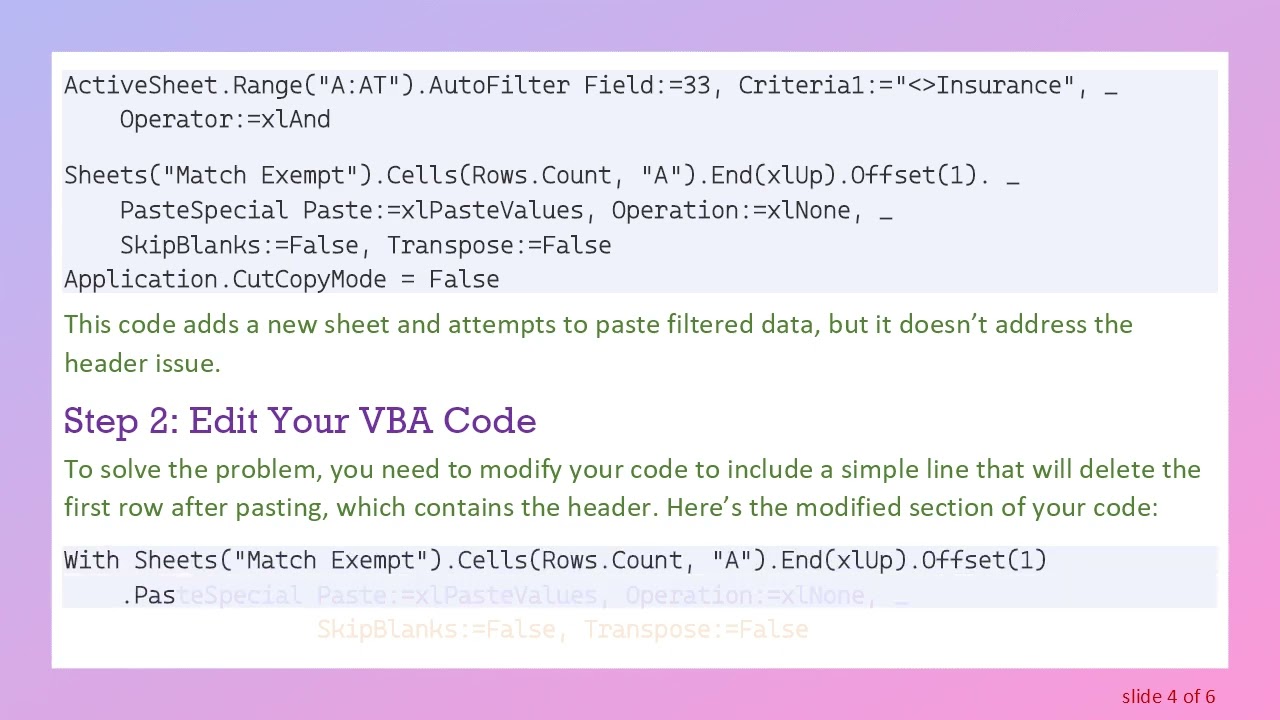
Initially, you might have a code snippet similar to this:
[[See Video to Reveal this Text or Code Snippet]]
This code adds a new sheet and attempts to paste filtered data, but it doesn’t address the header issue.
Step 2: Edit Your VBA Code
To solve the problem, you need to modify your code to include a simple line that will delete the first row after pasting, which contains the header. Here’s the modified section of your code:
[[See Video to Reveal this Text or Code Snippet]]
Key Changes Explained
Using the With Statement: This makes your code cleaner and more manageable. It specifies the target location for your actions, simplifying the references.
.EntireRow.Delete: This command removes the first row after the paste, effectively eliminating the header from the pasted data.
Step 3: Final Check and Testing
Before you run your code, ensure that:
Your data is correctly filtered in the original sheet.
The new sheet has been named appropriately, which allows for better organization.
You save your work; testing VBA can sometimes lead to unexpected results.
After running your script with these modifications, your pasted data in the "Match Exempt" sheet should be free of the header, leaving your data structured and ready for analysis.
Conclusion
Copying rows from one sheet to another while excluding the header might seem like a tricky task, but with the right VBA code, it can become part of your routine data management. By following these steps, you can ensure your data is clean and organized, allowing for better analysis and reporting in Excel. Happy coding!

Информация по комментариям в разработке