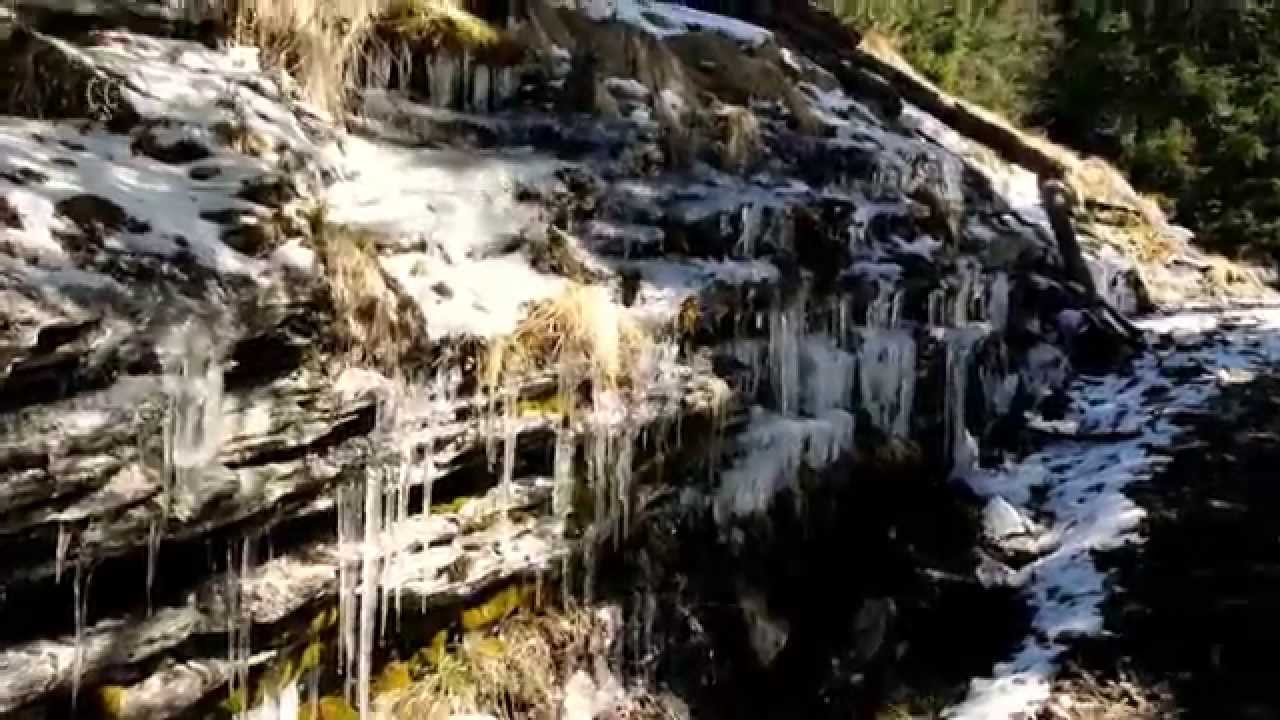
Free video about icicles. This free video was created for you by http://epsos.de and can be used for free under the creative commons license with the attribution of epSos.de as the original author of this icicles video.
Thank you for supporting the creative commons movement !!
An icicle is ice in the form of a cone or column, composed of frozen droplets is formed. The lower end may be pointed or rounded, depending on the effect of the wind and the flow rate of the droplets that make up the icicles. At the beginning there is the icicles that has not yet adopted its typical shape at this time, from a single drop. It grows by dropwise water running down it and freezes the side or at the top. Icicles occur at locations where the one liquid (melting) water accumulates (eg. As the edge of a sunlit, snowy roof) and other below-freezing temperatures prevail (eg., Below the edge of the roof, where additional wind evaporative cooling arises). The water must therefore freeze in layers, so that the icicles can take a mature form.
A small, young icicles usually has a conical shape, often some bubbles are still visible inside. If an icicle grows, vertical ridges and horizontal ribs can form, thereby grow the icicles both down. If an icicle is in a later stage of growth, the ribs are already more pronounced. The ribs are, however, towards the tip progressively narrower and smaller. The rings are separated by a groove. The ridges are formed mostly after already over a longer period of time no water is coagulated on the icicles. After a period of such new melt water flow down begins in narrow lanes icicles when it freezes then, there are thin ridges that can be up to one centimeter thick form.
The tip of a growing icicle consists of liquid water, which can hang several meters down under certain circumstances. It is held together by the outside of a very thin skin of ice crystals. At the extreme lower end of an icicle usually hang a drop of water. The shape is constantly changing, for example, by evaporation of ice can occur a change in shape. Generally icicles can be several meters long. After a certain length of the point, however, is reached at which the pin due to its own weight and can not be held and breaks off. Since falling icicles can certainly kill a man, it is important to remove icicles on paths and roads before they can become a hazard.
An icicle is a piece of ice in a cone shape that is formed when water dripping from an object is frozen due to the frost. Normally icicles are straight and pointed cones, but by wind or water falls very slowly, can be made of rounded and curved shapes. If the process of continuous freezing and thawing icicle progressively increases in length and thickness. The weight can reach icicles can sink the structure of roofs and breaking branches hung with, and can get nailed like a knife fell to the ground from the top.
The icicle forms when ice or slush makes water run off of a surface to a corner (typically a roof). This melting is due to the heat of the sun or any other heat source (such as that escaping from inside a heated building), while refreezing occurs in contact with an area at a temperature below 0 ° C
Normally icicles cones are relatively straight and sharp, but the wind or a slow drip can create unexpected ways. If the process continues to thaw frozen and the Icicle increases in length and thickness. The weight can have the icicles can be dangerous for a roof or structure whose branches hang.
Usually the icicles form when ice or snow melt from the heat of the sun (or other source) or to the pressure due to the weight of overlying snow and then the water thus obtained, coming in contact with the temperature of 'air below 0 ° C, freezes again. If the process of thawing and refreezing continues, the ice increases in thickness and length. Usually the ice lolly is sharp but, due to the wind and the speed with which the water falls, it can also be rounded. Icicles can be hazardous to the structure of the roof, the branches of the trees and to the physical safety of people in case of breakage and fall.
Thank you for supporting the creative commons movement !!

Информация по комментариям в разработке