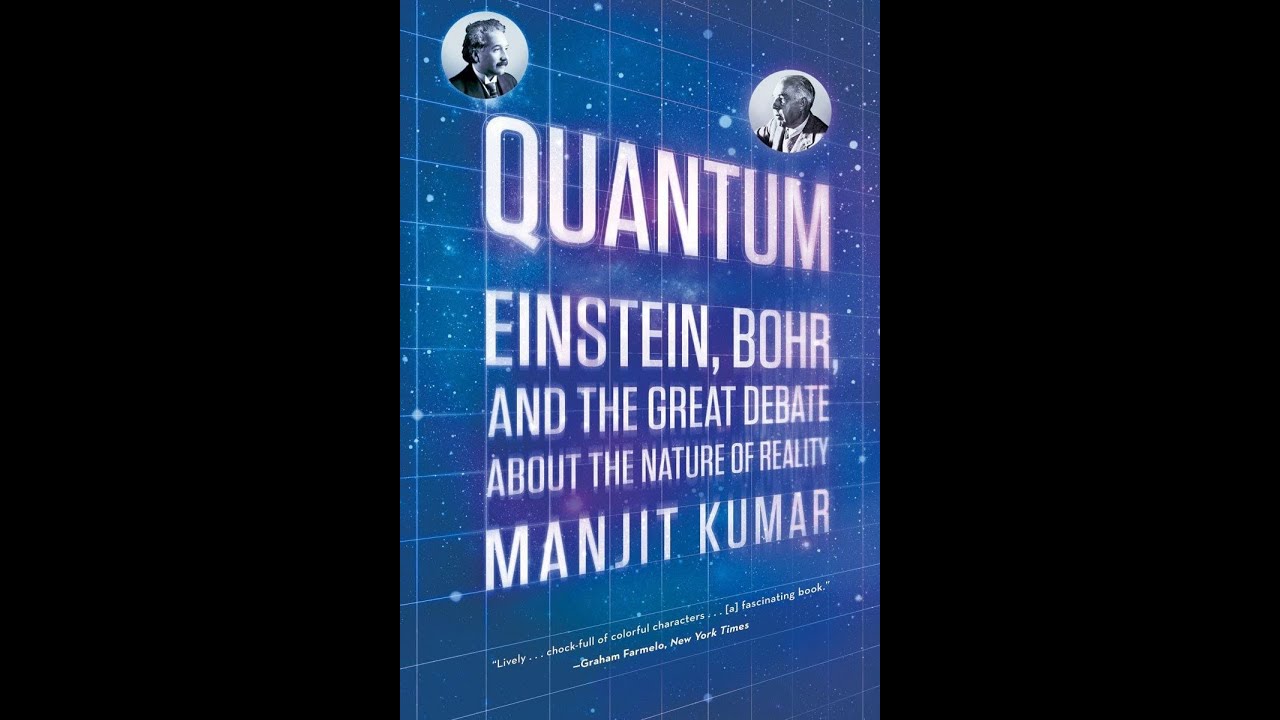
Manjit Kumar's "Quantum: Einstein, Bohr and the Great Debate About the Nature of Reality" takes readers on a captivating journey through the intellectual battleground of quantum physics. Published in 2008, this book delves into the profound and contentious debate between two of the greatest minds of the 20th century, Albert Einstein and Niels Bohr, as they grappled with the enigmatic nature of reality at the quantum level.Kumar's narrative is a meticulous blend of scientific exposition and biographical storytelling, offering readers a comprehensive understanding of the historical, philosophical, and scientific context surrounding the development of quantum mechanics. The book masterfully intertwines the personal lives and professional journeys of Einstein and Bohr, adding a human touch to the scientific discourse and making it accessible to both experts and lay readers.At the heart of the book lies the clash between Einstein's deterministic worldview and Bohr's probabilistic interpretation of quantum phenomena. Kumar meticulously explores the evolution of quantum theory, from its inception in Max Planck's work on blackbody radiation to its later developments by luminaries like Werner Heisenberg and Erwin Schrödinger. The author astutely navigates the complex scientific concepts, such as wave-particle duality and the uncertainty principle, making them comprehensible to non-specialists.One of the book's strengths is its portrayal of the personal and intellectual struggles of Einstein and Bohr. Kumar paints a vivid picture of Einstein's unwavering commitment to a deterministic universe governed by hidden variables, as evidenced by his famous quote, "God does not play dice with the universe." On the other side, Bohr's pragmatism and willingness to accept the inherent unpredictability of quantum systems is expertly depicted. These differences in perspective and temperament laid the foundation for the great debate at the Solvay Conferences in the 1920s and 1930s, which are central to the narrative.Kumar effectively captures the tension and drama of the debates between these intellectual giants. The dialogues between Einstein and Bohr, as well as other prominent physicists of the time, are brought to life, providing readers with a front-row seat to the intellectual clashes that shaped the course of modern physics. Through their exchanges, the author highlights the profound philosophical implications of quantum mechanics, including its challenge to our classical intuitions about reality.The book also delves into the broader historical and sociopolitical context of the era. Kumar discusses how the upheaval of World War I and the subsequent rise of Nazism in Germany forced many Jewish scientists, including Einstein, to flee Europe and seek refuge in the United States. This migration of scientific talent had a profound impact on the development of quantum theory and its dissemination to the wider world.Kumar excels in weaving together the intricate threads of quantum theory, philosophy, and biography. He skillfully navigates the philosophical conundrums raised by quantum mechanics, such as the nature of observation and the role of the observer in collapsing wave functions. He also sheds light on the ongoing quest for a unified theory that reconciles quantum mechanics with Einstein's theory of general relativity, a challenge that continues to captivate the minds of physicists today.Throughout the book, Kumar maintains a balanced perspective, refraining from taking sides in the Einstein-Bohr debate. Instead, he allows readers to form their own conclusions about the nature of reality and the limits of human understanding. This approach is emblematic of the author's commitment to presenting a fair and comprehensive account of the subject matter.In conclusion, "Quantum: Einstein, Bohr and the Great Debate About the Nature of Reality" is a superbly crafted exploration of one of the most profound intellectual battles in the history of science. Manjit Kumar's narrative prowess, combined with his deep understanding of quantum physics and its philosophical implications, makes this book an engaging and enlightening read for anyone interested in the nature of reality, the history of science, or the enduring legacy of Einstein and Bohr's intellectual clash. It is a testament to the enduring relevance of these debates and the ceaseless quest to unveil the mysteries of the quantum world.
















Информация по комментариям в разработке