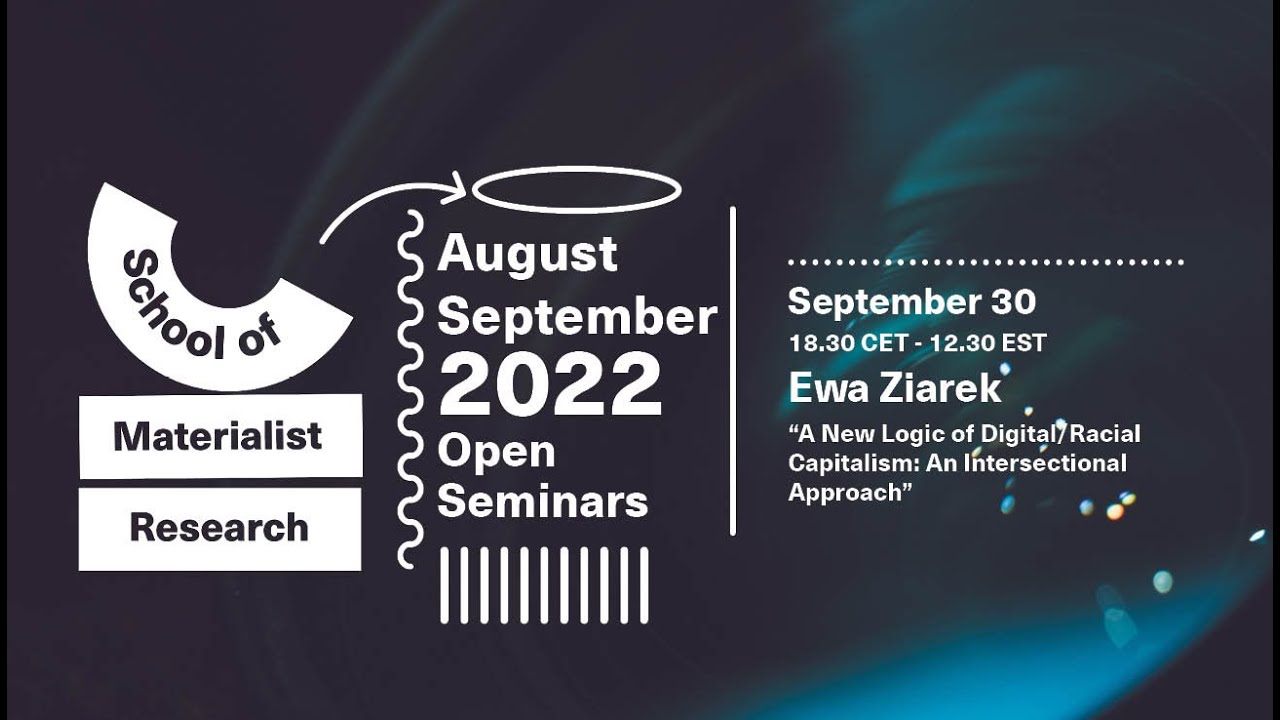
Ewa Ziarek will be giving a free lecture on September 30th, 18:30 CET, as part of SMR's Open Seminar Series for August-September 2022 entitled: " A New Logic of Digital/Racial Capitalism: An Intersectional Approach" You can register for her talk on our Eventbrite page here: https://tinyurl.com/d5wjpnb8
Abstract: By ruining early promises of the Internet to increase access to knowledge and democracy, the annexation of digital technologies by capitalism intensifies economic, racial and gender inequality, on the one hand, and expands neocolonialism, on the other. In this paper, I offer an intersectional analysis of digital capitalism, AI and systemic racism and argue that such analysis is indispensable for understanding and resisting a new logic of capital accumulation, which produces new forms of power, reshapes social relations and deepens racial and gender inequalities. Although critical attention to racialized and digital dimensions of capital has occurred almost simultaneously (in the 80s and 90s, respectively) and intensified in the last decade, the intersectional analysis of both formations is insufficient. Yet, as Milner and Traub, among others, argue, since capitalism from its inception is inseparable from systemic racism, the re-integration of racism into digital is both an old and a new phenomenon, which “concentrates and consolidates power in ways that dramatically increase inequality along the lines of race, class, gender, and disability.”
In order to sketch out the main contours of this formation, I draw on the “algorithmic racism” elaborated by critical race scholars, such as Noble, Benjamin, Milner and Traub, as well as on the constellation of related terms, such as data, platform, cognitive or surveillance capitalism. Dependent on the computational technologies and artificial intelligence, digital racial capitalism in turn subordinates the use, design and investment in these technologies for the optimization of profits. It scales up the global expansion of capitalism and enables capitalization of affective experiences, tastes, behavior and bodies for profit. In the last resort, the capitalization of the new technological affordances reconfigures space/ time and social relations according to the efficient, unimpeded accumulation of capital.
Bio: Ewa Plonowska Ziarek is Julian Park Professor of Comparative Literature at UB and a Visiting Faculty in the Institute for Doctoral Studies in the Visual Arts Maine. Most recently she co-authored, with Rosalyn Diprose Arendt, Natality and Biopolitics: Towards Democratic Plurality and Reproductive Justice (2019), a book awarded Book Prize of Symposium: Canadian Journal for Continental Philosophy. Her other books include: Feminist Aesthetics and the Politics of Modernism (2012); An Ethics of Dissensus: Feminism, Postmodernity, and the Politics of Radical Democracy (2001); The Rhetoric of Failure: Deconstruction of Skepticism, Reinvention of Modernism (1995); and co-edited volumes, such as, Intermedialities: Philosophy, Art, Politics (2010); Time for the Humanities (2008) and Revolt, Affect, Collectivity: The Unstable Boundaries of Kristeva's Polis (2005). Her interdisciplinary research interests include feminist political theory, modernism, critical race theory, and algorithmic culture.
About SMR's Open Seminars: The School of Materialist Research hosts seminars on original content engaging materialist thought and practice across the humanities, arts, and sciences. Topics covered in the seminars range from contemporary philosophical, political, and scientific materialisms, and the various ecological, aesthetic, and feminist materialisms that have sprung up in the last few decades, to the material challenges and possibilities confronting engineering and design on a planetary scale (through the distributed practices of computing, finance, urbanization, etc.), especially the host of geopolitical, racial, and ecological asymmetries that emerge in their wake. The seminars therefore embrace a full range of methodologies—philosophical, artistic, empirical, ethnographic, etc.—and offer a platform for showcasing research and experimentation on the many complexities of materialist thought and practice today.

Информация по комментариям в разработке