In United States history, the Gilded Age was an era extending roughly from 1870 to 1900. It was a time of rapid economic growth, especially in the Northern and Western United States. As American wages grew much higher than those in Europe, especially for skilled workers, and industrialization demanded an ever-increasing unskilled labor force, the period saw an influx of millions of European immigrants.
The rapid expansion of industrialization led to real wage growth of 60% between 1860 and 1890, and spread across the ever-increasing labor force. The average annual wage per industrial worker rose from $380 in 1880, to $564 in 1890, a gain of 48%. Conversely, the Gilded Age was by millions of immigrants—many from impoverished regions—poured into the United States, and the high concentration of wealth became more visible and contentious.
Railroads were the major growth industry, with the factory system, mining, and finance increasing in importance. Immigration from Europe, and the eastern states, led to the rapid growth of the West, based on farming, ranching, and mining. Labor unions became increasingly important in the rapidly growing industrial cities. Two major nationwide depressions—the Panic of 1873 and the Panic of 1893—interrupted growth and caused social and political upheavals.
The South, after the American Civil War remained economically devastated; its economy became increasingly tied to commodities, cotton, and tobacco production, which suffered from low prices. With the end of the Reconstruction era in 1877, African-American people in the South were stripped of political power and voting rights and were left economically disadvantaged.
Local governments across the North and West built public schools chiefly at the elementary level; public high schools started to emerge. The numerous religious denominations were growing in membership and wealth, with Catholicism becoming the largest. They all expanded their missionary activity to the world arena.
The "Gilded Age" term came into use in the 1920s and 1930s and was derived from writer Mark Twain and Charles Dudley Warner's 1873 novel The Gilded Age: A Tale of Today, which satirized an era of serious social problems masked by a thin gold gilding. The early half of the Gilded Age roughly coincided with the mid-Victorian era in Britain and the Belle Époque in France.
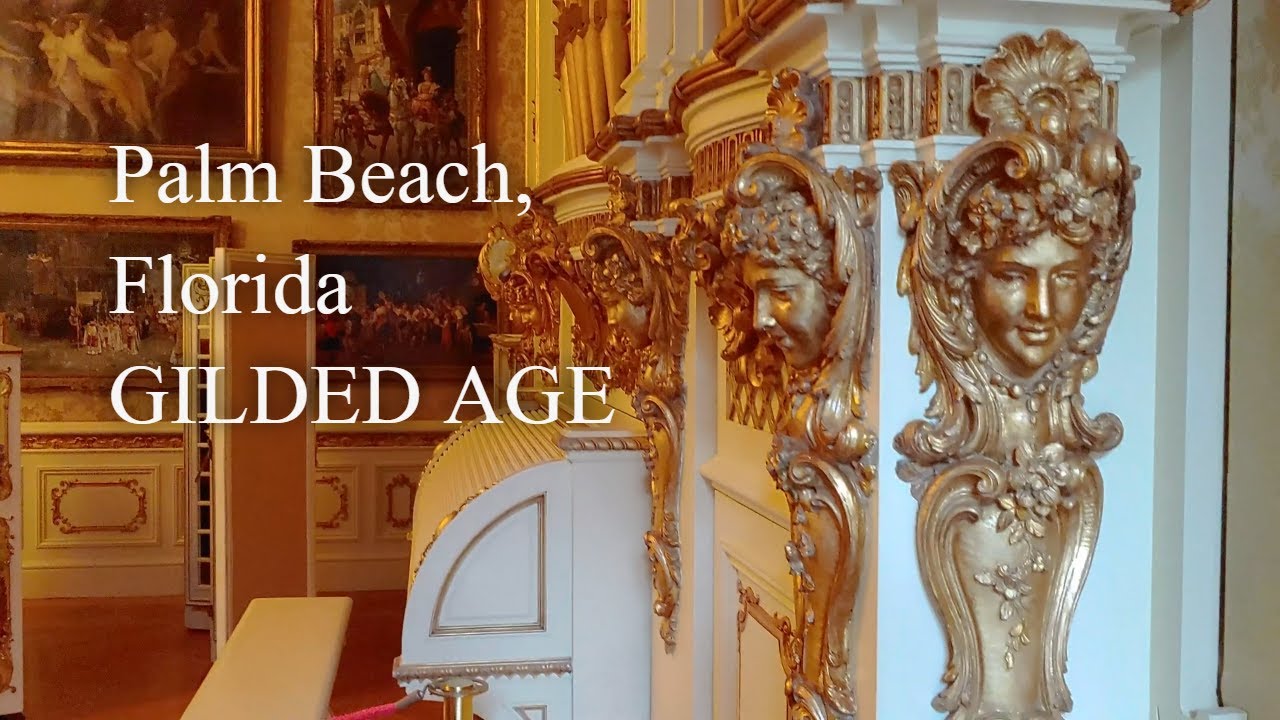
Whitehall is a 75-room, 100,000 square foot Gilded Age mansion open to the public in Palm Beach, Florida in the United States. Completed in 1902, it is a major example of neoclassical Beaux Arts architecture designed by Carrère and Hastings for Henry Flagler, a leading captain of industry in the late 19th century, and a leading developer of Florida as a tourist destination. The building is listed a National Historic Landmark.
Henry Flagler, one of the founders of Standard Oil, built Whitehall for his third wife, Mary Lily Kenan. Whitehall was to be a winter residence, and Henry gave it to Mary Lily as a wedding present. They would travel to Palm Beach each year in one of their own private railcars, one of which was No. 91.
In 1959, the site was saved from demolition by one of Henry Flagler's granddaughters Jean Flagler Matthews. She established the Henry Morrison Flagler Museum non-profit corporation, which purchased the building in 1959, opening it as a museum in 1960.
Today, Whitehall is a National Historic Landmark and is open to the public as the Henry Morrison Flagler Museum, featuring guided tours, exhibits, and special programs. In addition to an annual chamber music series, the Flagler hosts the Whitehall lecture series, which brings “experts and best-selling authors to discuss Gilded Age topics, events, and local history.” Past lecture series include historical talks about Gilded Age presidents, engineering feats, and Metaphysical America: Spirituality and Health Movements During the Gilded Age. The Flagler also holds a special exhibition each year, often showcasing Gilded Age paintings, sculptures, glamour photography, or material culture, such as board games, jewelry, cartoons, Tiffany & Co. silver pieces (including ones displayed at the 1893 Chicago World's Columbian Exposition), and women's fashion. It also hosts a variety of local galas and balls throughout the year. The Museum is located at Cocoanut Row and Whitehall Way in Palm Beach.
When it was completed in 1902, Whitehall was hailed by the New York Herald as "more wonderful than any palace in Europe, grander and more magnificent than any other private dwelling in the world." It was designed in the Beaux Arts style, meant to rival the extravagant mansions in Newport, Rhode Island.
The mansion is built around a large open-air central courtyard and is modeled after palaces in Spain and Italy. Three stories tall with several wings, the mansion has fifty-five fully restored rooms furnished with period pieces. These rooms are large with marble floors, walls and columns, murals on the ceilings, and heavy gilding.

Информация по комментариям в разработке