This is a playlist of my attempts at friction surfacing various metals on various ceramics to produce electronic devices. This is a dataset for a future publication and it is provided under an AGPL-3 license, and CERN open hardware license.
The experiments were all run on a 1610 genmitsu minimill with a 30,000 RPM dremel rotary tool installed as the spindle. Collet chucks were used to hold metal wires in the rotary tool chuck for subsequent surfacing onto ceramic substrates.
Ceramic substrates were provided courtesy of the University of Arkansas High Density Electronics Center. (HiDEC)
https://high-density-electronics.uark...
This was filmed on a D750 nikon DSLR with a macro lens.
There are also data sets for profilometry, also courtesy of HiDEC.
I also provide feed and speed data for every experiment correlated with its video name as a column in the data set, as well as thermal data for each experiment.
There will soon be follow up data that includes ampacity of the printed traces for comparison to other electronics techniques as well as mechanical adhesion strength between trace and substrate. Preliminary results indicate strengths of 30-70 MPa are obtainable depending on deposition conditions, and material pairing.
The datasets associated with this footage can be found on zenodo:
https://zenodo.org/records/10308544
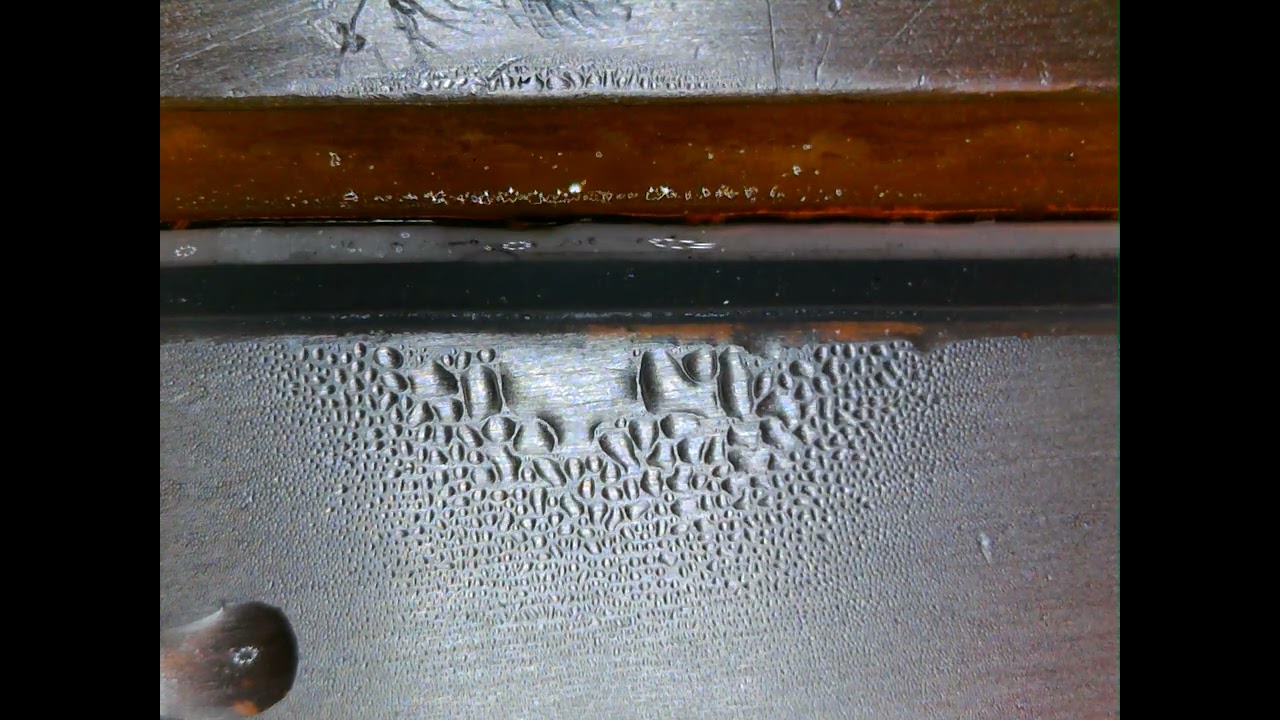
https://doi.org/10.5281/zenodo.10308544 The top and bottom of this shot are aluminum metal heat sinks, clamping (via two 6-32" X 1 3/4" long phillips screws) an FR2 copper veroboard (stripboard), a silicon carbide monofilament, bridging the copper strips on the strip board, an aluminum oxide substrate, and a silicone rubber pad to prevent point loading of the aluminum oxide and soak up thermal expansion stresses.
The flashing light on the left of center, is a section of silicon carbide monofilament (0.5mm wide, by 0.135 mm diameter) heating and cooling in water, via joule heating at ~28 V, 1Am, or 28 watts peak power.
This is the business (bottom side) of the generation 1 pyrojet print head... it was a big step up from gen 0, but partly an overreach as well. I thought at the time, that trying to increase the number of heaters, we could increase the print width, and print speed without needing to do any additional machining on the strip boards. this turned out to be true, but not all that helpful, since the device became unwieldy and lacked any clear way to feed material in the heaters to be deposited... the use of the aluminum heat sinks, also added the complication of requiring machining to fit the appropriate fasteners, which was undesirable.
The design was still such that the filament was located at the very outside edge of the print head, where it could eject preheated material and fuel (water) into the gap between the print head and a substrate, which it could then ignite by heating further to a higher temperature, at least, in principle.
This design has a lot more in common with a conventional thermal print head than an inkjet (except perhaps for a first generation inkjet that was never really published on)...
Much was learned in terms of design, manufacturing and operation of the pyrojet print head from generation 1. Mostly, that the manufacturing would need to be revised to something more standardized, and allowing for shorter and wider channels for material to flow through to reach the print head heaters.
This design was also the first to utilize cheap strip board, (FR2/FR4), which demonstrated that they could tolerate the operating conditions required, and eliminate the need for screen printing expensive silver palladium leads onto fragile and troublesome ceramic substrates. Eventually this lead to print heads made completely of FR4.
If you want to join in and help with the development, or just follow our progress at the Open Pyrojet project links are below:
Discord Community:
/ discord
Project Webpage
https://www.openpyrojet.com
Github Pages
You are encouraged to invent your own packaging and connection schemes. If you want to save time and are willing to pay a small price for a more reliable product, [panelized PCB based printhead designs](https://github.com/Sindry-Manufacturi...) are available on the github. Courtesy of Paul (Parkview785).
[Driver electronics and a controller board](https://github.com/Sindry-Manufacturi..., (an experimenters board) also by Paul can be found here:
Adjoining firmware, UI and web-app interface can be found here, courtesy of Ken (Hayland).
[Firmware](https://github.com/Sindry-Manufacturi...)
[web-app interface](https://github.com/Sindry-Manufacturi...)

Информация по комментариям в разработке