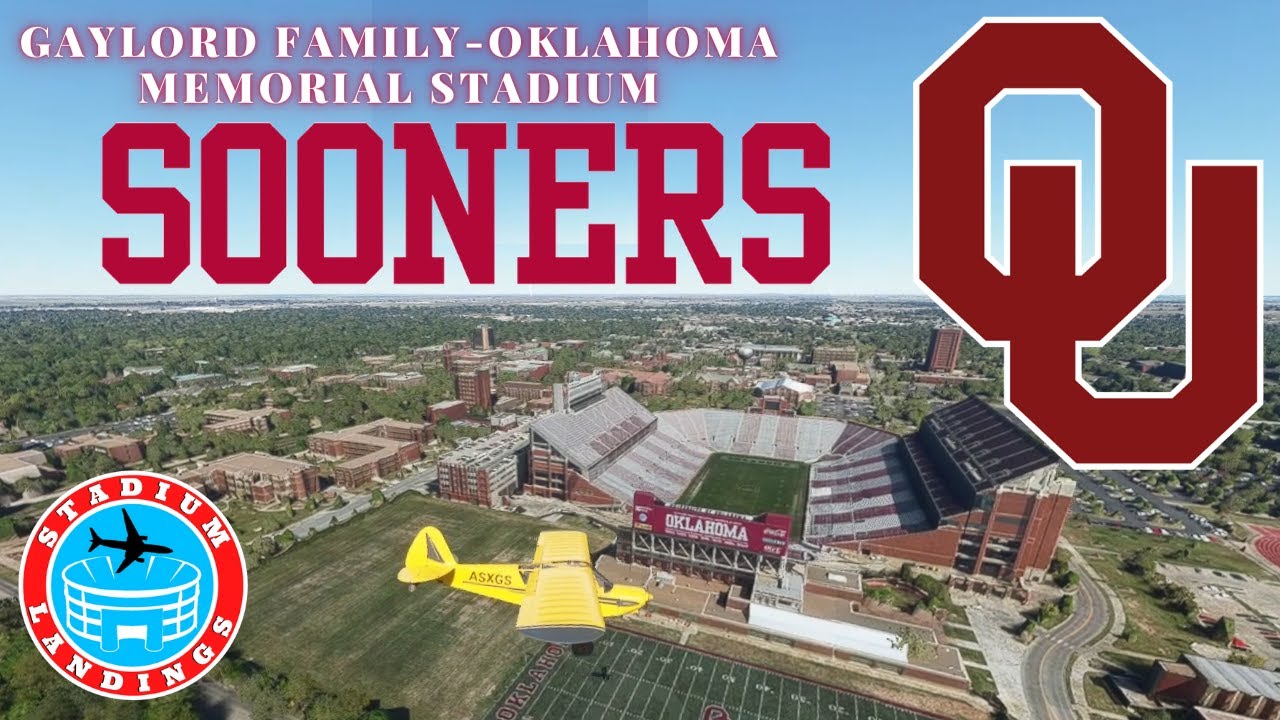
Today we visit the campus of the University of Oklahoma and their gorgeous Gaylord Family-Oklahoma Memorial Stadium!
History:
Gaylord Family Oklahoma Memorial Stadium, also known as Owen Field or The Palace on the Prairie, is the football stadium on the campus of the University of Oklahoma in Norman, Oklahoma. It serves as the home of the Oklahoma Sooners football team. The official seating capacity of the stadium, following renovations before the start of the 2019 season, is 80,126, making it the 23rd largest stadium in the world, the 15th largest college stadium in the United States, and the second-largest in the Big 12 Conference, behind Darrell K Royal–Texas Memorial Stadium at the University of Texas at Austin. The stadium is a bowl-shaped facility with its long axis oriented north/south, with both the north and south ends enclosed. The south end has only been enclosed since the 2015-2016 off-season when it was renovated as part of a $160 million project. Visitor seating is in the south end zone and the southern sections of the east side. The student seating sections are in the east stands, surrounding the 350-member Pride of Oklahoma band which sits in section 29, between the 20- and 35-yard lines. The Sooners' bench was once located on the east side with the students, but the home bench was moved to the west side in the mid-1990s.
The first game played at the current stadium site was in 1923, with the Sooners prevailing over Washington University 62–7. Originally, seating consisted of an approximately 500-seat bleacher area on the east side. The first permanent seating wasn't built until 1925 when 16,000 seats were built on the west side of the site–corresponding to the lower level of the current facility's west grandstands. However, OU reckons 1923 as the stadium's opening date. The new stadium was named Oklahoma Memorial Stadium in honor of university students and personnel that died during World War I. The facility was constructed at an approximate cost of $293,000, and coach Bennie Owen himself helped raise the money. To honor Owen, the playing surface was named Owen Field during the 1920s. The stadium as a whole has long been called Owen Field, but in actuality, the field and the stadium are two separate objects with two separate names.
There are two main reasons why the stadium was not originally a fully enclosed "bowl" like, for example, Michigan Stadium or the Rose Bowl. First, access to the three outdoor football practice fields, which are behind the south end zone seats, would have been restricted by completely enclosing the south end of the stadium. Secondly, any enclosure would have forced the baseball field, which shared its outfield with the practice fields until 1982, to shorten its left-field line considerably.
More permanent seating was added, this time to the east side, in 1929. In 1949, the north end of the stadium was enclosed, the playing area was lowered six feet with the elimination of the running track around the field. This created a 55,000-seat "horseshoe," and the addition of south end bleachers in 1957 brought capacity to just under 61,836 fans. AstroTurf replaced the natural grass field in 1970. The west side upper deck was added in 1975, featuring a lounge and a new press box, for a total capacity of 71,187 fans at a cost of about $5.7 million. Improved south end zone seating, including new coaches' offices and training facilities, was added in 1980 and the old turf was replaced with Superturf in 1981. The new turf was more or less a necessity; the old surface had literally become threadbare. With a few exceptions, these changes took place during or shortly after the Sooners' national championship seasons of 1950, 1955, 1956, 1974, and 1975 – all high times for Sooner sports.
By 1999, the 75-year-old stadium was showing its age. Aside from the turf and lighting enhancements, the last substantial upgrade to the stadium had been the construction of the press box in 1975. The OU College of Architecture was housed under the west stands and in the north end zone until other facilities became available in 1990. The east stands still had the original dirt flooring underneath the stands, making for a cloudy, dusty walk into the student and visitor seating sections. Plans began in 1997 to upgrade most athletic department facilities, beginning with a five-year fundraising campaign. Then, unexpectedly, the Sooners won the BCS National Championship for the 2000 season. The university began to get more freshman applications than it could house due in large part to the football team's success. Along with other campus improvements such as more and better student housing, the refurbishment and expansion plan for the stadium was accelerated to be ready by the beginning of the 2003 season.
Thank you for watching and please Like, Subscribe, & Comment on where to head to next!
https://en.wikipedia.org/wiki/Gaylord...

Информация по комментариям в разработке