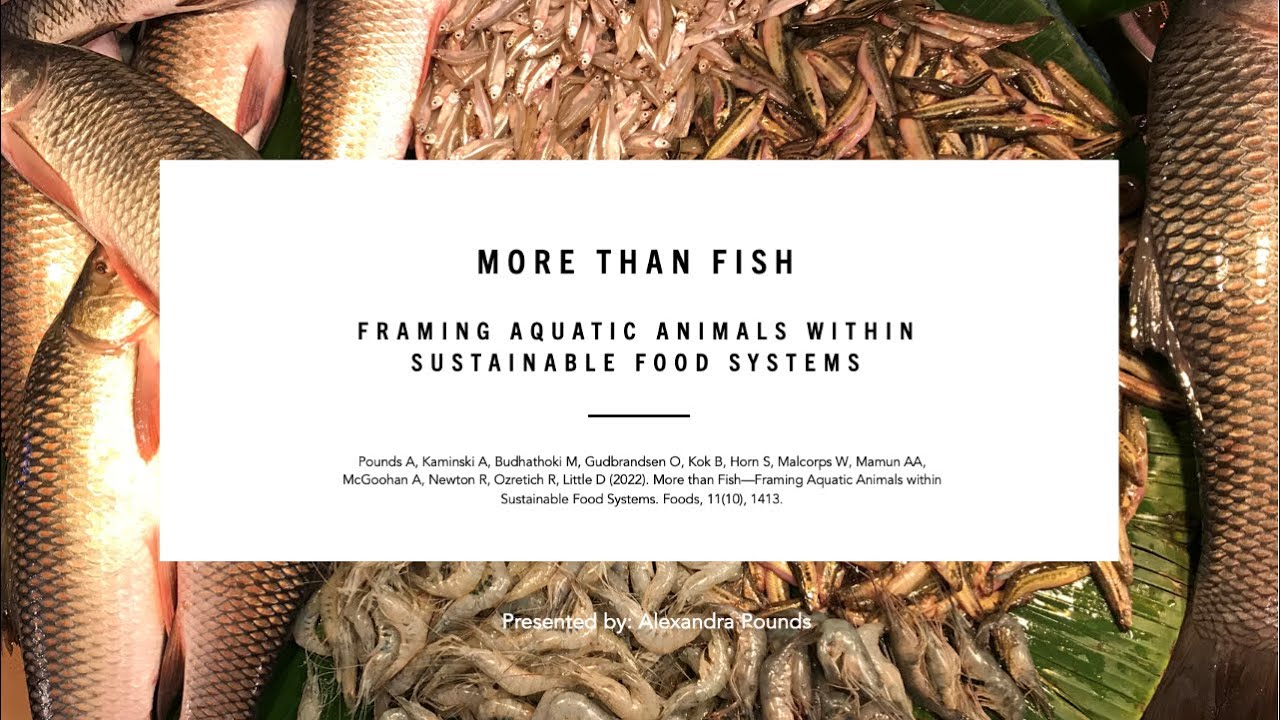
In this presentation, Alexandra Pounds presents seven points that food security policymakers and researchers should consider when evaluating the role of aquatic foods in food systems. This work was an intellectual output of the entire group of authors, all of whom are researchers in various elements of food security and sustainable food systems.
The seven points influencing nutritional outcomes and environmental impacts are:
1. The diversity of species and production methods
2. Variable definitions of an ‘edible yield’
3. Circular economy principles and effects beyond nutrient provision
4. The role of aquatic animals in the overall diet
5. Contextual effects of preparation, preservation, and consumer choices
6. The globalised nature of trade across the value chain
7. Aquatic animals are produced from a continuum, rather than a dichotomy, of aquaculture of fisheries.
Aquatic animal systems discussions need to be informed by wider food systems literature and the diversity of species and production systems. Discussions should include species- and production-level analysis that compares nutritional outcomes with environmental impacts contextualised by regional consumption preferences, affordability, and availability. Furthermore, discussions should contextualise the role of nutrients from aquatic foods in the broader diet and allow for the examination of different systems’ impact on different regions and populations. This will reflect (1) the highly international nature of the global seafood trade and the circular economy therein, and (2) all nutritional outputs of aquatic food systems, including co-products, rather than just the primary species.
Pounds A, Kaminski A, Budhathoki M, Gudbrandsen O, Kok B, Horn S, Malcorps W, Mamun AA, McGoohan A, Newton R, Ozretich R, Little D (2022). More than Fish—Framing Aquatic Animals within Sustainable Food Systems. Foods, 11(10), 1413. doi: https://doi.org/10.3390/foods11101413
Relevant literature in relation to aquaculture processing by-products:
Malcorps, W., Newton, R.W., Sprague, M., Glencross, B.D., and Little, D.C. (2021). Nutritional Characterisation of European Aquaculture Processing By-Products to Facilitate Strategic Utilisation. Frontiers in Sustainable Food Systems 5. doi: https://doi.org/10.3389/fsufs.2021.72...
Newton, R., Telfer, T., and Little, D. (2014). Perspectives on the utilization of aquaculture coproduct in Europe and Asia: prospects for value addition and improved resource efficiency. Crit. Rev. Food Sci. Nutr. 54(4), 495-510. doi: https://doi.org/10.1080/10408398.2011...
Relevant literature in relation to the importance of utilizing fish by-products in aquafeed:
Kok, B., Malcorps, W., Tlusty, M.F., Eltholth, M.M., Auchterlonie, N.A., Little, D.C., et al. (2020). Fish as feed: Using economic allocation to quantify the Fish in : Fish out ratio of major fed aquaculture species. Aquaculture 528, 735474. doi: https://doi.org/10.1016/j.aquaculture...
Malcorps, W., Kok, B., Land, M.v.t., Fritz, M., Doren, D.v., Servin, K., et al. (2019). The Sustainability Conundrum of Fishmeal Substitution by Plant Ingredients in Shrimp Feeds. Sustainability 11(4), 1212. doi: https://doi.org/10.3390/su11041212
Alexandra Pounds: www.fishbythepounds.wordpress.com
Alexander Kaminski: https://www.stir.ac.uk/people/1045825
Mausam Budhathoki: https://www.linkedin.com/in/mausam-bu...
Prof. Oddrun Gudbrandsen: https://www.uib.no/en/persons/Oddrun....
Björn Kok: / bjrn-kok
Stephanie Horn: https://www.stir.ac.uk/people/1027171
Wesley Malcorps: / wesley-malcorps
Abdullah-Al Mamun: https://www.linkedin.com/in/abdullah-...
Amy McGoohan: https://www.linkedin.com/in/amy-mcgoo...
Dr. Richard Newton: https://www.linkedin.com/in/richard-n...
Reed Ozretich: https://www.linkedin.com/in/reed-ozre...
Prof. Dave Little: https://www.stir.ac.uk/people/255974
#aquaculture #fisheries #foodsystems #foodpolicy #foodsecurity #sustainability #circulareconomy #seafood #fishfarming #fish #byproducts #zerowaste #fishprocessing #aquafeed

Информация по комментариям в разработке