Lincoln’s Gettysburg Address: Recording by William F. Hooley (1898)
This recording captures a unique moment in American history. Spoken by William F. Hooley (1861–1918) in 1898, the performance preserves Lincoln’s words with slight variations—Hooley occasionally omits lines or adjusts phrasing—but it remains a powerful rendition of the Gettysburg Address.
Background on the Speech and the Battle of Gettysburg
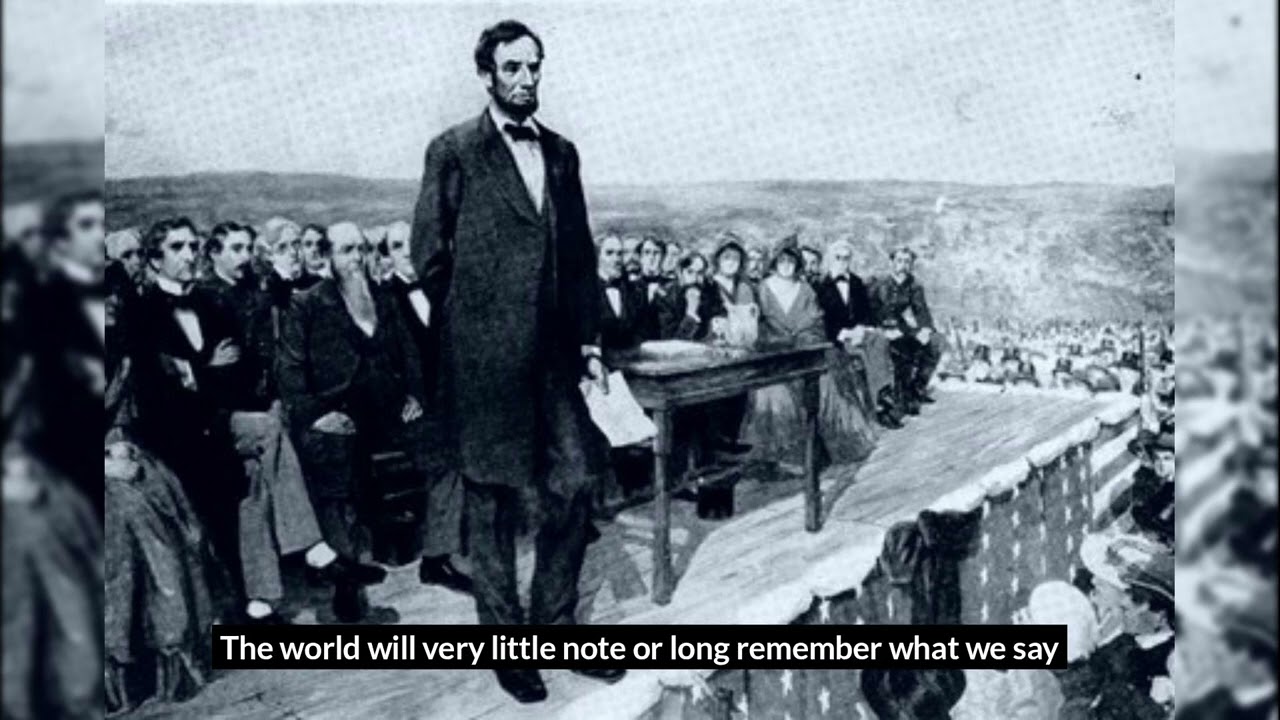
The Gettysburg Address was delivered by Abraham Lincoln on November 19, 1863, during the dedication of the Soldiers’ National Cemetery in Gettysburg, Pennsylvania. The cemetery was created to honor Union soldiers who had fallen in one of the Civil War’s most decisive battles, fought over three days from July 1–3, 1863.
Unlike most battles of the war, Gettysburg was fought on Northern soil. After three days of intense combat, Union forces held the field, forcing Confederate troops to retreat south. Had the South prevailed, they might have inflicted further damage on Northern territory, pressuring Lincoln to allow Southern states to secede.
Lincoln’s speech was delivered in a somber environment. Many corpses still lay unburied on the battlefield, including Confederate soldiers. Despite these grim circumstances, Lincoln spoke not about revenge or even emancipation directly, but about the preservation of democracy. The address emphasizes that the war was a test of whether a nation “conceived in liberty, and dedicated to the proposition that all men are created equal” could endure.
Five Manuscript Copies of the Gettysburg Address
Five original manuscript copies survive today:
Nicolay Copy – often considered the earliest draft
Hay Copy – annotated by Lincoln’s private secretary, John Hay
Everett Copy – presented to Edward Everett, the main orator of the day
Bliss Copy – formally signed, often reproduced in textbooks
Lyon Copy – held in Lincoln Room of the White House
Two of these are held by the Library of Congress, one by the Illinois State Historical Library in Springfield, one at Cornell University, and the fifth in the White House.
The Speech (Nicolay Copy)
“Four score and seven years ago our fathers brought forth, upon this continent, a new nation, conceived in liberty, and dedicated to the proposition that all men are created equal.
Now we are engaged in a great civil war, testing whether that nation, or any nation so conceived, and so dedicated, can long endure. We are met on a great battlefield of that war. We come to dedicate a portion of it, as a final resting place for those who died here, that the nation might live. This we may, in all propriety, do. But, in a larger sense, we can not dedicate — we can not consecrate — we can not hallow this ground — The brave men, living and dead, who struggled here, have hallowed it far above our poor power to add or detract. The world will little note, nor long remember what we say here; while it can never forget what they did here.
It is rather for us, the living, we here be dedicated to the great task remaining before us — that, from these honored dead, we take increased devotion to that cause for which they here gave the last full measure of devotion — that we here highly resolve these dead shall not have died in vain; that the nation shall have a new birth of freedom, and that government of the people, by the people, for the people, shall not perish from the earth.”
The closing line reminds listeners of why Lincoln saw the war as necessary: the fight was for democracy itself, not solely to end slavery. Had the Confederacy succeeded, Lincoln feared that democratic governance in North America would be permanently threatened.
Recording Details: William F. Hooley (1898)
Speaker: William F. Hooley (1861–1918)
Created / Published: New York: E. Berliner’s Gramophone, 1898
Recorded: September 21, 1898, New York, NY
Medium: 1 analog sound disc, 72.5 rpm, mono, 7 inches
Notes: Autograph of Hooley inscribed in zinc master; acoustic recording; recorded on one side only
Call Number: Berliner 6012 (Copy 2)
Digital Access: Library of Congress Digital Copy
LCCN Permalink: https://lccn.loc.gov/99392021
This recording allows modern listeners to experience Lincoln’s words in performance nearly 35 years after the original speech. Though Lincoln’s own voice is lost to history, Hooley’s rendition preserves the cadences, solemnity, and enduring power of one of America’s most famous addresses.

Информация по комментариям в разработке