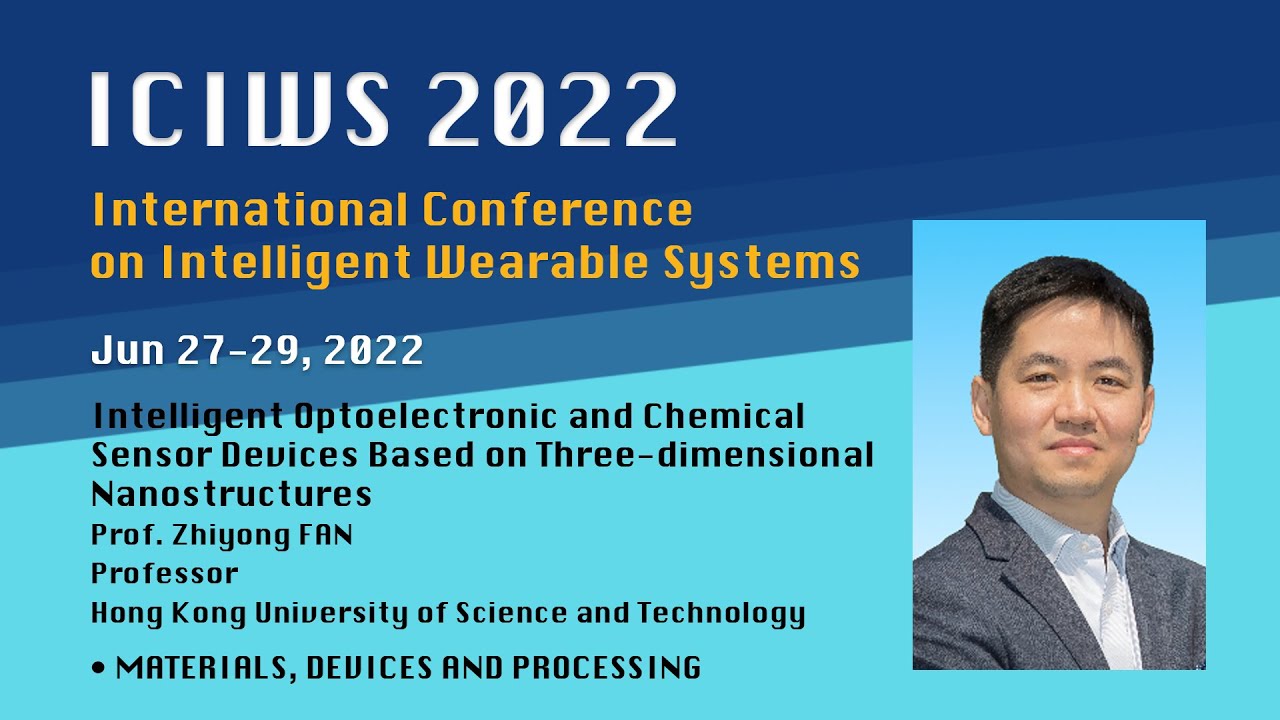
Prof. Zhiying FAN
Professor
Hong Kong University of Science and Technology
Dr Zhiyong Fan received PhD degree from University of California, Irvine in 2006 then worked as a postdoctoral fellow at UC Berkeley in 2007~2010. He joined HKUST in 2010 and now is a full professor at the Department of Electronic and Computer Engineering. He is the founding Director of Center on Smart Sensors and Environmental Technologies, Associate Director of Materials Fabrication and Preparation Facility of HKUST. He is also a member of the State Key Laboratory of Advanced Display and Optoelectronics Technologies at HKUST, Fellow of the Royal Society of Chemistry, and Founding Member of the Young Academy of Sciences of Hong Kong. He is an Associate Editor of Journal of Semiconductors. He has won a number of awards, including HKUST SENG Young Investigator Award, Outstanding Research Award, HKUST President Award and Innovation Award, and the Shandong Natural Science Second Prize, 2020 Top 10 Research Progress on Semiconductors in China. His research interest is focused on novel nanomaterials for electronic, optoelectronic and sensing devices. Till date, he has published close to 210 peer reviewed papers with citations ~23,000, H index 80, and is a highly cited author of Clarivate Analytics. He also has ~30 Chinese and US patents and two startups commercializing sensor technologies.
Intelligent Optoelectronic and Chemical Sensor Devices
Based on Three-dimensional Nanostructures
Abstract
Nano/micro-structured optoelectronic materials have the advantages of small size, high surface-to-volume ratio and lots of unique and interesting physical and chemical properties, including surface chemical catalysis, quantum confinement, surface bandbending, sub-wavelength optical wave-guiding, etc. These materials can be widely used to construct a variety of new optoelectronic and chemical sensor devices. This talk will summarize the use of three-dimensional nano/micro porous templates to assemble and integrate various perovskite nanowire based optoelectronic devices, based on our recent research. The devices include LED, hemispherical bionic retina and spherical bionic electronic eyes. In addition, the speaker will will also introduce nano-structured chemical sensors and high-performance intelligent electronic nose (E-nose) system. The core of the system is the semiconductor oxide nanotube sensor array, besides readout circuits, wireless data transmission units, artificial intelligence algorithms and mobile data processing applications. By combining the unique nanotube sensor structure with different electrode materials, gas detection and classification with high-sensitivity, are realized. Therefore, compared with traditional thin-film based gas sensors, the power consumption of our sensor is markedly reduced, and it has superior sensitivity compared with similar reported products. This sensor system can meet the urgent and imminent requirements of distributed environmental monitoring in smart homes and smart buildings, and can also be used in future mobile and wearable health devices.





![Почему реактивный двигатель не плавится? [Veritasium]](https://i.ytimg.com/vi/F6UB0V2Fct4/maxresdefault.jpg)




![Почему взрываются батарейки и аккумуляторы? [Veritasium]](https://i.ytimg.com/vi/a3-3R9zwyGY/maxresdefault.jpg)


Информация по комментариям в разработке