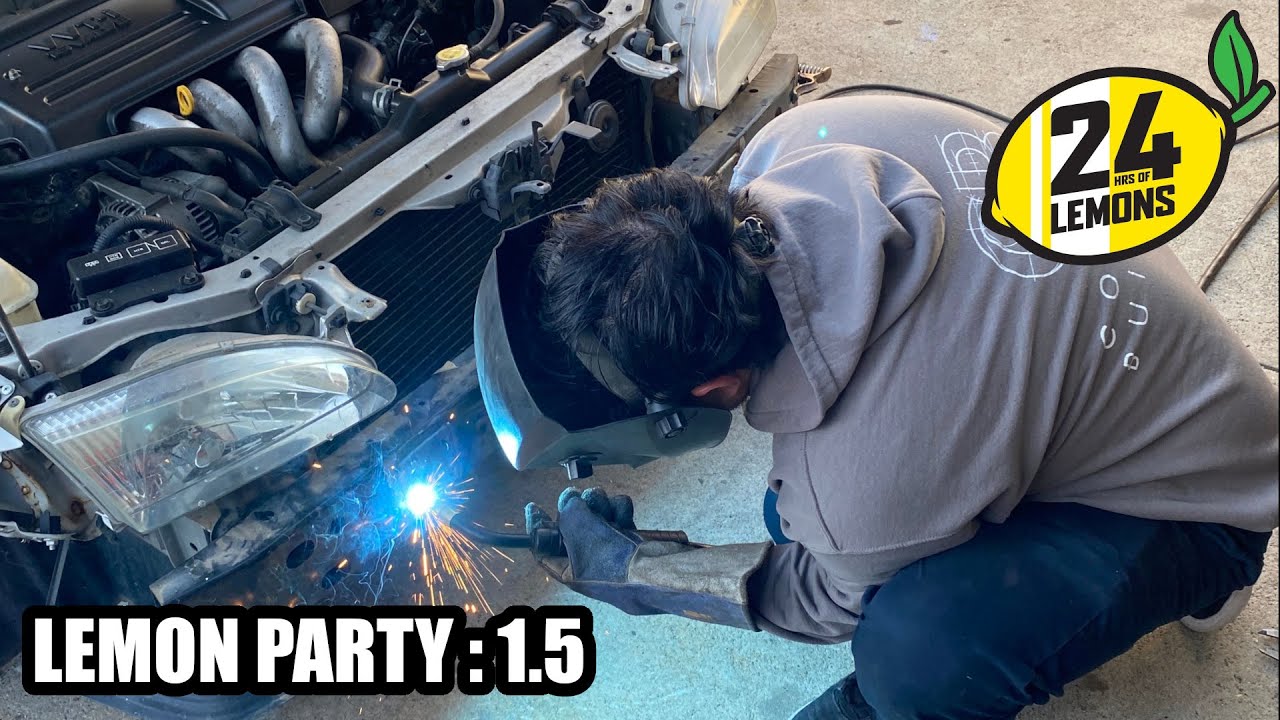
This car is for @24hoursoflemons , we have about a month to finish it and race wheel to wheel.
This segment we install Tow bar plate to tow the car to Jon's to get the Roll Cage done.
Initial dingus - 2001 Toyota Corolla 5 speed with 1zz engine
WHAT IS 24 HOURS OF LEMONS?
An endurance car racing series on dedicated road courses for $500 cars. Check out our YouTube, Instagram, and Facebook to witness the spectacle.
WHAT’S A $500 CAR?
It’s a car bought and track-prepped for $500 or less (not including safety equipment, brakes, and wheels/tires).
DO $500 CARS REALLY EXIST?
Absolutely. See a $1000 car on Craigslist? Bring $400 cash and a 12er of Old Milwaukee. Nine times out of ten, you’ll be driving it home.
WHAT CARS ARE ELIGIBLE?
Pretty much any four-wheeled machine that was street-legal when made and passes our safety inspection today. Smog, insurance, or title aren’t required.
WHAT IF I SPENT MORE THAN $500?
If our judges decide you spent over the $500 limit, they can assign negative laps to your standings. Your cheaty-ass Spec Miata will still start the race when the green drops–it just may be working Lap -629.
WHAT KIND OF SPECIAL CAR RACING EQUIPMENT IS NEEDED?
Cars need a legal 6-point or better cage, a race seat, race belts, an onboard fire suppression system, a kill switch, and either a 100% stock fuel system or pro-quality fuel cell. Drivers need a legal helmet, head-and-neck restraint, and fire-resistant suit/gloves/shoes. See the Rules to get the particulars.
HOW MUCH WILL IT COST?
If you want to go wheel-to-wheel car racing, it doesn’t get much cheaper. Entry fees are listed here. You can borrow the safety gear from a teammate, or rent it from various online vendors, or buy a full set from us. Sleeping bags, gas, bologna sandwiches, and car-building costs vary hugely. There are great threads about cage costs, and fab shops on the Lemons Forum.
CAN I MODIFY THE CAR?
Unless it puts you afoul of a safety rule, any mod is allowed. Just remember, it’ll count toward the build total, so be ready to talk price with the judges. Absurd non-performance enhancing mods are usually exempted: Don’t lose sleep about penalty laps incurred for the costs of putting a Suzuki Sidekick inside a pop-top camp trailer or a Dodge slant-6 in your E30 BMW
Introduced in 1997 (1998 model year), all Corollas for the North American market were built in Fremont, California (by NUMMI) or Cambridge, Ontario (by TMMC). Unlike the Japanese counterparts, the North American Corolla at this time was only offered as a four-door compact sedan. A new all-aluminum 1ZZ-FE engine powered all Corollas, making this generation lighter than its predecessor. This new engine uses a timing chain instead of a timing belt. It also incorporated laser etched valve guides directly in the block, rather than the old shrink to fit valve guides in the predecessor Corolla motor (4A-FE & 7A-FE). This prevents oil burning and valve guide failure in the future.
In North America, only sedans were offered, and all came with day-time running lights. This Corolla has a maximum legal carrying capacity of 1,500 lb (680 kg). Grades were VE, CE and LE. The VE model was the base model available in a 3-speed automatic or the 5-speed manual transmission with 175/65R14 tires. The CE model offered either the 4-speed automatic with overdrive or the 5-speed manual transmission, while the LE offered the 4-speed automatic, but both offered 185/65R14 tires. An optional powered sunroof was offered on the CE and LE models. An optional Touring Package with color matched side skirts, color matched rear mudflaps, a white faced instrument cluster with tachometer and outside temperature gauge, and aluminum wheels was reserved for the CE and LE models. Side airbags and ABS were optional for the CE and LE models, but very few of them actually had them. The first batch of 1998 Corolla VE's did not have a front sway bar but by June 1998 it was included on all models. VVT-i variable valve timing and individual coils for each cylinder were added to the engine in model year 2000 with a small increase in power from 120 hp (89 kW) to 125 hp (93 kW) along with child seat anchors added on the rear deck. The introduced VVT-i optimizes cam and valve timing to reduce emissions, and the addition of individual coils for each cylinder helped control spark timing to each individual cylinder.

Информация по комментариям в разработке