Alumnus Binayak Das presents 'Corruption in water, understanding the issue and taking preventive measures'
Investigations and sanctions are the last steps in the fight against corruption – and they come at a price, as they can further tarnish the reputation of organizations. Measures to prevent corruption strengthens integrity within organizations, thereby reducing the risks for corrupt practices.
Corruption is a major obstacle for work toward achieving universal access to water and sanitation, as called for in Sustainable Development Goal (SDG) 6. Corruption leads to higher costs for drinking water and sanitation services and degrades the quality and reliability of supply, thus endangering the health of people (SDG 3). In many countries, women and girls are responsible for the management of household water supplies, sanitation and health, meaning that they are unequally affected by corruption, which erodes gender equity efforts (SDG 5).
The increasing flows of climate finance into the water sector combined with its complexity and its infrastructure-intensive nature makes the sector particularly vulnerable to corruption and integrity risks.
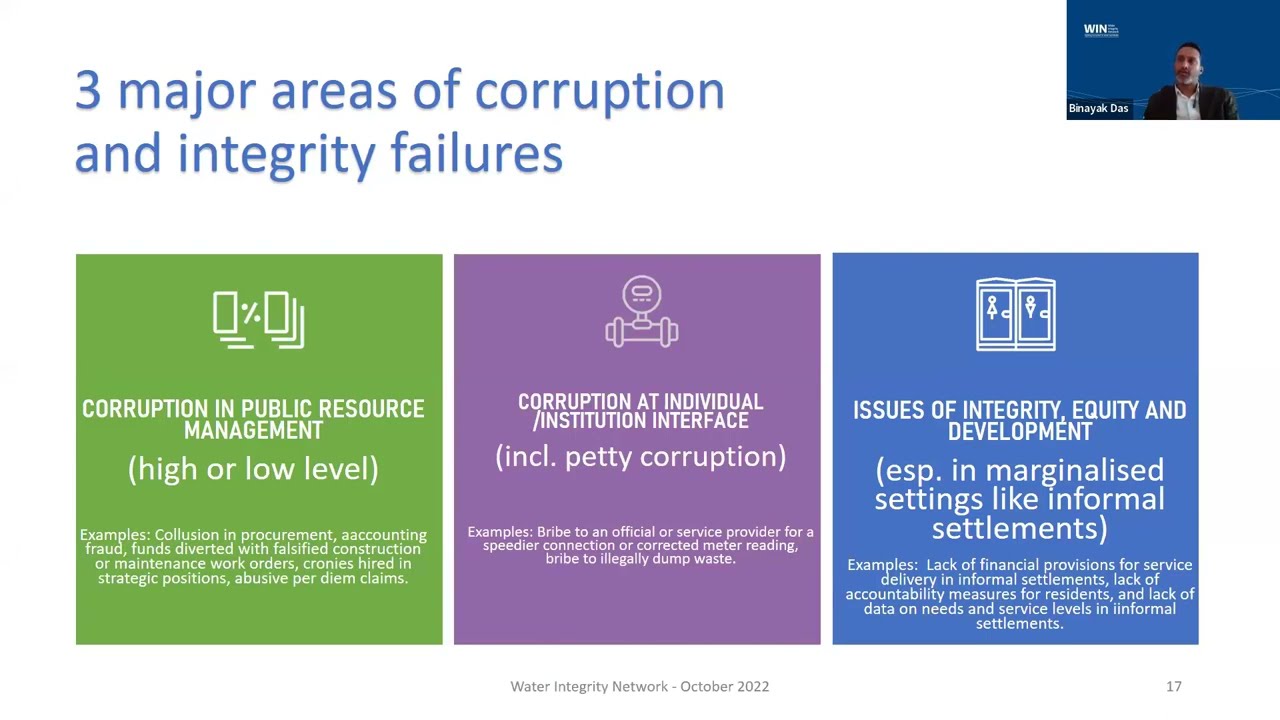
This webinar will focus on highlighting some key corruption and integrity-related challenges that the water sector encounters. It will share standards, frameworks, tools, and good practices for strengthening integrity within the water sector from policy to implementation level across institutions.
Corruption is estimated to be responsible for “losses” of 10% of the investments going into the capital-intensive water sector – in some countries reaching as high as 40% to 50% (WIN, 2016). Poor integrity tarnishes the reputation and creditworthiness of water sector entities, at a time when they need significantly increased investments to meet the urgent need for climate action. A study by the Inter-American Development Bank states that mitigating corruption risks can lead to substantial savings across the sector.
To strengthen integrity, there is a need to focus on accountable institutions (SDG 16). Water and sanitation sector organizations need to operate with integrity to prevent corruption, avoid sanctions, and enhance credibility to attract investments to be able to achieve the SDGs and climate-related goals.
Speaker
IHE Delft alumnus Binayak Das has years of progressive experience spanning more than 20 years in development cooperation, with a strong expertise on water governance and management. His work is interdisciplinary and transcends into the subjects of environment, climate change, corruption and sustainable development.
Binayak has a masters’ degree on water management from IHE Delft, The Netherlands, and a post graduate degree on environment management from IISWBM, Kolkata, India. He is a Panos journalist fellow and author of numerous books and articles on water, environment, and climate issues. Binayak founded SixDegrees News, a news website on sustainable development.
Currently he is Programme Coordinator at the Water Integrity Network, where he leads the development, adaptation, training, and promotion of water integrity tools, and manages collaborations with key global partners. In addition, he is leading development of WIN’s climate portfolio. Binayak’s earlier appointments include engagements with IUCN, Transparency International, Arghyam, Centre for Science and Environment and Down To Earth magazine.

Информация по комментариям в разработке