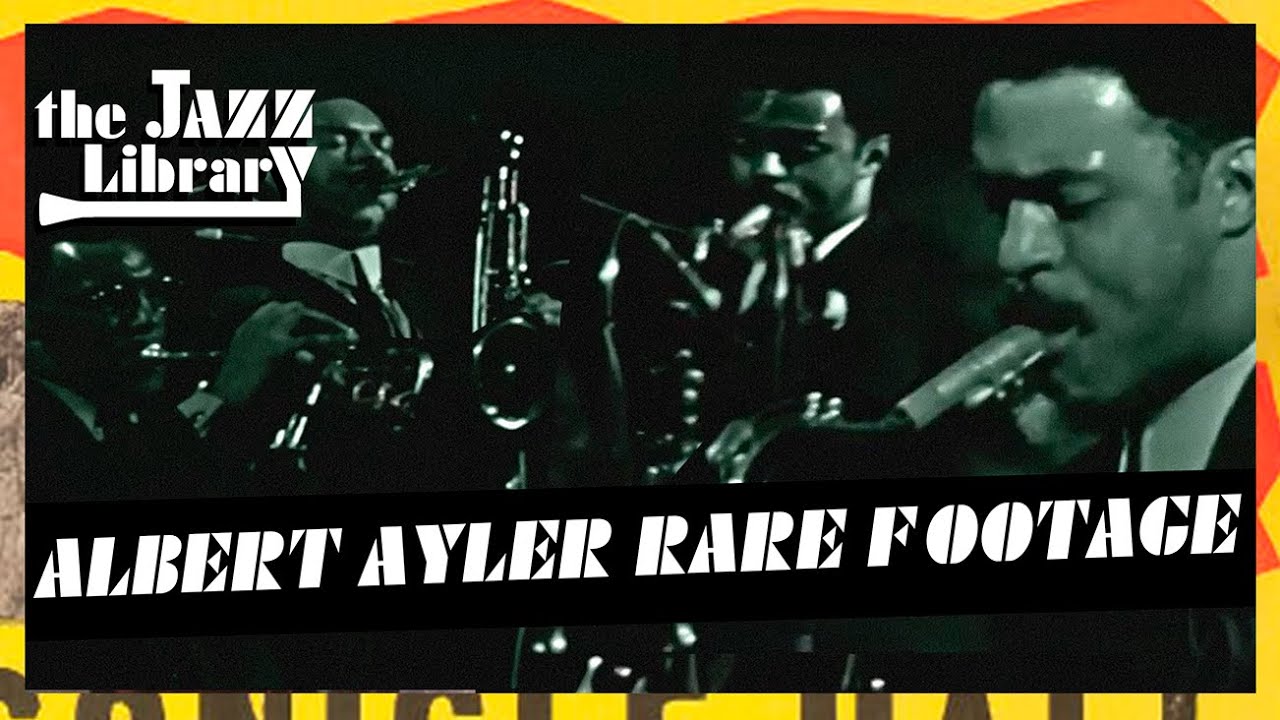
Rare footage of the Albert Ayler Quintet performing at the Sigma Festival in Bordeaux, France November 14, 1966
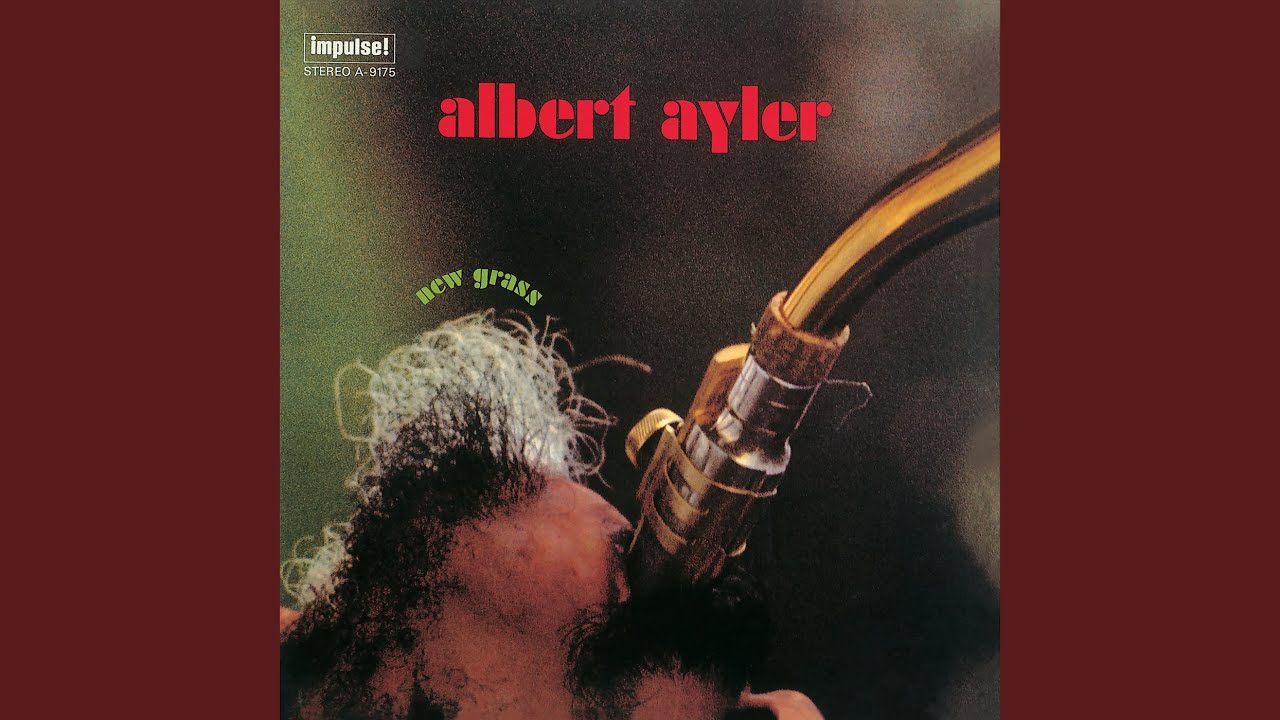
Albert Ayler - Tenor Sax
Donald Ayler - Trumpet
Michel Samson - Violin
Bill Folwell - Bass
Beaver Harris - Drums
At the French Theater, explosive encounter
Free Jazz and total spectacle
Paris Jazz Festival, 13 November, 1966 . Published in Jazz Magazine (December 1966, p. 19-20)
"IT squeals, it yelps, it screams, it squeals, it blows, it bombs: it hums! Albert Ayler's quintet is unleashed: collective madness at its peak. It is, it seems, “free jazz”. We knew the jazz of political protest, here no message: it is only a question of anathema to everything that is concession or musical conditioning, technique included. Ayler and his ilk spit like never before on norms, rules, canons and academicisms. With his self-indulgent Trane vibrato, Ayler's sound is as, if not more, blasphemous as the hoarse bellowing of John Coltrane. Faced with outrageous research in the treatment of sound - equally sensitive to the trumpet (Don Ayler), the violin (Michel Samson), the drums and the bass - the absence of research or, if we want to be lenient , formal, rhythmic and harmonic solutions is all the more disappointing.
Destructive will? Want to start from scratch? It seems that the jazzman wants to reinvent, by mistreating it, even the instrument he uses and which he does not want to owe to anyone. This is what makes his music so retrograde, so clumsy, so shocking even.
However, in the face of this universe of revolt, madness and delirium, we cannot remember a certain “rage for life”.
What will Ayler's contribution to future jazz be? By voluntarily putting himself outside the law, is he not condemning himself to sterility?
That said, Ayler had his place at Sigma which proposes... and is delighted to provoke the most heated controversies."
Sculpting time...
"The second part of this evening was devoted to the sculptor Nicholas Schöffer for an experimental audiovisual show. Embryo of total spectacle, assembly of very diverse successive events: light games, ballets, plays, cinema, Nicholas Schöffer's "Carte blanche" had, in fact, to partially obey the laws of chance, some of its components being perfectly indeterminate. This was the case, for example, of the spectator's reactions to the luminous attacks of photographic flashes — a timid but painful outline of a happening! — This was also the case for the choreographic part inspired by Sara Pardo and her contemporary dance company. Audacious confrontation of the mechanical structures of Nicholas Schöffer and a female body which can abdicate all romanticism but not all sensuality.
The theatrical episode was undoubtedly one of the most interesting elements of the show. Nicholas Schöffer chose Jean Tardieu's "Sonata" because, in his opinion, this is where the best bases for renewal for the theatrical form lie. We can imagine that the sculptor, accustomed to carving material and color, is seduced by the most convincing verbal carving.
The program thus composed has several appreciable virtues: conciseness, originality, “punch”. No repetitions, no boredom. It is a great victory, as great for the artist as having managed to tame time." M. C. ICRE.
🎷 Join The Jazz Library | Jazz Photo Archives Collective!
🔗 Support the collective through the store.
🏛 The Jazz Library Store
https://linktr.ee/thejazzlibrary
📷 Jazz Photo Archives Gallery
https://www.instagram.com/jazzphotoarchives
📚 The Jazz Library Instagram
https://www.instagram.com/thejazzlibrary
Jazz Photo Archives Threads
https://www.threads.net/@jazzphotoarchives
The Jazz Library X
https://www.x.com/thejazzlibrary








Информация по комментариям в разработке