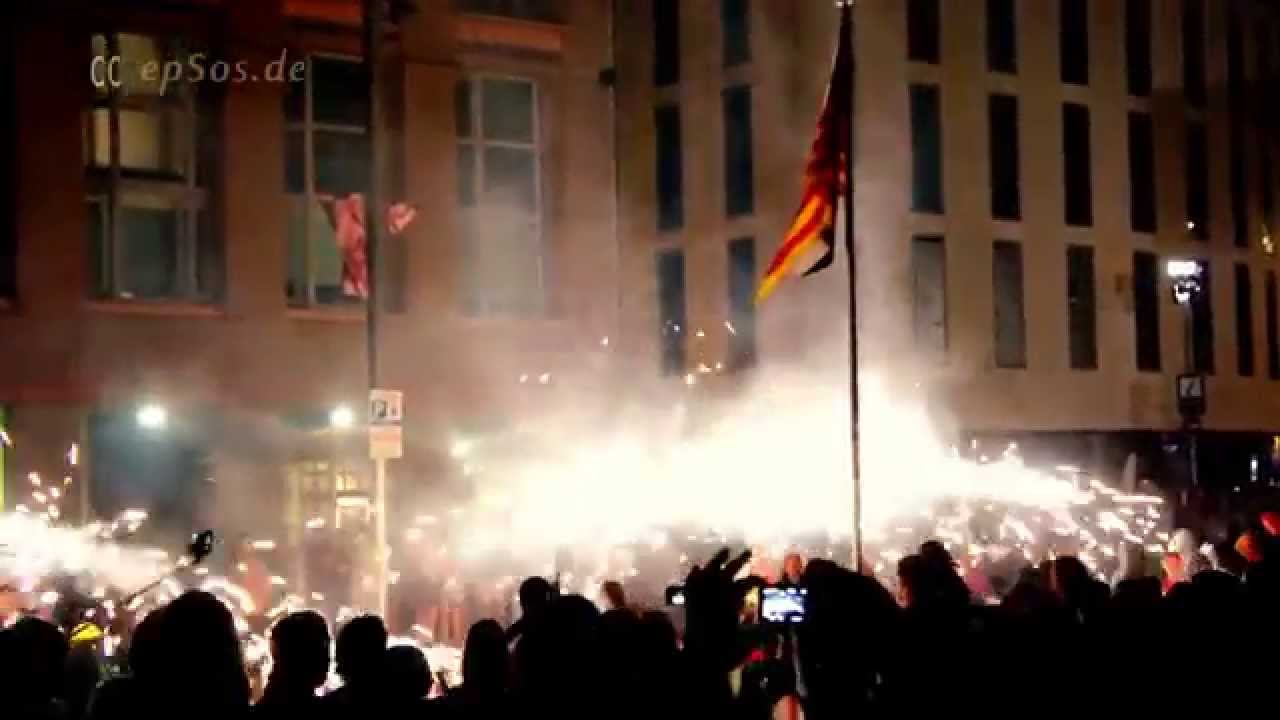
Free video about correfoc fireworks. This free video was created for you by http://epsos.de and can be used for free under the creative commons license with the attribution of epSos.de as the original author of this correfoc fireworks video.
Thank you for supporting the creative commons movement !!
A correfoc is a Catalan folk expression that literally means "fire loop". It is one of the most remarkable events in the Catalan culture. The correfoc takes place mainly during village festivals where colles the diables groups dressed as devils, with fireworks spectators run along or dance to the rhythm of drums. The correfoc differs from a Cercavila where the public without problem between the devilish state.
The tradition originated probably in the Middle Ages. But it was not until the 20th century that the correfoc themselves in this manner. During the 80s and 90s were the correfocs increasingly popular and they have spread throughout the Catalan-speaking territories, both in Spain and in France. The event has now become a spectacle to compare with big plays.
The term firework appeared in various parades and celebrations largest popular celebrations in Catalonia, as an impromptu demonstration of people, dragons and demons that acted running, jumping and dancing together under fire. It is an event celebrated mostly in Catalonia, but also extended by Valencia, the Balearic Islands and Northern Catalonia. It has its roots in the dance of demons already documented in the twelfth century, but it was not until the twentieth that took its present form.
The suits currently are cotton, leather or fabric fireproof. During the 70s and 80s these were simple potato sacks painted with horns on top, and towards the early 90th century have left some hornless groups (typical gang of fire). There are two types of characteristic correfocs the option of making use of one or the other depends on the group, the type of firework and the type of route. There is no tradition of making use either.
The tools tend to lead the Devils are a car that makes central warehouse of fireworks, a bag, pouch or oatmeal, where carried material Devils a Botafoc or fuse, which allows turning carts, mace, which is put on carts and other items put on fireworks as ceptrot, dragon or beast figure or other static or mobile.
The dragon is an element in turning parades and correfocs. The Legend of St. George and the Dragon is emblematic. The dance of devils is a tradition rooted initially Hello montse fuentes in Catalonia, and later in Valencia and the Balearic Islands. His participation in the parade, in processions and in correfocs have become an essential part of the feasts of many towns and cities.
The demon groups tend to be organized as non-profit entities or as sections of other entities that provide coverage. The number of groups that are in Barcelona is very abundant, and this is a good indicator of rooting and acceptance of this rally bonfire. At the same time, the groups are federated into the Coordinadora Devils Barcelona and the Federation of Devils and Demons of Catalonia. They numerous performances throughout the year to organize correfocs in many festivals. In all, the Mercy is the most awaited by all.
At the end of the Franco dictatorship, the devil dances and correfocs recovered, as happened with other symbols of Catalan culture, such as castles, dancing poles, the trabucaires, giants, etc. The fire as a symbol remote, has always been something strange and aroused universal concern. It is also special because it generates agitation, and also is unusual because it occurs in a dream world chimerical.
The first news of the devils Cervera, one of the earliest written references of the Principality of Catalonia, the arrangement can be found in the Corpus Christi procession in the year 1411, preserved in the Archives Regional Segarra, in the city of Cervera. The first written reference of the Devils Dance Ribes is the festival of St. Paul in 1913 when they accounted verses dance of the devils, but there are indications that they did performances throughout the nineteenth century. Moreover, in the texts of other dances verses of the municipality represented between the eighteenth and twentieth there is the intermittent presence of the devil satirical integrated into the other characters dance, introducing elements of social satire. The dance of devils, like other dances verses, entered decay 20s in 1951 decided to recover the Devils Dance Ribes for the festival of San Pedro.
Thank you for supporting the creative commons movement !!

Информация по комментариям в разработке