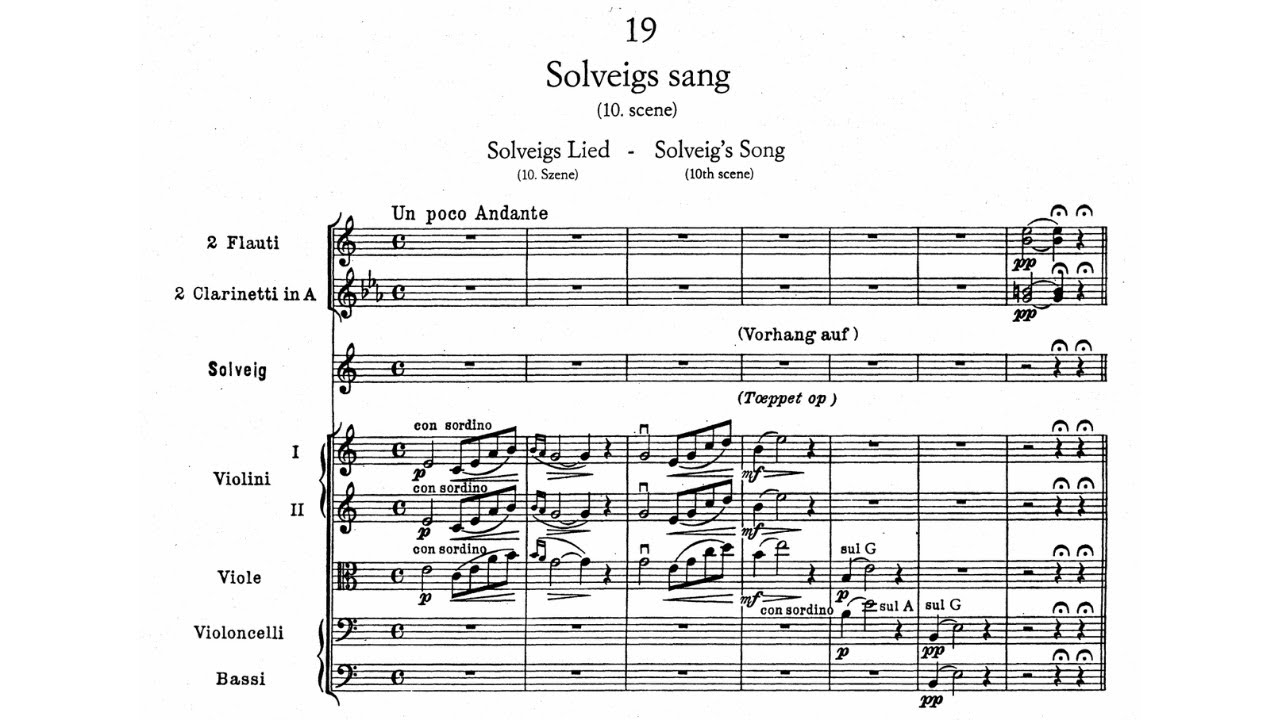
00:00 - I. Solveig's Song: Un poco andante (from Op. 23)
05:21 - II. Solveig's Lullaby: Lento (from Op. 23)
09:51 - III. From Monte Pincio: Andante molto (from Op. 39)
14:54 - IV. A Swan: Andante ben tenuto (from Op. 25)
17:30 - V. Last Spring: Andante espressivo (from Op. 33)
24:58 - VI. Henrik Wergeland: Andante solenne (from Op. 58)
_____
Soprano: Solveig Kringelborn
Conductor: Gennady Rozhdestvensky
Orchestra: Royal Stockholm Philharmonic Orchestra
Year of Recording: 1992
_____
"The Six Songs were orchestrated during 1894 and 1895 and published shortly afterwards. ‘Solveig’s Song’ (Op. 23 No. 18) hardly needs any introduction. Originally part of Grieg’s well-known incidental music (1874–75) for Ibsen’s Peer Gynt, it remains one of the composer’s most moving, yet simple, pieces. It is lightly scored for strings with flutes and clarinets. Also from Peer Gynt is ‘Solveig’s Cradle Song’ (Op. 23 No. 23). This employs a sensitive accompaniment of strings and harp, the strings muted throughout and often divided. The musical content of ‘From Monte Pincio’ is more diverse, in order to match the words (by Bjørnson). The stillness of the opening is in sharp contrast to the dance-like middle section, complete with some colourful turns of harmony. The song was originally published in 1884 as part of a set of six songs, Op. 39. The orchestral version uses two each of flutes, clarinets, bassoons and horns, plus harp, triangle and strings. Back to Ibsen for the words of ‘A Swan’, originally part of the Op. 25 set of six Ibsen songs (1876). This beautiful setting, which glides as gently as a swan, is scored for oboe, bassoons, horns, harp and strings. At the same time, Grieg was working on Twelve Songs to Poems by A.O. Vinje, Op. 33 (1873–80), of which ‘Springtide’ is the second of the set. It is one of Grieg’s bestknown songs, and is eloquently scored for strings. Henrik Wergeland (1808–1845) was a Norwegian playwright and poet. John Paulsen’s elegy on the writer forms part of five Paulsen settings, Op. 58, completed in 1894. This dramatic song, marked Andante solenne, is scored for full orchestra.
Bjørnstjerne Bjørnson (1832–1910), a close friend of Grieg’s, was one of the most influential figures in nineteenth-century Norwegian literature. It was in 1872 that Grieg began writing the incidental music for Bjørnson’s new play Sigurd Jorsalfar (Sigurd the Crusader). The music consists of eight numbers, two of which are vocal. In 1892 three of the numbers were revised, and published separately a year later. They form the suite, Op. 56, on this disc. The first movement, ‘Prelude’ (‘In the King’s Hall’), opens with a gentle march-like melody on clarinets and bassoons, supported by pizzicato strings. Although in quadrupletime, the rhythm allows the metre some ambiguity, often feeling as if it were in triple-time. This opening provides much of the basic material for the movement. The use of dialogue between upper and lower strings, accompanied by reiterated woodwind chords, could seem to have strayed from Tchaikovsky were it not for Grieg’s individual fingerprint of melodic shape. The use of instrumental dialogue, this time with woodwind, is a prominent feature of the more intimate middle section, before the opening is repeated. From A major to the darker key of B minor for the second movement, ‘Intermezzo’ (‘Borghild’s Dream’). Although the movement is not without volume of sound, the overall effect is still suitably veiled and dreamy. The opening of the third piece, ‘Hommage March’, in B flat major is another example of Grieg’s use of orchestral colour. After a brief fanfare there follows a passage for four solo cellos announcing the main march tune. This rich sound is followed by the rest of the strings, divided into nine parts, repeating the melody. The music builds up until the whole orchestra blazes forth with the march tune in augmentation (i.e., the original note values doubled). A gentler, yet faster, middle section adds contrast, until a reprise of the opening section concludes the suite." (David Fligg)
_____
Note: Published, engraved editions of the first two pieces are not available, but as the orchestration for the first piece is essentially identical with his past orchestration, the score from Peer Gynt was available. However the second piece had significantly revised orchestration (no winds and the addition of the harp), so as a published, engraved edition was not available, the autograph manuscript was required. In addition, it should be noted that the fifth piece actually repeats three times as opposed to the notated two times.
_____
© COPYRIGHT Disclaimer, Under Section 107 of the Copyright Act 1976. Allowance is made for "fair use" for purposes such as criticism, comment, news reporting, teaching, scholarship, and research. Fair use is a use permitted by copyright statute that might otherwise be infringing. Non-profit, educational or personal use tips the balance in favor of fair use.

Информация по комментариям в разработке