🎵 Song Description (with Lyrics + Translation)
Title: “Kāla Nīrattin Mūlam” (“Source of the Ancient Waters”)
Language: A poetic reconstruction inspired by Proto‑Dravidian phonology and root vocabulary.
Lyrics (Reconstructed‑Style Dravidian Poetic Form)
Ār maṇ
ār → water, river, flood
maṇ → earth, soil
“the water‑soaked earth” / “river‑land”
por‑aḷai tū‑rum
por‑aḷai → waves, ripples, movement
tū‑rum → pushing through, stirring, moving
“where ripples move” / “where waves stir the soil”
nār aḷ
nār → reeds, fibrous plants
aḷ → place, abundance
“the place of reeds” / “reedy wetlands”
ti‑ru‑nīr pā‑yum
ti‑ru‑nīr → sacred water, pure water
pā‑yum → flowing, spreading
“where sacred water flows”
pāl va‑yal
pāl → milk, pale, fertile
va‑yal → field, cultivated land
“the fertile pale fields” / “milk‑rich fields”
tu‑ḷa‑vi nā‑dum
tu‑ḷa‑vi → wandering, moving through
nā‑dum → land, region
“wandering through the land”
ēl u‑ru
ēl → young, new, tender
u‑ru → form, body, figure
“a young form” / “a new figure”
pā‑ṭu nā‑dum
pā‑ṭu → song, chant
nā‑dum → sounding, spreading, going forth
“the song that goes forth” / “the chant that moves through the land”
This style draws on reconstructed Proto‑Dravidian roots such as nīr (“water”), amma (“mother”), uyir (“life”), and nāṭu (“land”), which are attested across the Dravidian family and trace back to the proto‑language through comparative reconstruction.
Malayalam is part of the South Dravidian branch, which descends from Proto‑South‑Dravidian, which itself descends from Proto‑Dravidian.
Because of this:
Many Proto‑Dravidian roots survive unchanged in Malayalam.
Malayalam and Tamil share a particularly close relationship, preserving many ancient forms.
It is inevitable that some words will look Malayalam, Tamil, or Kannada — because they all inherited them.
Words like nīr, amma, nāṭu, uyir are pan‑Dravidian, not uniquely Malayalam.
🧭 The Dravidian Family: What Linguists Agree On
Modern Dravidian languages fall into four major branches, not three:
1. South Dravidian
This is the branch that eventually produces:
Tamil
Kannada
Malayalam
Tulu
Kodava
Badaga
Irula
Toda
Kota
Proto‑Dravidian → Proto‑South Dravidian → Proto‑Tamil‑Kannada → Tamil → Malayalam (later split)
So Malayalam is not a Proto‑Dravidian branch.
It is a descendant of Tamil, which is itself a descendant of Proto‑South Dravidian.
2. Central Dravidian
Includes:
Kolami
Naiki
Parji
Gadaba
Ollari
Koya
These languages are spoken in central India.
3. North Dravidian
Includes:
Kurukh
Malto
Brahui (spoken in Pakistan)
These are the most geographically distant Dravidian languages.
4. South‑Central Dravidian (sometimes grouped with South Dravidian)
Includes:
Telugu
Gondi
Konda
Kui
Kuvi
Some classifications treat this as a sub‑branch of South Dravidian; others treat it as its own major branch.
🧬 Where Proto‑Dravidian fits
Proto‑Dravidian is the hypothetical ancestor of all Dravidian languages.
It is reconstructed through comparative linguistics, not directly attested.
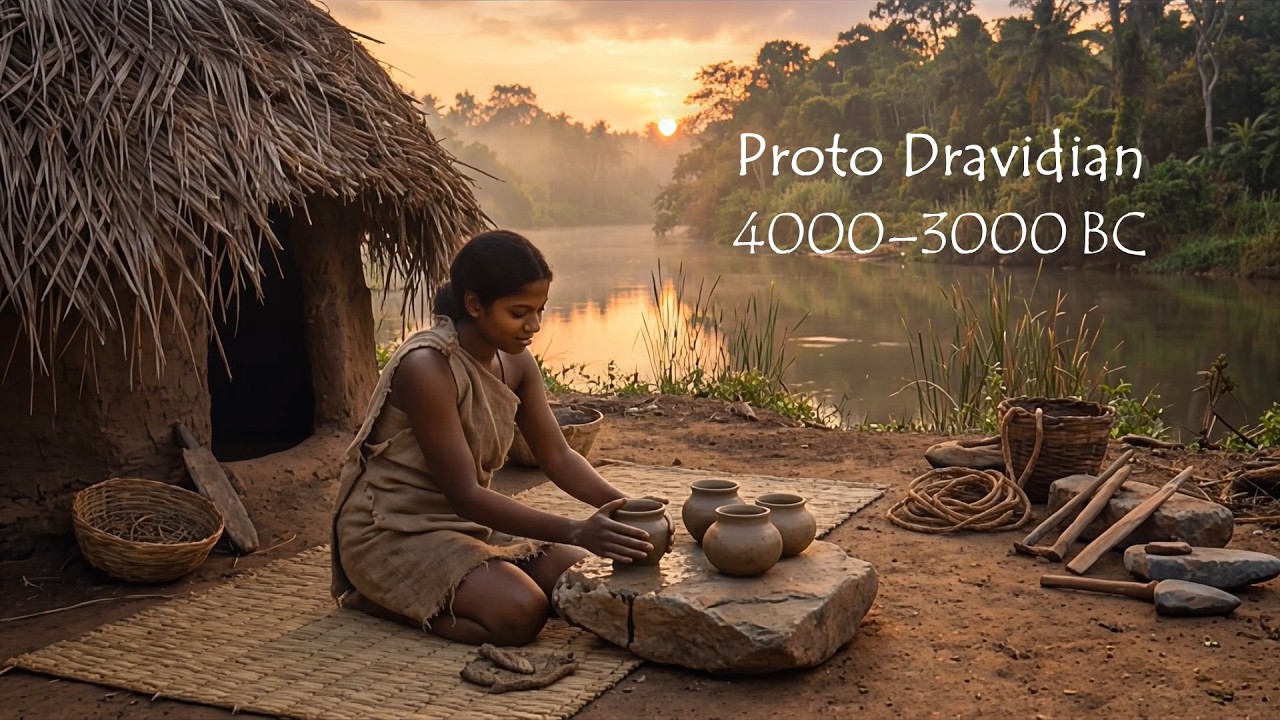
Time period: 4000–3000 BCE (supported by linguistic and archaeological correlations).
From Proto‑Dravidian, the family splits into the branches above.
Don't forget to like, share, and subscribe if you enjoyed the video!
Hashtags: #ProtoDravidian, #DravidianHistory, #AncientSouthIndia, #PrehistoricIndia, #RiverCivilizations, #MythicRealism, #CinematicWorldbuilding, #AIArtVideo, #AIVideoArt, #SouthIndianWildlife, #WaterBuffalo, #RiverLife, #AncientSong, #WorldMusic, #LinguisticReconstruction
Thank you for watching! 🎥🕺









Информация по комментариям в разработке