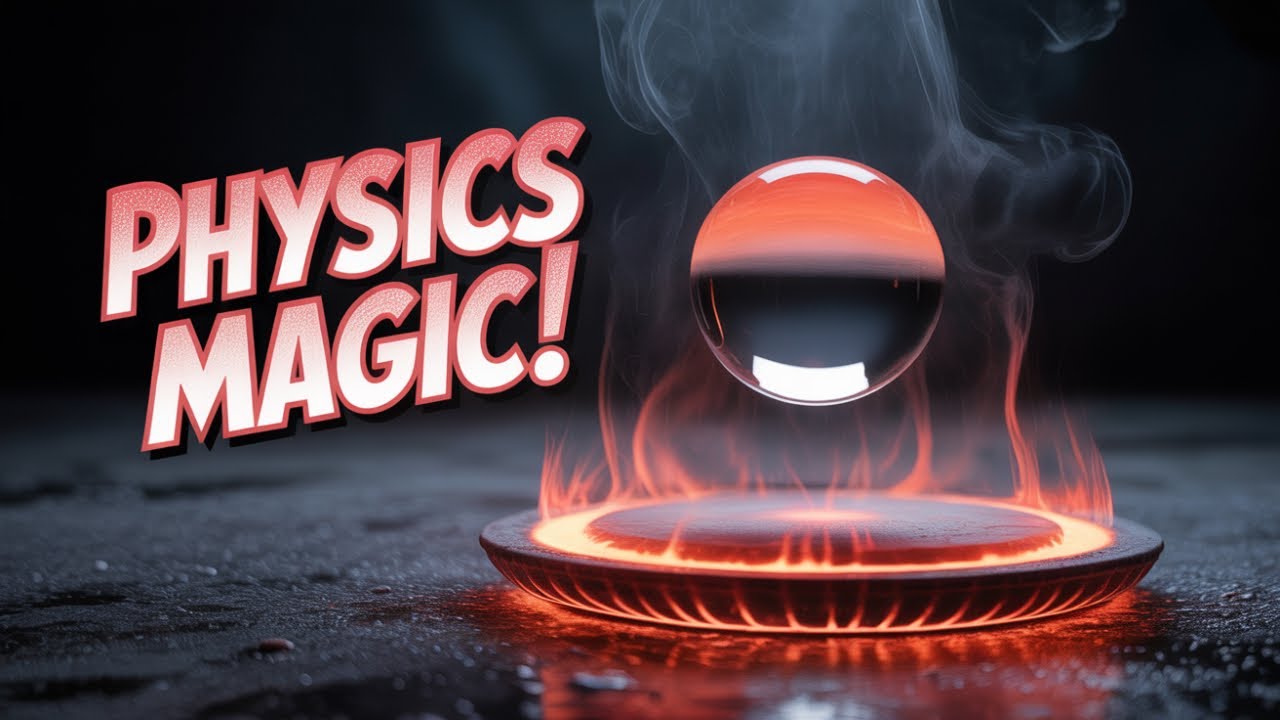
Explore the science of Leidenfrost micro hovercrafts! These droplets levitate on hot surfaces because of a steam layer, creating a fascinating visual physics experiment. Learn about states of matter and thermal gradient as we explain the fluid dynamics behind this counterintuitive phenomenon. Fluid Dynamics, Thermodynamics, Nanofluidics, Surface Engineering, Soft Matter Physics — how droplets turn into self-propelled “hovercrafts” when heat, evaporation, and surface design work together. This video, “Leidenfrost Micro Hovercrafts,” explores how a simple droplet landing on a surface far hotter than its boiling point transforms into a levitating, racing, shape-shifting micro-machine. Supported by a vapor cushion it creates itself, the droplet glides, accelerates, and even climbs thermal gradients — behaving like an autonomous engine powered purely by heat. Why it matters: Leidenfrost droplets show how thermal energy can be converted into motion without pumps, motors, or external fields. Mastering this effect unlocks pathways in microfluidic transport, self-cleaning surfaces, thermal logic, and energy harvesting directly from waste heat.
🧠 What You’ll Learn
The Leidenfrost Effect — A Thermal Levitation Phenomenon:
When a droplet meets a surface hundreds of degrees above its boiling point, rapid evaporation forms a stabilizing vapor layer. The droplet never touches the surface — it floats, skitters, and survives dramatically longer than a boiling droplet.
How the Vapor Cushion Works:
Gravity pushes the droplet down while vapor pressure pushes up. This balance creates a thin insulating layer that can be microns to tens of microns thick, dictating lifetime, stability, and hovering behavior.
Self-Propulsion on Thermal Gradients:
Asymmetrical evaporation generates uneven vapor flow. The droplet is pushed toward hotter regions, producing spontaneous motion without external control — a heat-driven “rocket effect.”
Ratcheted & Textured Surfaces:
Microengineered grooves and saw-tooth patterns steer droplets along predefined trajectories, enabling sorting, routing, and thermal logic operations.
Dynamics & Shape Instabilities:
Under rapid evaporation, droplets can oscillate, vibrate, and form star-like rotating patterns — soft-matter analogues of wave modes seen in more exotic systems.
Energy Conversion & Limits:
Only a tiny fraction of heat input becomes motion; most energy fuels evaporation. Yet this is enough for reliable micro-scale transport.
Applications:
Lab-on-chip delivery, self-cleaning coatings, thermal diodes, passive cooling, and waste-heat micro-engines.
Core Message:
Heat, geometry, and evaporation allow droplets to become autonomous active matter — tiny thermal machines that move, sort, and perform tasks without mechanical parts.
🕒 Timestamps
00:00 — The Mystery of Levitating Droplets
01:30 — How the Vapor Cushion Forms
03:00 — Gravity vs. Vapor Pressure
04:40 — Temperature Thresholds for Leidenfrost Levitation
06:10 — Droplet Lifetime on Hot Surfaces
07:35 — Thermal-Gradient Self-Propulsion
09:20 — Ratcheted Surfaces and Guided Motion
10:55 — Speeds, Forces & Flow Regimes
12:30 — Applications in Microfluidics & Thermal Engineering
14:00 — Oscillations & Star-Mode Dynamics
15:30 — Efficiency Limits & Challenges
16:20 — Future: Programmable Thermal Landscapes
17:10 — Conclusion
#LeidenfrostEffect #FluidDynamics #Nanofluidics #Microfluidics #SurfaceEngineering #ThermalPhysics #SelfPropulsion

Информация по комментариям в разработке