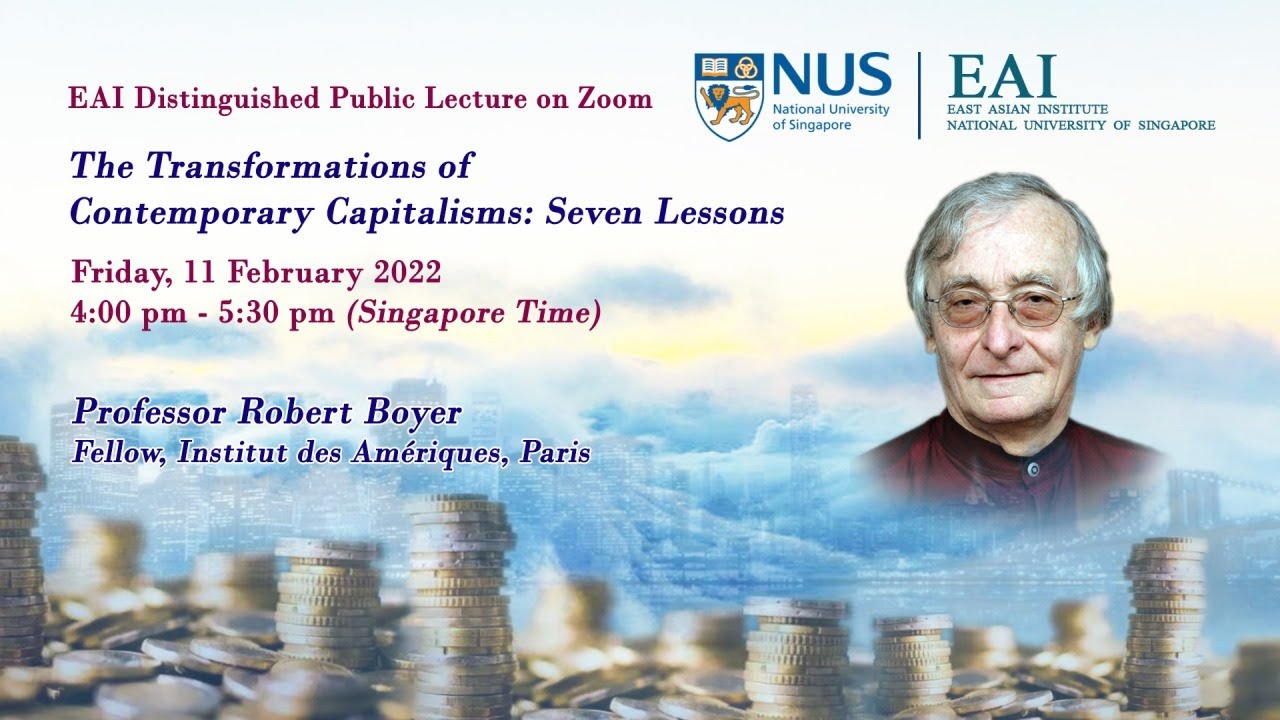
EAI Distinguished Public Lecture on Zoom
Organised by East Asian Institute, National University of Singapore
Topic:
The Transformations of Contemporary Capitalisms: Seven Lessons
Speaker:
Professor Robert Boyer
Fellow, Institut des Amériques, Paris
Date & Time:
Friday, 11 February 2022
4:00 pm – 5:30 pm (Singapore Time)
*****
Please visit https://research.nus.edu.sg/eai/wp-co... for the PowerPoint slides of this lecture.
*****
Abstract:
Capitalism is a constantly evolving socio-economic regime under two core mechanisms: endo-metabolism, the self-transformation of an autonomous system under endogenous forces, and hybridisation, the emergence of new configurations by failed attempts to mimic a canonical model. This vision inspired by régulation theory has generated a flow of investigations that suggest seven main teachings. First, East Asia has shown that the inevitability of underdevelopment could be overcome under favourable circumstances. Second, East Asian capitalisms are not a mere repetition of mature industrial ones, they display genuine institutional architectures. Third, a precise comparative analysis falsifies the hypothesis that geographical proximity implies similar capitalism brands that should converge in the long run. Fourth, the Chinese trajectory shows that a radically new configuration may emerge, built upon a surprising complementarity between typical capitalist competition and state’s ability to monitor technological catching up and even leapfrogging. Fifth, the patient building of complementarities between institutional forms, the productive system and specialisation imply more interdependence than frontal competition among the different socio-economic regimes provided that a stable international regime prevails. Sixth, a radical uncertainty about the future of international relations prevails because it is transformed under converging pressures: the limits reached by the global value chains, the rise of nationalist movements and governments and the diverging national interests concerning the design of new multipolar international regime. Seventh, almost all the past development strategies have to be reassessed especially those which used to rely on direct foreign investment coupled with export led growth as inward-looking development is now on top of many national agenda.
About the Speaker:
Robert Boyer is a French economist trained at Ecole Polytechnique, Sciences-Po Paris and Paris 1 University. Previously senior researcher at Centre National de la Recherche Scientifique (CNRS) and professor at École des Hautes Études en Sciences Sociales (EHESS), he is now Fellow at Institut des Amériques, Paris. He has developed an historical and comparative analysis of the institutional transformations of capitalism, under the label of Régulation theory. From Fordism to the finance-led regime, crises are recurring, but their forms change from one historical period to another. Systematic international comparisons converge towards a taxonomy of contemporary socioeconomic regimes and their growing interdependence within an unprecedented configuration of the world economy. This allows some prospective views, for instance about the next anthropogenetic model inspired by Japanese trajectory since 1945. Among his publications are Régulation Theory; the State of the Art (with Yves Saillard), Routledge, 2001, The Future of Economic Growth: As New Becomes Old, Edward Elgar, 2004, Les financiers détruiront-ils le capitalisme? Economica, 2011 and Economie politique des capitalismes, La Découverte, 2015. His most recent works deal with the consequences of COVID-19 on capitalist diversity, Les capitalismes à l’épreuve de la pandémie, La Découverte, 2020 and economic theorising Une discipline sans réflexivité peut-elle être une science? Epistémologie de l’économie, Editions de la Sorbonne, 2021. For more information, please check out http://robertboyer.org. He is one of the editors of Revue de la Régulation (https://journals.openedition.org/regu....
About the Moderator:
Prof Bert Hofman, a Dutch national, is Director of the East Asian Institute at NUS and Professor of Practice at the Lee Kuan Yew School of Public Policy. Before joining NUS, he was with the World Bank for 27 years, 22 of which in Asia, and 12 of which on China. Prof Hofman was the World Bank Country Director for China 2014-2019, the Country Economist 2004-2008, and the Chief Economist for the World Bank in the East Asia and Pacific region 2011-2014. He also worked on Indonesia, the Philippines, Korea and Mongolia. Before joining the World Bank, Prof Hofman worked at the Kiel Institute of World Economics, The OECD and NMB Bank (Now ING).
Please feel free to visit us at https://www.eai.nus.edu.sg. If you wish to subscribe to the emailing lists of EAI, please visit https://tiny.cc/eai-emailing. Thank you.

Информация по комментариям в разработке