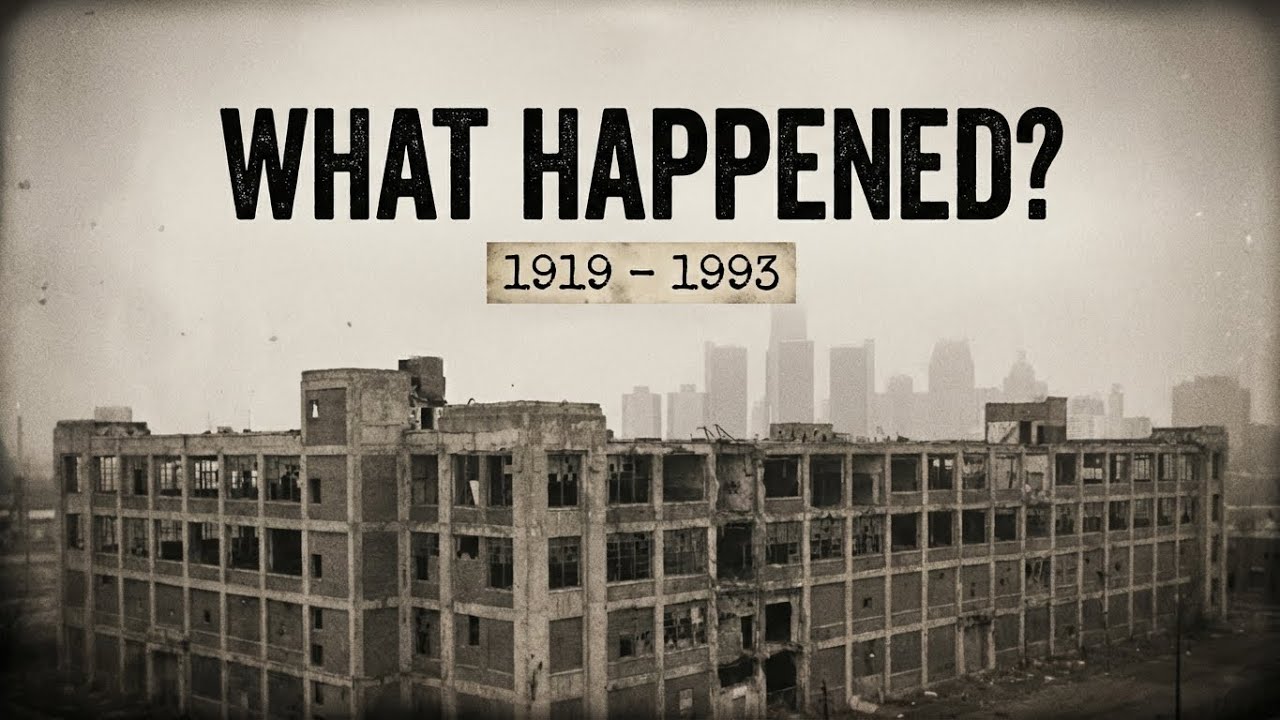
There is a cathedral of rust standing on the east side of Detroit, a monument to American industrial power that has been left to rot in silence. Fisher Body Plant 21 rises seven stories into the gray Michigan sky, its thousands of windows either broken or boarded over, its massive halls that once employed 5,000 workers now occupied only by pigeons, trees growing from its upper floors, and the overwhelming weight of silence. This is not a place that died suddenly—it died slowly, over decades, as Detroit itself died, as the promise of industrial prosperity was broken, as General Motors walked away and left this cathedral to collapse.
Built in 1921 by legendary industrial architect Albert Kahn, Fisher Body Plant 21 was once the beating heart of General Motors' manufacturing empire. This massive seven-story facility on Piquette Avenue produced automobile bodies for Chevrolet, Buick, and Cadillac—the vehicles that defined American prosperity and freedom throughout the 20th century. At its peak in the 1940s and 1950s, the plant employed over 5,000 workers who earned middle-class wages, bought homes in surrounding neighborhoods, raised families, and believed the promise that hard work and loyalty would be rewarded with security and dignity.
But that promise was broken. As Japanese competition eroded GM's market share, as the company prioritized short-term profits over long-term investment, as manufacturing moved to automated facilities in right-to-work states, Fisher Body Plant 21 began its long slow death. Employment declined through the 1980s and 1990s. Entire floors were abandoned. Equipment was stripped and sold. Workers were laid off in waves. On May 22, 2006, General Motors announced the plant would close permanently. The remaining 200 workers—men who had spent entire careers in this building—punched out for the final time, and GM walked away, leaving the massive structure to decay.
This atmospheric documentary takes you inside Fisher Body Plant 21 as it stands today: a seven-story ruin where trees grow from the upper floors, where ceilings have partially collapsed, where graffiti covers walls that once echoed with the sound of stamping presses and welding torches. We explore every floor from the flooded ground level to the apocalyptic seventh floor where the roof has failed and nature is reclaiming what humans built. We examine the artifacts left behind—rusted toolboxes, abandoned safety equipment, union stickers, time clocks frozen at the moment of closure—and reflect on what this ruin represents: the collapse of American manufacturing, the broken social contract between corporations and workers, the death of Detroit, and the impermanence of even the mightiest industrial empires.
Through detailed historical narrative, philosophical reflection, and melancholic urban exploration, this is the definitive account of Fisher Body Plant 21—a meditation on work, community, decline, and the ruins that remain when empires fall.

Информация по комментариям в разработке