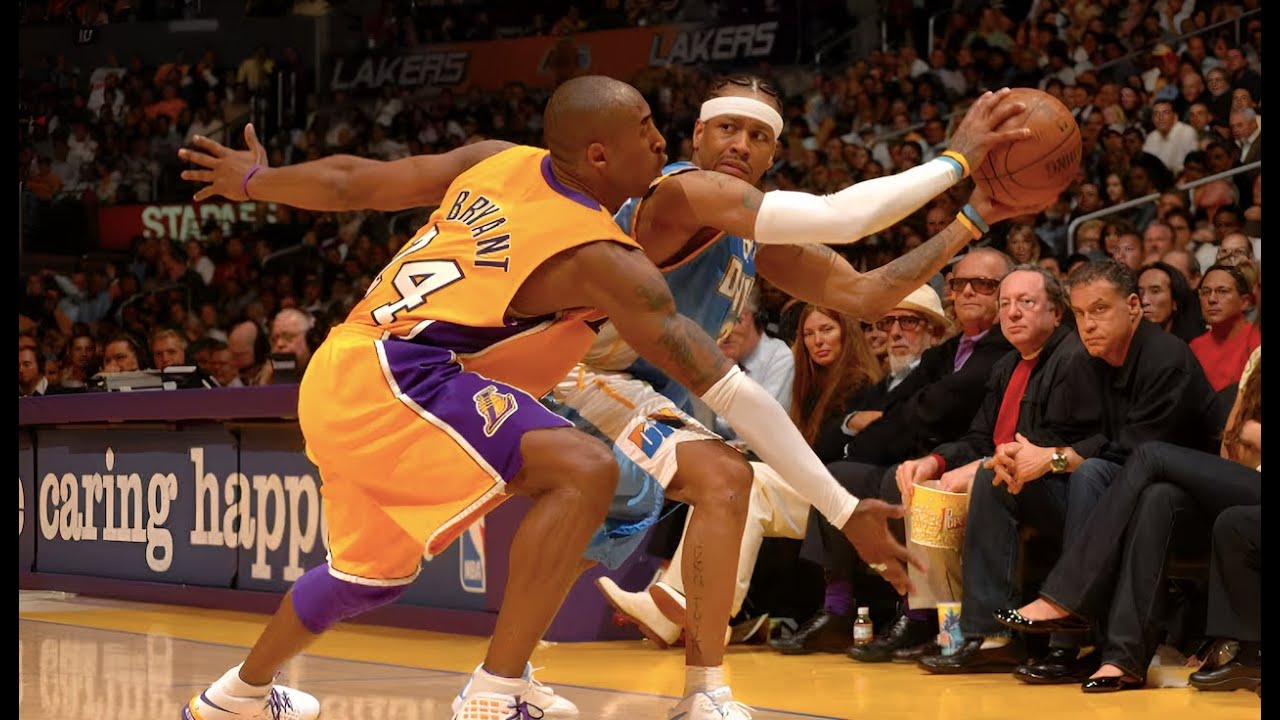
DEN 107, LAL 122 - At 32, Allen Iverson made his last 30-point playoff game in also his last playoffs series of his career came against Kobe Bryant, and it was a fitting conclusion given their history. In their early matchups, Bryant was so driven to beat Iverson that it fueled him to become a better defender and player.
Sidenote: In the thumbnail, Dad, with the long hair, is behind Jack. L-O-L.
Player of the game:
Kobe Bryant: 49 PTS, 18-27 FGM, 67 FG%, 5-9 3PM, 56 3P%, 8-9 FTM, 4 REB, 10 AST, 1 STL, 1 BLK
Notable performance:
Allen Iverson: 31 PTS, 10-21 FGM, 48 FG%, 1-6 3PM, 10-13 FTM, 1 REB, 6 AST, 3 STL
On November 12, 1996, Iverson scored 35 points, while Kobe managed only two in five minutes. Bryant recounted, “When I checked into my hotel room later that night and saw the 35 on SportsCenter, I lost it. I flipped the table, threw the chairs, broke the TV.” This frustration was further compounded by Iverson’s 41-point performance against him in Philadelphia in 1999.
This rivalry spurred Bryant to transform into the Black Mamba. “I obsessively read every article and book about AI,” Bryant explained. “I watched every game he had played, from the IUPUI All-American Game onward. I studied his every success and struggle, searching for any weakness I could find.” Reflecting on his growth, Bryant admitted, “I wasn’t satisfied after the win. I was frustrated that Iverson had made me feel that way in the first place. From that moment on, I vowed to treat every matchup as a matter of life and death. No one would ever have that kind of control over my focus again.”
Allen Iverson was voted an All-Star for both the 2008-09 and 2009-10 seasons, but his impact in his final All-Star game as a starter was negligible. He was also replaced in his last All-Star selection due to an injury, showing that he was a shadow of his former self. A serious back injury in February 2009 led to his deactivation, and conflicts with the Detroit Pistons' management arose when he refused to come off the bench, believing he could still be the team's franchise player. Iverson was traded to the Memphis Grizzlies and played just three games before returning to the Philadelphia 76ers, where he had started his career. He received a standing ovation both upon his return to Philadelphia and in his final game.
Allen Iverson's career was marked by both extraordinary achievements and notable controversies, yet he remains one of the greatest NBA players pound for pound. Known for his electrifying scoring ability, tenacious defense, and unwavering determination, Iverson captivated fans with his relentless drive and skill on the court. Despite facing conflicts with management, issues off the court, and struggles with injuries, his impact on the game is undeniable. Iverson's legacy is defined by his unmatched versatility and the indelible mark he left on the league, earning him a place among the all-time greats in basketball history.
During his career as the franchise of the Philadelphia 76ers from 1996-97 to 2005-06, Iverson averaged 26.8 points, 42 FG%, 31.3 3 P%, 78.2 FT%, 3.7 rebounds, 6.2 assists, 2.2 steals, and 3.6 turnovers, showcasing his scoring prowess, playmaking skills, and defensive abilities.
Allen Iverson's career achievements include:
11× NBA All-Star (2000–2007, 2009–2010)
4× NBA Scoring Champion (1999, 2001, 2002, 2005)
1× NBA Most Valuable Player (2001)
3× All-NBA First Team (2001, 2002, 2005)
2× All-NBA Second Team (2003, 2006)
1× All-NBA Third Team (2004)
1× NBA All-Defensive Second Team (2005)
NBA Rookie of the Year (1997)
NBA Finals Appearance (2001, with the Philadelphia 76ers)
Olympic Bronze Medalist (2004, as a member of the U.S. National Team)
2 x NBA All-Star Game MVP (2001, 2005)
Iverson is a member of the Naismith Memorial Basketball Hall of Fame, inducted in 2016. His impact on the game is further highlighted by his influence on the style of play and his iconic role in the sport.

Информация по комментариям в разработке