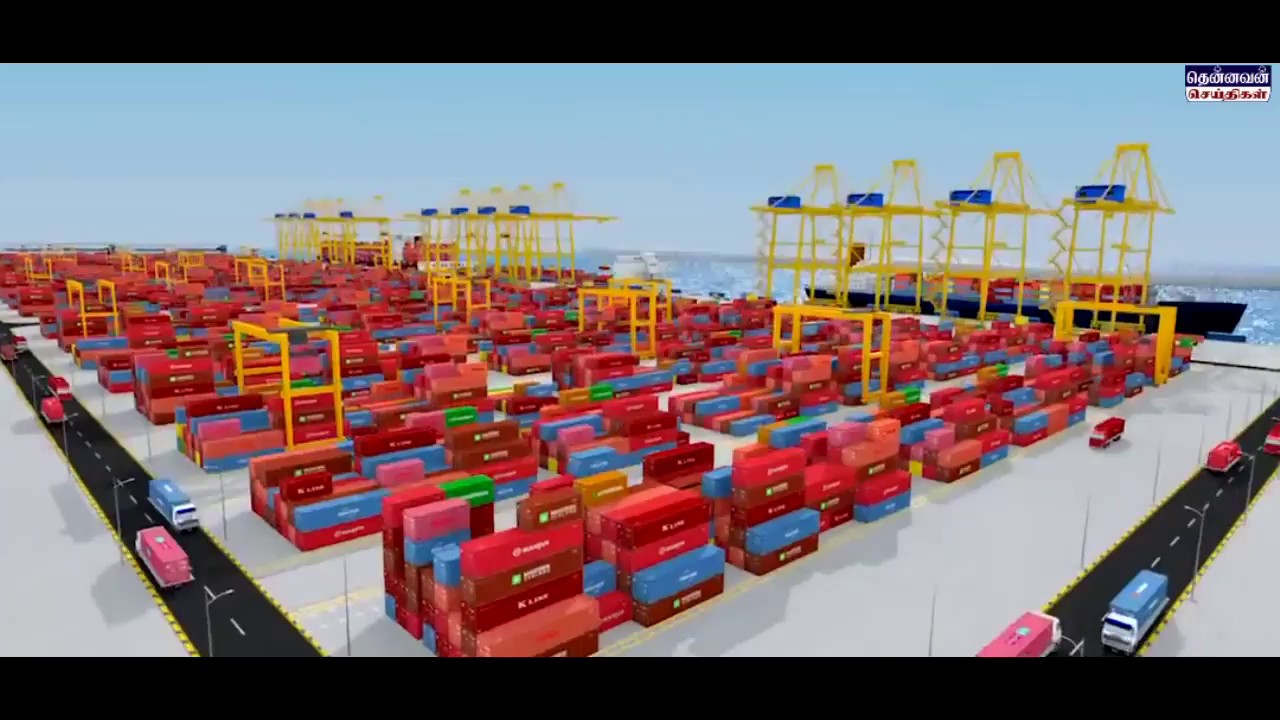
enayam port | colachal harbor | இனையம் துறைமுக எதிர்ப்பு | thennavan tv | The confusion and controversy surrounding a port proposed to be set up at Enayam in Kanyakumari district, Tamil Nadu, refuses to subside. To be developed as a major international port, the Enayam International Container Trans-shipment Terminal, or the Enayam port, has been struggling since the 1990s. This was when the initial technical and economic feasibility studies for developing a port at Colachel (near Enayam) were carried out by the state government “to support industrial growth”.
After having been in limbo for almost 20 years, the Enayam port project was revived two years ago, when the Union cabinet approved the setting up of a new major trans-shipment port at Enayam to make “India a destination on the global east-west trade route” in principle.
The shipping ministry hired a consultant to prepare a fresh feasibility report. It was submitted in August 2015, and said that the “development of a deep Sea Port at Enayam near Colachel to handle larger Container vessels up to 18,000 TEUs [twenty-foot equivalent, a unit of container ship capacity] with 16m draught is technically feasible and financially viable”.
The port is to be built in three phases from 2017 to 2030 at a total cost of Rs 27,570 crore. The 840-acre piece of land for it is to be reclaimed from the sea through dredging. The detailed project report (DPR) of the Enayam port is expected to be finalised by this year’s end, after which the tender process for the construction of breakwaters and dredging is expected to begin.
However, shipping industry experts have been sounding notes of caution. “There are already two trans-shipment ports, Vallarpadam port in Cochin and the under-construction Vizhinjam port in Trivandrum. The proposed Enayam port is the third major trans-shipment port in the region. Having three major ports close to each other looks difficult from a sustenance point of view,” K. Ravichandran, the senior vice-president and sector head of corporate ratings at ICRA Ltd., an independent credit-rating agency, told The Wire.
The Kerala government has already expressed its displeasure at the Enayam port having received the go-ahead because it is barely 36 km away from the Vizhinjam trans-shipment port, which is being built with private funds from the Adani Ports and Special Economic Zone Ltd. (APSEZ). In turn, the Vizhinjam port is about 225 km from the government-owned Vallarpadam port, where the Dubai-based company DP World has been operating India’s first container trans-shipment terminal for the last six years. And according to the Indian Container Market Report 2017, the Vallarpadam trans-shipment port is running at only 49% of its total installed capacity.
There is already an oversupply in the global shipping market and some container companies have already gone bankrupt, Ravichandran said. The present container rates are not remunerative, so shipping liners very carefully control their the costs. “Realistically speaking, three trans-shipment ports close to each other are not needed. Maybe we can manage two – Vallarpadam and Vizhinjam. But these ports will also take a minimum of five to ten years to make any difference in the country’s trans-shipment business,” he explained.
The Enayam port has also been facing stiff opposition from local fishers, who fear the dredging and reclamation will adversely impact their livelihoods. “The coastal stretch where Enayam port is proposed has a fishers population of 1,101 per square kilometre. More than one lakh fishers are dependent on the sea for their livelihood,” said R.S. Lal Mohan, the chairperson of Conservation of Nature Trust, a non-profit based in Nagercoil, and a former scientist at the Indian Council of Agriculture Research. “The consultants tried surveying the area for preparation of DPR but the local people drove them away.”
Need for a trans-shipment port
In 2016, Indian ports handled about 11.3 million TEUs of containers, of which nearly 70% was gateway container cargo and 25% trans-shiped en route to a different destination. Trans-shipment is the act of off-loading a container from a large container ship (generally at a hub port) and loading it onto a second, smaller ship to be carried to the final port of discharge.
Global vessel sizes have significantly increased in the last decade and most main liner vessels have capacities of 10,000 TEUs or more, with the largest vessel reaching a capacity of 18,000 TEUs. Large container ships need deep-draft ports of depth 18-20 metres to berth and move containers.
India’s extant major ports do not have such deep drafts, so a quarter of all containers are trans-shipped through ports in other countries. Colombo (Sri Lanka), Singapore and Klang (Malaysia) handle more than 80% of India’s trans-shipment cargo; of them, Colombo alone handles about 43%.
Trans-shipment adds to the cost of handling cargo

Информация по комментариям в разработке