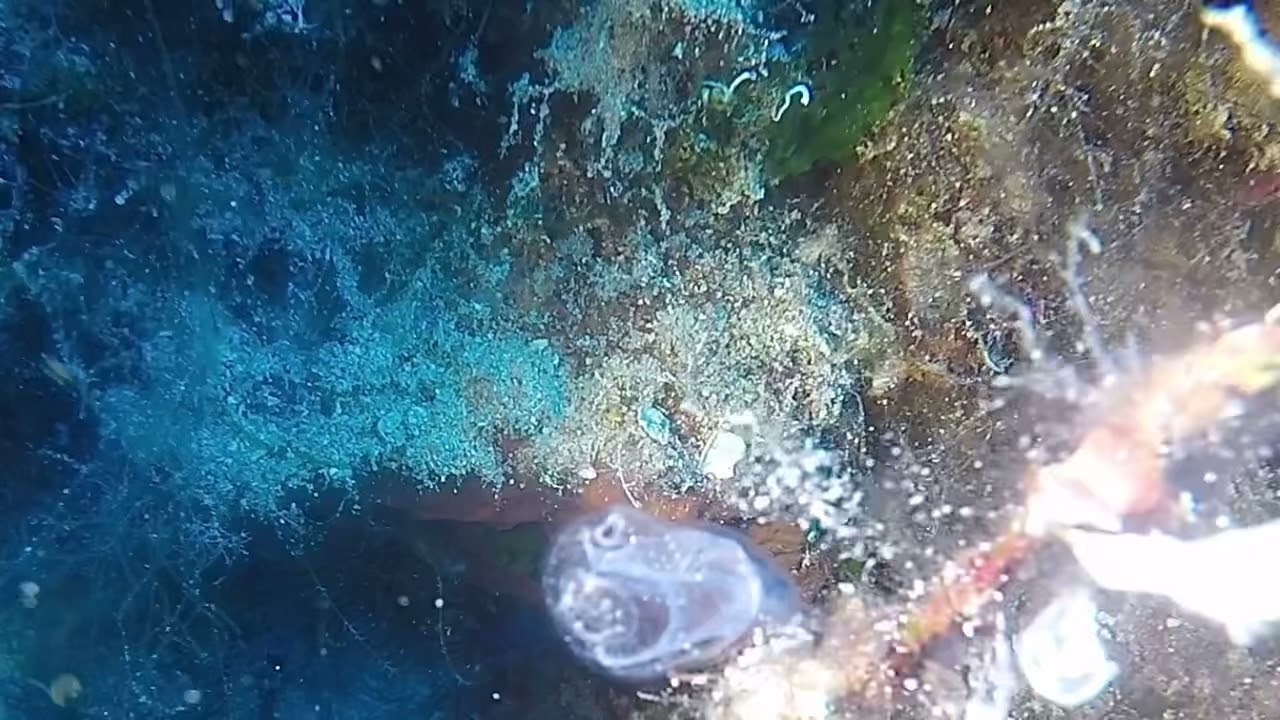
Clavelina lepadiformis, light-bulb sea squirt
💡
Clavelina lepadiformis is a colonial sea squirt that grows up to 20 mm high. Groups of transparent zooids are joined at the base by short stolons. In the Mediterranean the eggs and embryos are most often yellowish white and sometime pink although in other areas in NW Europe they can also be red (Fish & Fish, 1996). Zooids possess a white ring around the pharynx, and have pale yellow or white longitudinal lines along the endostyle and dorsal lamina.
A tunicate is a marine invertebrate animal, a member of the subphylum Tunicata. It is part of the Chordata, a phylum which includes all animals with dorsal nerve cords and notochords (including vertebrates). They are the only chordates that have lost their myomeric segmentation, with the possible exception of the 'seriation of the gill slits'.
Tunicates contain a host of potentially useful chemical compounds, including:
Didemnins, effective against various types of cancer, as antivirals and as immunosuppressants
Aplidine, a didemnin effective against various types of cancer; as of late January 2021 undergoing Phase III trials as a treatment for COVID-19
Trabectedin, another didemnin effective against various types of cancer
Tunicates are able to correct their own cellular abnormalities over a series of generations, and a similar regenerative process may be possible for humans.
Some tunicates live as solitary individuals, but others replicate by budding and become colonies, each unit being known as a zooid. They are marine filter feeders with a water-filled, sac-like body structure and two tubular openings, known as siphons, through which they draw in and expel water. During their respiration and feeding, they take in water through the incurrent (or inhalant) siphon and expel the filtered water through the excurrent (or exhalant) siphon. Most adult tunicates are sessile, immobile and permanently attached to rocks or other hard surfaces on the ocean floor.
The earliest probable species of tunicate appears in the fossil record in the early Cambrian period. Despite their simple appearance and very different adult form, their close relationship to the vertebrates is evidenced by the fact that during their mobile larval stage, they possess a notochord or stiffening rod and resemble a tadpole. Their name derives from their unique outer covering or "tunic", which is formed from proteins and carbohydrates, and acts as an exoskeleton. In some species, it is thin, translucent, and gelatinous, while in others it is thick, tough, and stiff.
About 3,000 species of tunicate exist in the world's oceans, living mostly in shallow water. The most numerous group is the ascidians; fewer than 100 species of these are found at depths greater than 200 m.
Tunicates are more closely related to craniates than to invertebrates.
By far the largest class of tunicates is the Ascidiacea. The body of an ascidiacean is surrounded by a test or tunic, from which the subphylum derives its name. The tunic is composed of proteins and complex carbohydrates, and includes tunicin, a variety of cellulose. The tunic is unique among invertebrate exoskeletons in that it can grow as the animal enlarges and does not need to be periodically shed.
Tunicates have a well-developed heart and circulatory system. The heart is a double U-shaped tube situated just below the gut. The blood vessels are simple connective tissue tubes, and their blood has several types of corpuscle. The blood may appear pale green, but this is not due to any respiratory pigments, and oxygen is transported dissolved in the plasma. Exact details of the circulatory system are unclear, but the gut, pharynx, gills, gonads, and nervous system seem to be arranged in series rather than in parallel, as happens in most other animals. Every few minutes, the heart stops beating and then restarts, pumping fluid in the reverse direction.
Tunicate blood has some unusual features. In some species of Ascidiidae and Perophoridae, it contains high concentrations of the transitional metal vanadium and vanadium-associated proteins in vacuoles in blood cells known as vanadocytes. Some tunicates can concentrate vanadium up to a level ten million times that of the surrounding seawater. It is stored in a +3 oxidation form that requires a pH of less than 2 for stability, and this is achieved by the vacuoles also containing sulfuric acid. The vanadocytes are later deposited just below the outer surface of the tunic, where their presence is thought to deter predation, although it is unclear whether this is due to the presence of the metal or low pH. Other species of tunicates concentrate lithium, iron, niobium, and tantalum, which may serve a similar function. Other tunicate species produce distasteful organic compounds as chemical defenses against predators.
Sources: https://en.m.wikipedia.org/wiki/Tunicate, https://www.marlin.ac.uk/species/deta...
—-
Adriatic Sea, Dalmatia, 2021 Croatia

Информация по комментариям в разработке