So we need to work out 186 times 94, but before we do that, let’s estimate our answer. How can we do that? Well, if we round 186 to the nearest 100, []we get 200, and then if we round 94 to the nearest 10, []we get 90. So what is 200 times 90? []It’s 18000, []because 2 times 9 is 18,[] []and then because we have a total of three end-zeros in the question, two here and one here, we need three end-zeros in our answer.[] So now we can work out 186 times 94, and we know that our answer should be something close to 18000. So 6 times 4 is [][]24, 8 times 4 is 32, plus 2 is [][]34, and 1 times 4 is 4, plus 3 is []7. []Now we can cross out our working []and write a 0 in our units column. 6 times 9 is [][]54, 8 times 9 is 72, plus 5 is [][]77, and 1 times 9 is 9, plus 7 is []16. Now we can add up our totals, so 4 plus 0 is []4, 4 plus 4 is []8, 7 plus 7 is [][]14, 1 plus 6 is []7 and nothing plus 1 is []1. []So our answer is 17484, and as that’s close to our estimation, we can be fairly sure we’ve got the right answer. It’s useful to estimate first, because imagine if we had forgotten that we need this 0 in the units: we would be adding 744 and 1674, so when we got our answer, we would realise that it wasn’t close to 18000 so we would know we had made a mistake.[]
Now, again, let’s round first to estimate. What is 641 rounded to the nearest 100? []That’s 600. And what is 63 rounded to the nearest 10? []That’s 60. So what is 600 times 60? []We have 36000, []because 6 times 6 is 36[] []and we know that if we have a total of three end-zeros in our question, we need three end-zeros in our answer.[] But is 36000 an under-estimation or an over-estimation? Do you think our actual answer will be larger than 36000 or smaller than 36000? Well, to get 600 times 60, we rounded both numbers down, so that means our actual answer will be larger than 36000. So now let’s work out our answer.1 times 3 is []3, 4 times 3 is [][]12 and 6 times 3 is 18, plus 1 is []19. []Now we cross out our working, []write a 0 in our units column, and now 1 times 6 is []6, 4 times 6 is [][]24 and 6 times 6 is 36, plus 2 is []38. Now, adding up our answers, 3 plus 0 is []3, 2 plus 6 is []8, 9 plus 4 is [][]13, 1 plus 1 plus 8 is [][]10, and 1 plus 3 is []4. []So our answer is 40383, so that’s close to our estimation, and like we expected, it’s a larger number than our estimate, because to estimate for this question we rounded both numbers down.[]
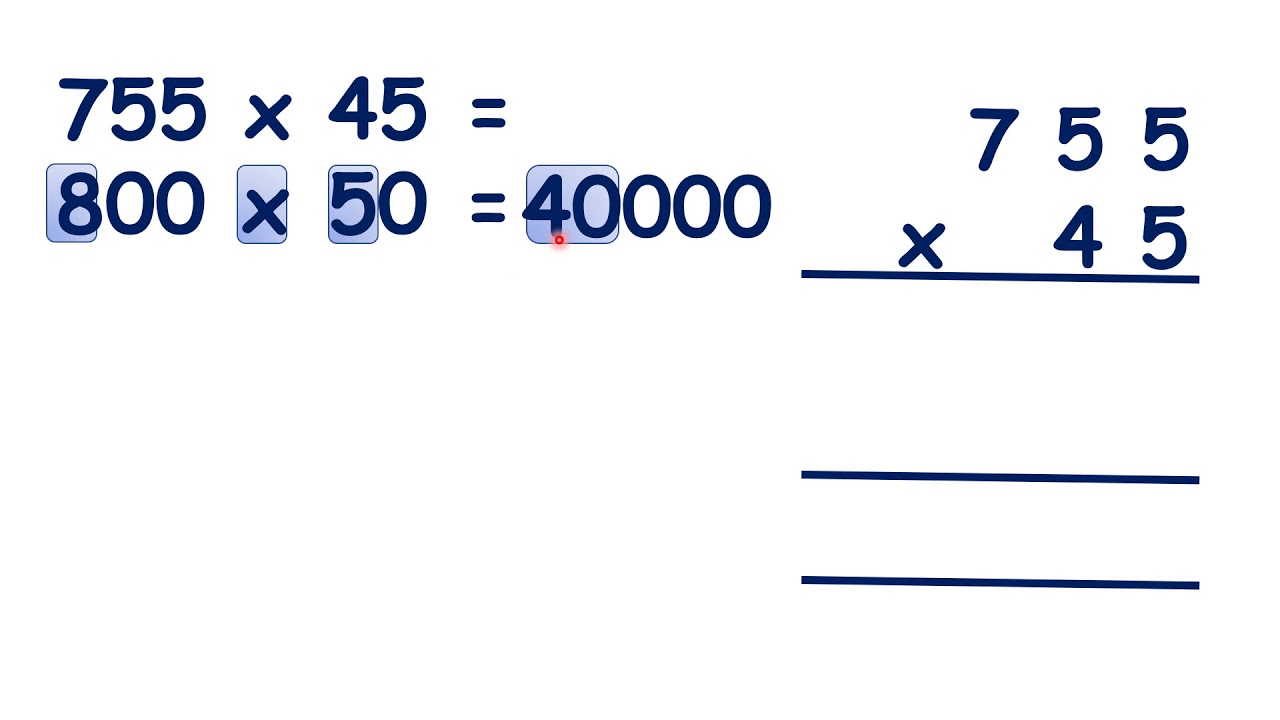
So pause the video, and write your estimate to 755 times 45, and see if you can explain whether you expect the actual answer to be larger or smaller than your estimate. Well, 755 rounded to the nearest hundred is []800, and 45 rounded to the nearest 10 is []50. Now if we work out 800 times 50, []we get 40000. []That’s because 8 times 5 is 40 – and it’s important to understand that this 0 here isn’t an end-zero, it’s just what we get by multiplying 8 by 5. But after we’ve written 40, [][]we need to count our end-zeros, and because there are three end-zeros in the question, we need three end-zeros in our answer.[] So we can expect our answer to 755 times 45 to be close to 40000 – but in fact, we can expect our answer to be slightly less than 40000, because we rounded both numbers up. So now let’s find our answer. 5 times 5 is [][]25, 5 times 5 is 25, plus 2 is [][]27, and 7 times 5 is 35, plus 2 is []37. []Now we can cross out our working []and write a 0 in our units. 5 times 4 is [][]20, 5 times 4 is 20 plus 2 is [][]22 and 7 times 4 is 28, plus 2 is []30. [][][][][]Now if we add up our totals, we can see that our final answer is actually quite a lot less than 40000 – []but it’s still the correct answer because, remember, to get our rounded answer, we had to round both numbers up, so 800 is 45 more than 755, and 50 is 5 more than 45, so we would expect our rounded estimate to be an over-estimate.[]

Информация по комментариям в разработке