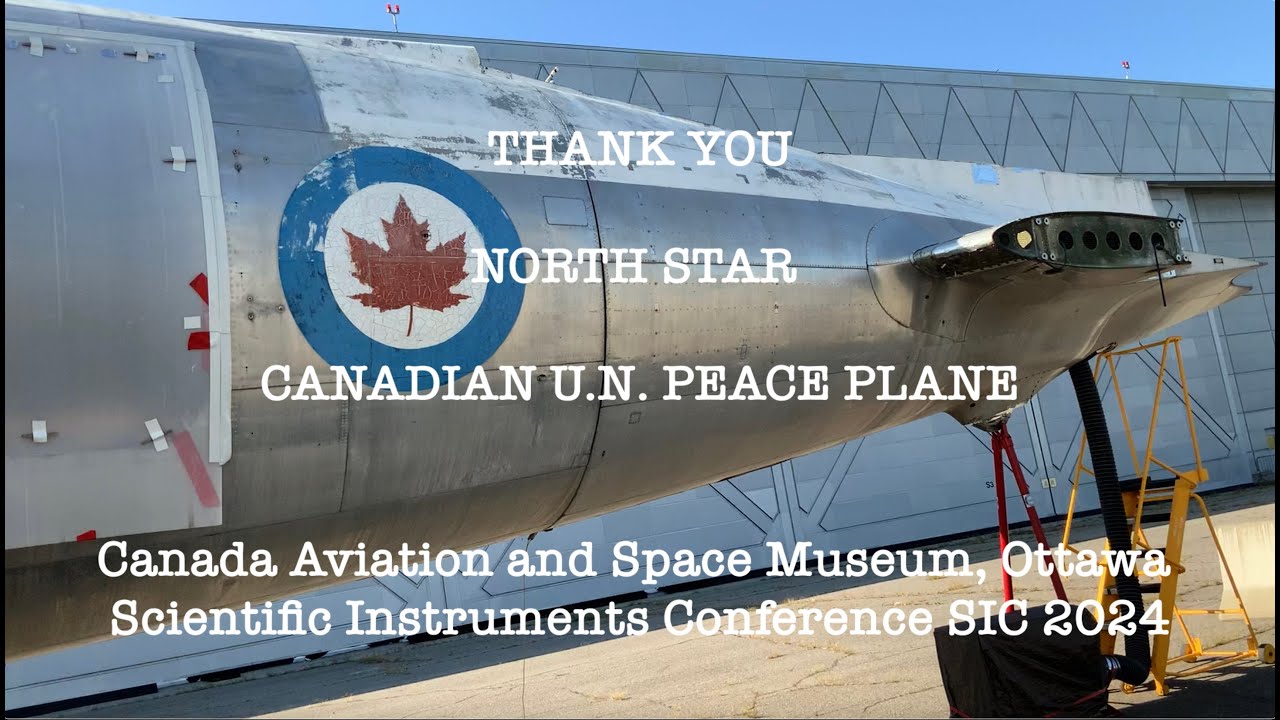
The North Stars, winged workhorses used on domestic and international routes, took flight in 1946. In 1949 RCAF North Star 17512 flew Vancouver to Halifax in 8’32’’, the first non-stop Canada flight. North Stars “Argonauts” served northern supply, research, training, relief missions, UN, NATO and Korean War operations.
In 1960 North Stars served in Congo UN operations to: "take immediately all appropriate measures to prevent the occurrence of civil war in the Congo, including arrangements for ceasefire, the halting of all military operations, the prevention of clashes, and the use of force, if necessary, in the last resort.”
Canadair built 71 North Stars: DC-4M, C-4, C-5 long range carrying ability for the Royal Canadian Airforce. One surviving airframe, 1948 RCAF C-54 GM 17515, is being restored at the Canada Aviation and Space Museum in Ottawa, Ontario, Canada, by dedicated volunteers for the Project North Star Association of Canada, PNSAC. They are
While searching her hidden past, the volunteers’ aircraft restoration obsessively strives to maintain her quality standards in the most minute details, while still providing an understanding and appreciation of her concealed effacing service scars, to give her life as she enters new future horizons.
https://www.projectnorthstar.ca/
The Coming of Independence p. 63
Mahatma Gandhi ignited the tide of independence movements in European colonies, an example to copy for the African continent…The movement reached the Belgian Congo, where Casa Vubu, a Mukongo… emerged as the political independence leader.
Patrice Lumumba, a young Batetela, soon joined Casa Vubu, the wise old man….
Lumumba and King Baudoin in town
The press announced that Lumumba was coming to visit the town. By this time Lumumba had already become famous as a seductive mover. He chose Stanleyville as his headquarters.
The local population broke into a frenzy upon hearing the announcement…
The white population became tense, prepared for the worst. A large crowd gathered at the airport, waiting for Lumumba's arrival.
I watched the scene from the control tower. Upon landing Lumumba was greeted with fanfare by supporters stationed on the tarnac, and invited into the back seat of a large convertible car where a well-rounded voluptuous girl was waiting for him. In her company Lumumba was triumphantly driven into town.
Next the African population started rioting. Before things got out of hand, the security forces managed to contain and cool down the outbreak.
A different illustrious Stanleyville visitor was Belgium’s King Baudoin. The King wanted to see first hand the events in the Colony…
The troops of the Force Public were nicely lined up on the tarmac for the King's arrival. The military band, in full decor, stood next to the control tower. The dignitaries of the Province, with the Governor in the lead, stood in the back in the shade of the trees inside the airport fence. On the road outside the fence a great crowd of Africans had gathered in colorful costumes, some representing organizations, carrying sign with greeting and with slogans. the air was full of suspense and expectations.
The royal airplane, a DC6, rolled to a stop, and the King, dressed in a light white uniform, descended to the tarmac. The dignitaries greeted him, while the sale was fired from the ceremonial canons in the nearby meadows. The King was then led to review the troops, while the band fervently played martial tunes. The official ceremonies seemed too slow for the restive crowd outside the fence. As yet, peaceful and mostly curious, the crowd began breaking through the fence, invading the tarmac, and surrounding the royal escort.
The situation soon got out of hand, becoming threatening. The troops were called to chase out the invaders. The review ended abruptly. the King was rushed to a car. The royal convoy departed forcing its way through an increasingly frenzied crowd.
Curiously impassive to all this tumult, the band, imperturbable, just played on.
…
My experience with war, collapse and chaos in Hungary in 1945 proved to be helpful now in confronting the turbulent times…
Those who did not want to believe in the reassuring statements of the officialdom, had been pressing for permission to evacuate their families before the storm. I belonged to this group, which became as “the Panicards.” (those who overreact and panic)
News of isolated rioting here and there, with stories about attendant atrocities began to arrive. In the light of this, the government could not refuse to organize the evacuation of families for those who so requested.
…In April the family left on a UN Canadian North Star.
The plane took off on a sunny afternoon and I was left alone to stand by my post.
The Guy from the Soviet Union p.68
At noon one day, when I returned home for lunch, I saw….
Volume 3, The African Passage — Francis Soges

Информация по комментариям в разработке