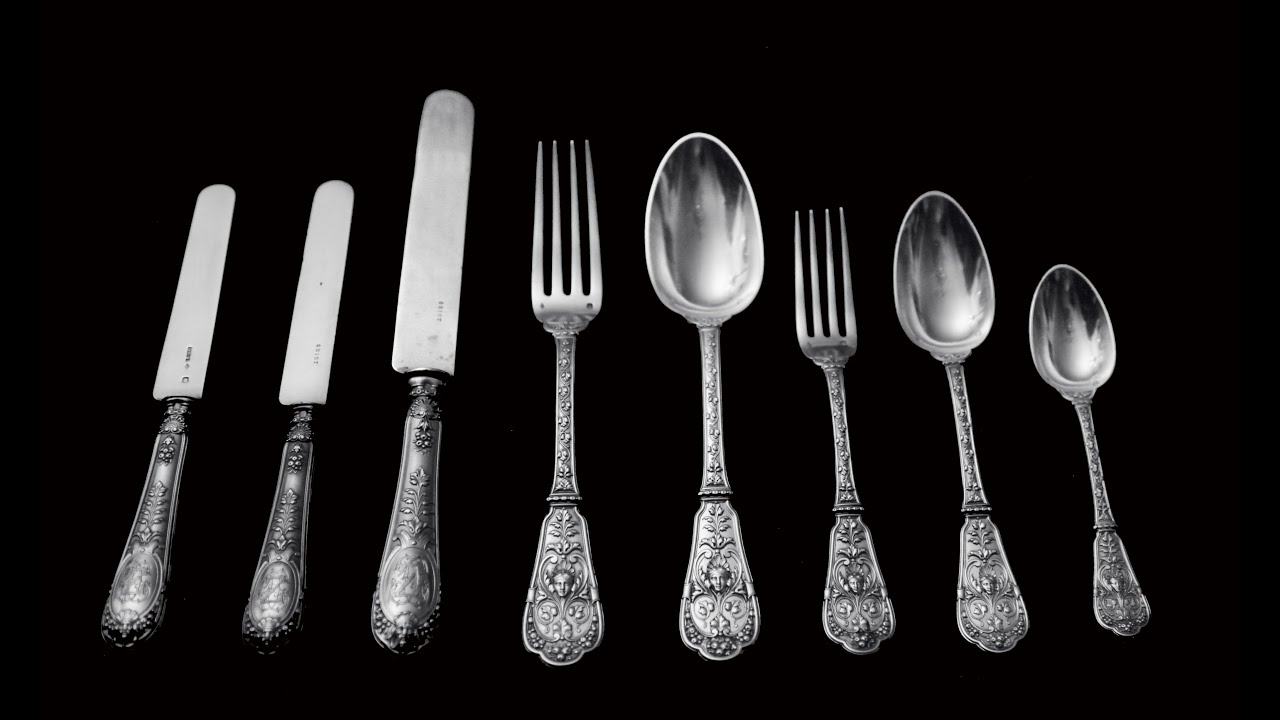
Direct from Paris, a magnificent 184pc. antique French sterling silver flatware set by renowned French silversmith “Odiot” in their much sought after “Chateaubriant” pattern in excellent condition and includes original custom made, 4-tiered storage chest. Includes two sets of knives - one set with sterling silver handles and the other set with Mother-or-Pearl handles, two sets in one - RARE.The name Odiot is synonymous with the pinnacle of French silversmithing, encapsulating a heritage of luxury, craftsmanship, and artistic excellence that has spanned centuries. From its inception in the 17th century to its modern-day prominence, Odiot has remained a beacon of superior quality in the world of silverware, cherished by royalty and connoisseurs alike.
The Odiot legacy began in 1690 with Jean-Baptiste Gaspard Odiot, who established the family business in Paris. As a silversmith, he quickly garnered attention for his exceptional skill and innovative designs. However, it was his grandson, Jean-Baptiste Claude Odiot (1763-1850), who elevated the family name to international acclaim. Jean-Baptiste Claude took over the family workshop during a period of significant political and social upheaval in France—the time of the French Revolution and the Napoleonic Wars. Despite these challenges, he managed to not only sustain the business but also to expand it significantly. His reputation for creating extraordinary pieces in the Empire style—characterized by its grandeur, classical motifs, and opulence—attracted the attention of Napoleon Bonaparte himself. Jean-Baptiste Claude Odiot became the official silversmith to the Emperor, and this royal patronage catapulted the Odiot name into the annals of French history. Under the leadership of Jean-Baptiste Claude, the Odiot workshop produced some of the most exquisite pieces of silverware ever seen, many of which were commissioned by Napoleon for himself, his family, and his court. These pieces were not merely functional objects but works of art, embodying the splendor and power of the Napoleonic Empire.
Odiot’s reputation for quality and craftsmanship is built on centuries of dedication to the highest standards of silversmithing. The firm's artisans have always been known for their meticulous attention to detail, their mastery of traditional techniques, and their ability to innovate within the craft. Each piece of Odiot silverware is a testament to the skill and artistry of the silversmiths who create them. In addition to their use of superior materials, Odiot is also known for their exceptional design and execution. The firm’s designs often draw on historical styles, particularly the Empire, Renaissance, and Rococo styles, which are characterized by intricate detailing, classical motifs, and a sense of grandeur. However, Odiot’s
artisans are not mere imitators of past styles; they are innovators who bring their own creativity and vision to each piece they create. One of the most notable aspects of Odiot’s craftsmanship is their ability to combine form and function. While their pieces are undoubtedly works of art, they are also designed to be used and enjoyed. Whether it is a lavishly decorated tea set or a simple flatware set, each piece is crafted with the user in mind, ensuring that it is as functional as it is beautiful.
Royal patronage has played a crucial role in the history and success of Odiot. From the time of Napoleon Bonaparte, who appointed Jean-Baptiste Claude Odiot as his official silversmith, the Odiot firm has been associated with the highest levels of power and prestige. Napoleon’s patronage was not only a mark of the firm’s excellence but also a significant factor in its growth and success. The Emperor commissioned numerous pieces from Odiot, including a famous set of gold flatware that was used at his coronation banquet. These commissions were not only lucrative but also helped to establish Odiot’s reputation as one of the finest silversmiths in Europe. The firm’s association with royalty did not end with Napoleon. Throughout the 19th and 20th centuries, Odiot continued to receive commissions from royal families and aristocrats across Europe. Among their most famous patrons were Louis XVIII, Charles X, and Louis-Philippe of France, as well as Tsar Alexander I of Russia and King William IV of the United Kingdom. These royal commissions often involved the creation of elaborate and luxurious pieces, such as large table services, tea sets, and ceremonial objects. The fact that Odiot was chosen to create these pieces is a testament to the firm’s reputation for quality and craftsmanship. Royal patronage not only provided financial support but also served as an endorsement of the firm’s excellence, helping to attract other high-profile clients and secure Odiot’s place in history.
Among the many magnificent creations of Odiot, the Chateaubriant pattern stands out as one of the most sought-after and admired.

Информация по комментариям в разработке