Logo video2dn
  • Сохранить видео с ютуба
  • Категории
    • Музыка
    • Кино и Анимация
    • Автомобили
    • Животные
    • Спорт
    • Путешествия
    • Игры
    • Люди и Блоги
    • Юмор
    • Развлечения
    • Новости и Политика
    • Howto и Стиль
    • Diy своими руками
    • Образование
    • Наука и Технологии
    • Некоммерческие Организации
  • О сайте

Скачать или смотреть The ‘Pathogen Access and Benefit-Sharing System’ in the Pandemic Treaty - Dr Michelle Rourke

  • IP Observatory
  • 2024-03-13
  • 293
The ‘Pathogen Access and Benefit-Sharing System’  in the Pandemic Treaty - Dr Michelle Rourke
pandemic treatyaccess to genetic resourcesbenefit-sharingintellectual propertycovid-19access to essential medicines
  • ok logo

Скачать The ‘Pathogen Access and Benefit-Sharing System’ in the Pandemic Treaty - Dr Michelle Rourke бесплатно в качестве 4к (2к / 1080p)

У нас вы можете скачать бесплатно The ‘Pathogen Access and Benefit-Sharing System’ in the Pandemic Treaty - Dr Michelle Rourke или посмотреть видео с ютуба в максимальном доступном качестве.

Для скачивания выберите вариант из формы ниже:

  • Информация по загрузке:

Cкачать музыку The ‘Pathogen Access and Benefit-Sharing System’ in the Pandemic Treaty - Dr Michelle Rourke бесплатно в формате MP3:

Если иконки загрузки не отобразились, ПОЖАЛУЙСТА, НАЖМИТЕ ЗДЕСЬ или обновите страницу
Если у вас возникли трудности с загрузкой, пожалуйста, свяжитесь с нами по контактам, указанным в нижней части страницы.
Спасибо за использование сервиса video2dn.com

Описание к видео The ‘Pathogen Access and Benefit-Sharing System’ in the Pandemic Treaty - Dr Michelle Rourke

Intellectual Property and Public Health: Symposium — 8 December 2023

Australian Centre for Health Law Research

QUT Faculty of Business and Law

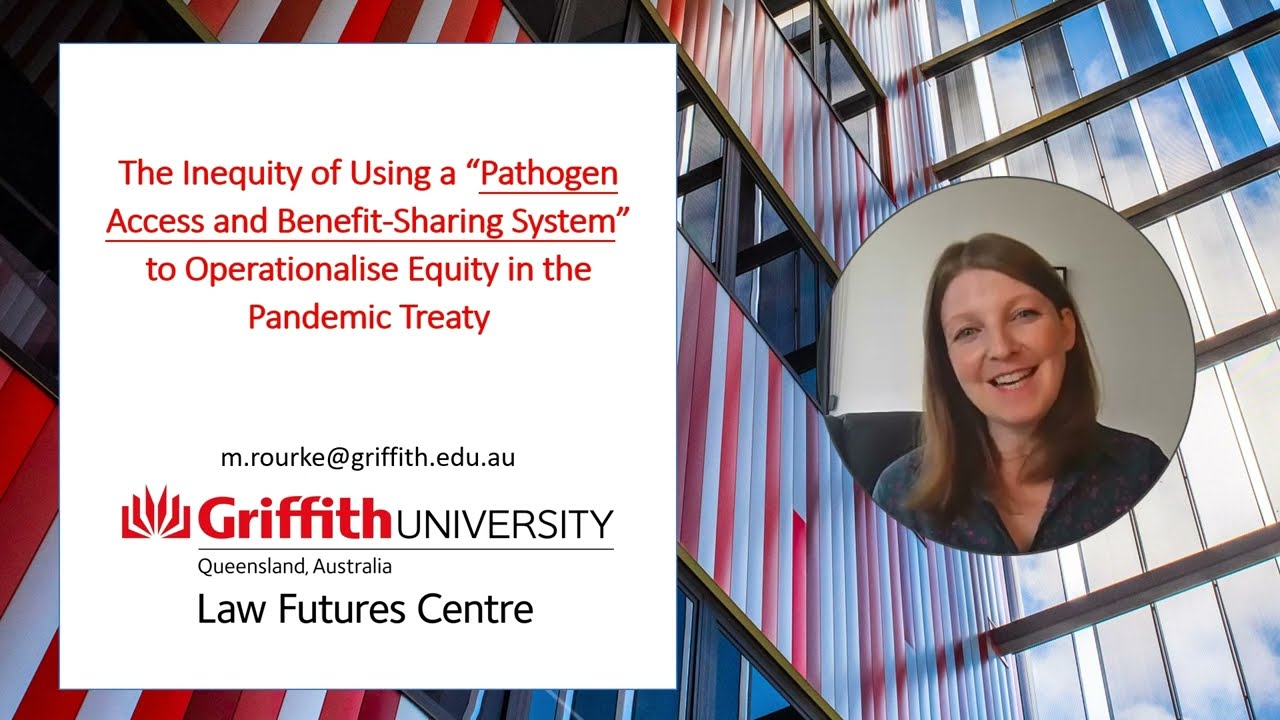
15. The Inequity of Using a ‘Pathogen Access and Benefit-Sharing System’ to Operationalise Equity in the Pandemic Treaty
Dr Michelle Rourke, Griffith University (via video)

Abstract

The World Health Organisation’s (WHO) International Negotiating Body (INB) has until May 2024 to deliver a “convention, agreement or other international instrument on pandemic prevention, preparedness and response” (“Pandemic Treaty”). With developing countries unlikely to get any concessions on intellectual property, their negotiating efforts are now directed towards a pathogen access and benefit-sharing system. Access and benefit-sharing (ABS) was designed in the late 1980s to incentivise biodiversity conservation and sustainable development. These are very different problems to those that a proposed pathogen ABS system seeks to address:

Under the current iteration of the International Health Regulations (2005), there is no obligation for WHO Member States to share pathogen samples or associated genetic sequence data with the global scientific community. Low and middle-income countries (LMICs) are at the highest risk for pathogen emergence. High-income countries (HICs) require samples and sequence data to track the spread of pathogens, and to develop and test medical countermeasures like diagnostics and vaccines.
LMICs did not get adequate access to medical countermeasures during the COVID-19 pandemic, with HICs hoarding more vaccine doses than required to protect their populations.
Proponents of a pathogen ABS system state that it would secure access to pathogen samples for HICs and deliver a fairer share of medical countermeasures for LMICs. The reasoning goes: pathogens are a type of genetic resource and countries have sovereign rights over genetic resources under the United Nations’ Convention on Biological Diversity (CBD; 1992). Under the CBD, countries should facilitate access to their sovereign genetic resources in exchange for a share of the benefits associated with their use in R&D. Therefore, when countries share their pathogens with the international scientific community they should get a share of the diagnostics, vaccines, medications and/or profits (benefits) that are generated using those pathogen samples. Thus, proponents argue that a specialised multilateral pathogen ABS system under the WHO’s Pandemic Treaty would help to realise the Treaty’s overarching goal of equity.

At first blush, this quid pro quo may seem like a fair (if convoluted) mechanism to ensure that LMICs provide their pathogen samples and secure much-needed medical countermeasures in the event of a pandemic. But this transactional way of thinking jettisons the argument that people have a human right to health and makes access to essential medicines contingent on the States’ provision of sovereign genetic resources. The ABS mechanism has proven incapable of generating tangible benefits for environmental conservation and sustainable development over the last thirty years. Instead, proponents cite the success of the only pathogen-specific ABS instrument, the WHO’s Pandemic Influenza Preparedness (PIP) Framework (2011). This instrument may be successful in securing influenza virus samples from LMICs, but it cannot induce vaccine-producing States to share vaccines with LMICs during a pandemic. Replicating this ABS model keeps LMICs in the role of the early warning system for HICs (canaries in the pandemic coalmine) and entrenches LMICs’ dependence on HICs for access to medical countermeasures (rather than building regional manufacturing capacity for LMICs). Yet LMICs will fight hard for this “better than nothing” pathogen ABS system, knowing that genuine concessions on IP, capacity building, and technology transfer will never be on the negotiating table.

Biography

Michelle Rourke is a Postdoctoral Research Fellow at the Law Futures Centre, Griffith University. She spent ten years as a Scientific Officer in the Royal Australian Army Medical Corps where she researched mosquito-transmitted viruses of importance to the Australian Defence Force. She completed her doctoral studies in international law at Griffith University and as a Fulbright Scholar at the O’Neill Institute for National and Global Health Law at Georgetown University. Her PhD thesis examined how international access and benefit-sharing (ABS) laws under the United Nations’ Convention on Biological Diversity and its Nagoya Protocol impact access to pathogen samples and associated information, including genetic sequence data. Michelle is a member of the Digital Sequence Information (DSI) Scientific Network, the Global Health Law Consortium and a non-resident Affiliate of the Center for Global Health Science and Security at Georgetown University.

Комментарии

Информация по комментариям в разработке

Похожие видео

  • О нас
  • Контакты
  • Отказ от ответственности - Disclaimer
  • Условия использования сайта - TOS
  • Политика конфиденциальности

video2dn Copyright © 2023 - 2025

Контакты для правообладателей [email protected]