Stonehenge: cálculo del número π empleado en su diseño y análisis geométrico de la Piedra del Altar (Nº80).
Comunicación presentada el jueves 22 de enero en el Congreso Bianual de la Real Sociedad Matemática Española (RSME) a las 5h de la tarde que tuvo lugar en el aulario de la Universidad de Alicante
Vicente Ibáñez Orts. (Jubilado)
capblach@camping-capblanch.com
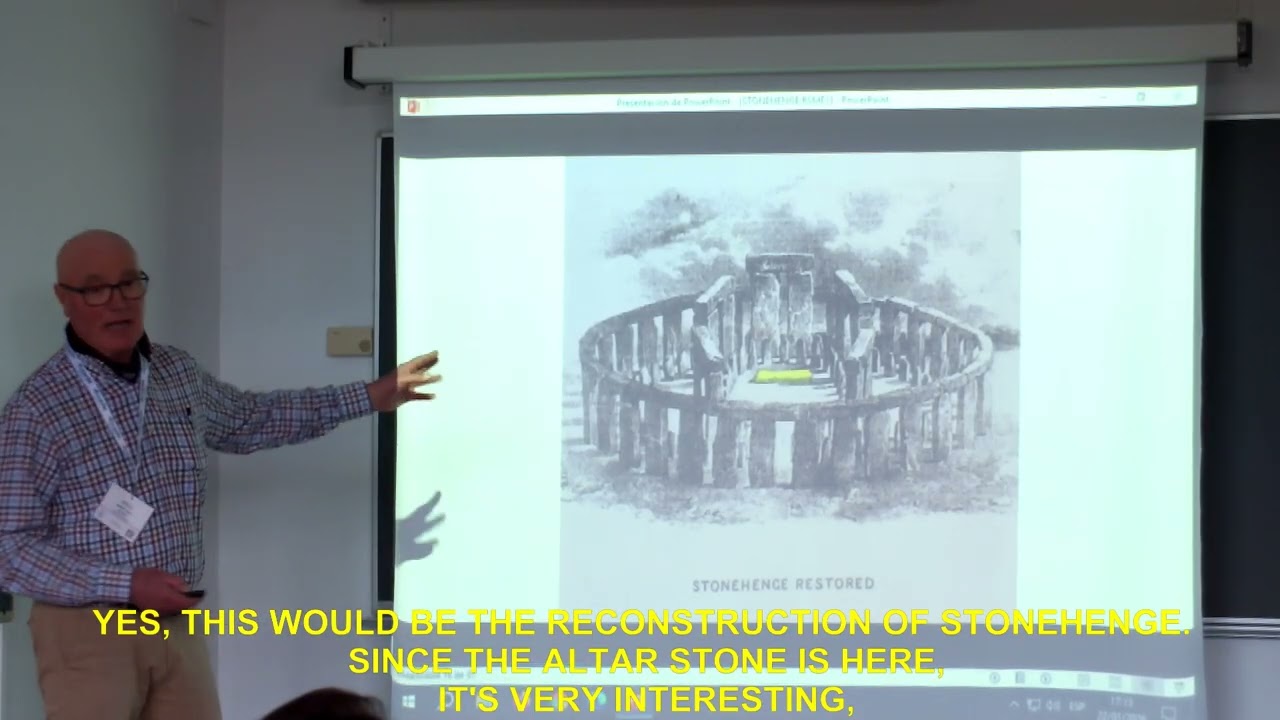
En este artículo confirmamos que la unidad de medida empleada en el diseño del círculo de Piedras Sarsens es el pie de 26.70 cm, como ya lo propuso William Stukeley (1790). Según está unidad cada dintel tiene unas dimensiones de 3x4x12. De modo que la longitud de un círculo de 30 dinteles de 12 unidades es 360 pies. Para esta longitud el valor del diámetro entero que mejor se ajusta a esa circunferencia es 115. Por ello, la fracción 360/115 es la aproximación al número π que se empleó en Stonehenge, y proponemos que se llame: “Aproximación a π de Stonehenge”. Esta aproximación es original y no está descrita hasta ahora. También proponemos que las dimensiones de la Piedra del Altar (Nº80), siguen entre sí una sucesión armónica (H), en contra de la opinión general que desconoce la relación que hay entre ellas. Según Anthony Johnson, en su libro “Solving Stonehenge, the new key to and ancient enigma” (2008), en el capítulo 5, página 134, las dimensiones de la Piedra del Altar son: 4.40 x 0.90 x 0.50 m, de modo que H = (2x4.4x0.5) / (4.4+0.5) = 4.4/4.9 = 0.898 ≈ 0.90, tal como queríamos demostrar.
Palabras clave: Stonehenge, número π, unidad medida, pie Stonehenge, piedra altar
Referencias:
1.- Johnson, Anthony. (2008). Solving Stonehenge. The new key to an ancient enigma. Thames & Hudson Ltd. London.
2.- Stukeley, W. (1790). Stonehenge, a temple restor´d to the British Druids. Republished 2007 by Forgotten Books.
Stonehenge: Calculation of the number π used and geometric analysis of the altar stone
In this article, we confirm that the unit of measurement used in the design of the Sarsens stone circle is the foot of 26.70 cm, as proposed by William Stukeley (1790). According to this unit, each lintel has dimensions of 3x4x12. Thus, the length of a circle of 30 12-unit lintels is 360 feet. For this length, the value of the whole diameter that best fits this circumference is 115. Therefore, the fraction 360/115 is the approximation to the number π used at Stonehenge, and we propose that it be called: “Stonehenge approximation to π.” This approximation is original and has not been described until now. We also propose that the dimensions of the Altar Stone (No. 80) follow a harmonic sequence (H). contrary to the general opinion that ignores the relationship between them. According to Anthony Johnson, in his book “Solving Stonehenge, the new key to and ancient enigma” (2008), in chapter 5, page 134, the dimensions of the Altar Stone are: 4.40 x 0.90 x 0.50 m, so H = (2x4.4x0.5) / (4.4+0.5) = 4.4/4.9 = 0.898 ≈ 0.90, just as we wanted to demonstrate.







Информация по комментариям в разработке