(5 Dec 2025)
RESTRICTION SUMMARY:
ASSOCIATED PRESS
Aceh Tamiyang District, Indonesia - 5 December 2025
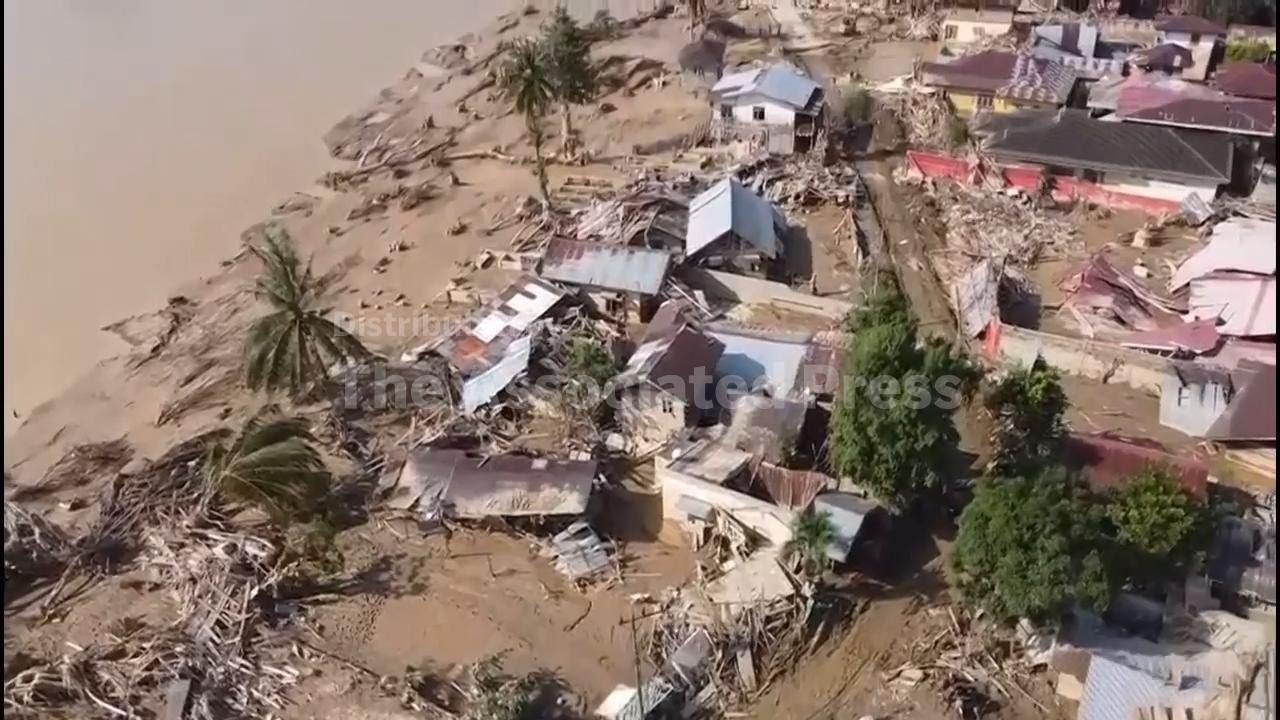
1. Various aerial drone shots showing devastated area of Aceh Tamiyang district ++MUTE++
++QUALITY AS INCOMING++
2. Pan left of damaged houses
3. SOUNDBITE (Indonesian) Mariana, 53, survivor:
“There is no food. There is no clean water, so we cook and feed the children using the floodwater. We collect the water and let it settle overnight, then we boil it. Even the rice we received was already wet, and we cooked it with the floodwater to feed the children.”
4. SOUNDBITE (Indonesian) Sri Yuliani, 48, survivor:
++SOUNDBITES BEGINS AS SHOT PANS LEFT++
“I saved myself using a leaking boat that could only carry one person. I asked for help from the search and rescue team, but they didn’t want to help us even though many people in Lintang city died from the (flood). I climbed onto the roof and stayed there for three days without food.”
5. Pan right of damaged houses
6. An old woman washing clothes using floodwater
7. SOUNDBITE (Indonesian) Mariana, 53, survivor:
“There has been no aid. I haven’t received any assistance at all. Other people might have gotten aid and they shared a little with me, but direct assistance — I haven’t received any aid. So I beg for clean water, rice, cooking oil, which we don’t have. Please help us, sir… because the relief effort here is very slow.”
8. Pan of people lining up for the distribution of aid
9. Wide of a man walking among debris carrying a plastic bag containing food assistance.
STORYLINE:
Emergency crews were racing against time on Friday after last week’s catastrophic floods and landslides struck parts of Asia, killing more than 1,500 people.
Relief operations are underway, but the scale of need is overwhelming the capabilities of rescuers.
Authorities said 867 people were confirmed dead in Indonesia, 486 in Sri Lanka and 185 in Thailand, as well as three in Malaysia.
Many villages in Indonesia and Sri Lanka remained buried under mud and debris, with nearly 900 people still unaccounted for in both countries, while recovery was further along in Thailand and Malaysia.
As the waters recede, survivors in Indonesia find that the disaster has crippled their villages’ lifelines.
Roads that once connected the cities and districts to the outside world are severed, leaving some areas accessible only by helicopter.
Transmission towers collapsed under the weight of landslides, plunging communities into darkness and causing internet outages.
In Aceh Tamiang, the hardest-hit area in Aceh province, infrastructure is in ruins.
Entire villages in the lush hills district lie submerged beneath a thick blanket of mud.
More than 260,000 residents fled homes once on green farmland.
With wells contaminated and pipes shattered, the floodwaters have turned necessities into luxuries.
Food is scarce, and the stench of decay hangs heavily in the air.
For many, survival hinges on the speed of aid.
Trucks carrying relief supplies crawl along roads connecting North Sumatra's Medan city to Aceh Tamiang, which reopened almost a week after the disaster, but distribution is slowed by debris on the roads, said National Disaster Management Agency's spokesperson Abdul Muhari.
“There is no food. There is no clean water, so we cook and feed the children using the floodwater,” Mariana, who goes by a single name, told the AP on Friday.
Another resident, Sri Yulianti, recounted how she, her relatives and neighbors clung to the tin roof of a shattered building for 3 days.
AP video shot by Binsar Bakkara
Find out more about AP Archive: http://www.aparchive.com/HowWeWork
Twitter: / ap_archive
Facebook: / aparchives
Instagram: / apnews
You can license this story through AP Archive: http://www.aparchive.com/metadata/you...

Информация по комментариям в разработке