https://teachyourselfbagpipes.co.uk/f...
http://www.lindsaydavidson.co.uk
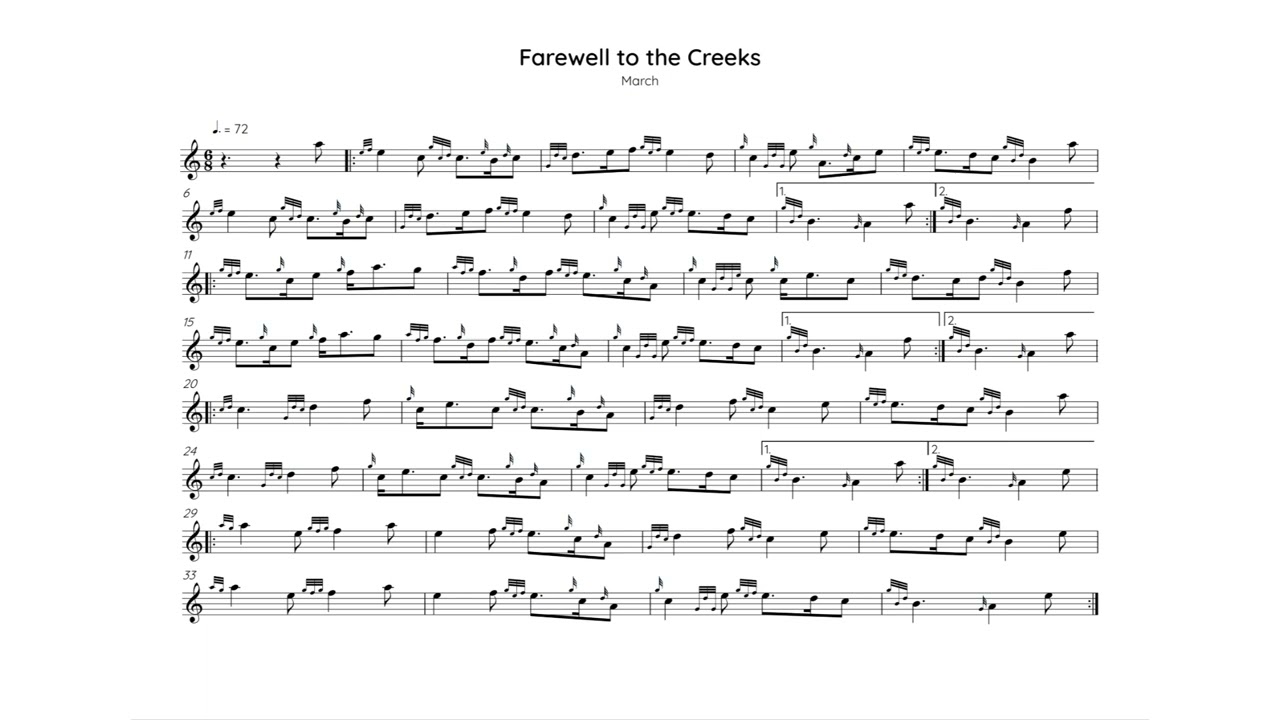
1 The High G gracenotes are 64th notes
2 Throws - the low G preceding the beat is a 32nd note and the second D is opened after a 32nd note too. The strike is light in the proportion 3:1
3 After the beat, the B, C, E, F and high A doublings are arranged in the same way as the throws, whilst the introductory high G gracenote (except high A doublings) takes half the time of the low G in the throws, therefore a 64th note, closing on the beat.
4 Grips and taorluaths fit in the same amount of space - the entire movement is inside a 16th note, meaning both low Gs come across as sounding like 32nd notes. The regularity makes it fairly easy to make this a positive interpretative feature, a point to excite the audience with. The preceding quarter note is in fact now a dotted 8th in every case.
5 At the end of each part, the low G gracenote to low A is a long gracenote. The reason is to give a strong effect of closure. It is a 32nd note, like in the throws.
The Magic Maxim:
"If you can play slowly you can play quickly, but the converse isn't necessarily true..."
This means exactly what it says - the better you become the more exactly you should be able to control what you are doing, and so to test ourselves, we shouldn't practice more quickly, but more slowly.
To think again like computers - a sampling rate for a recording is a measure of how many times a second the computer will measure what is happening in the sound. A higher sampling rate makes for a higher quality of recording, up to a point beyond which it doesn't make much difference. It is the same with piping - the more times in a beat you can say exactly what is happening, the better your piping, up to a point..
By remembering the five steps in learning (see how to practice), we can see that at the point when we assign time to our actions we can get better by increasing our sampling rate. We do this simply by dividing by two, and playing at half speed, with awareness of twice as many points in the beat. When we succeed at this level, we half our speed again, and double the number of places in the bar we try to feel and be aware of what is happening. We keep doing this until every gracenote can be measured opening and closing. If you know the 'New French Method' of rhythm, this helps dramatically, as it automatically gives us a sampling rate of four points per beat.
Start with a quick video (or a medium one) and when you feel you are playing with this nicely, go to a slower one, and try to feel more detail. First listen carefully, bearing in mind that most things are divided by two, to find where the actions occur. Obviously, when you accomplish this, go to the next slower file.
Once you have gone to the slowest file and played along correctly, start to go through the faster ones again to see how much more precisely you are playing, and hearing what you are playing.
Playing exactly with the midi files at a quarter speed is a fairly good test for a group, and this extra secret can dramatically affect the strength of playing within a band, and the confidence. It is true that using this approach, you can bring about a positive revolution in your band's playing and attitude.
It's a simple set of tasks, the trick is in disciplining yourself to do it.













Информация по комментариям в разработке