What is the physical definition of a note, and how does frequency affect our perception of it? A note is a consistent vibration of air particles that our brains interpret as a specific pitch. Higher frequencies, or faster vibrations, are perceived as higher pitches, while lower frequencies represent lower pitches.
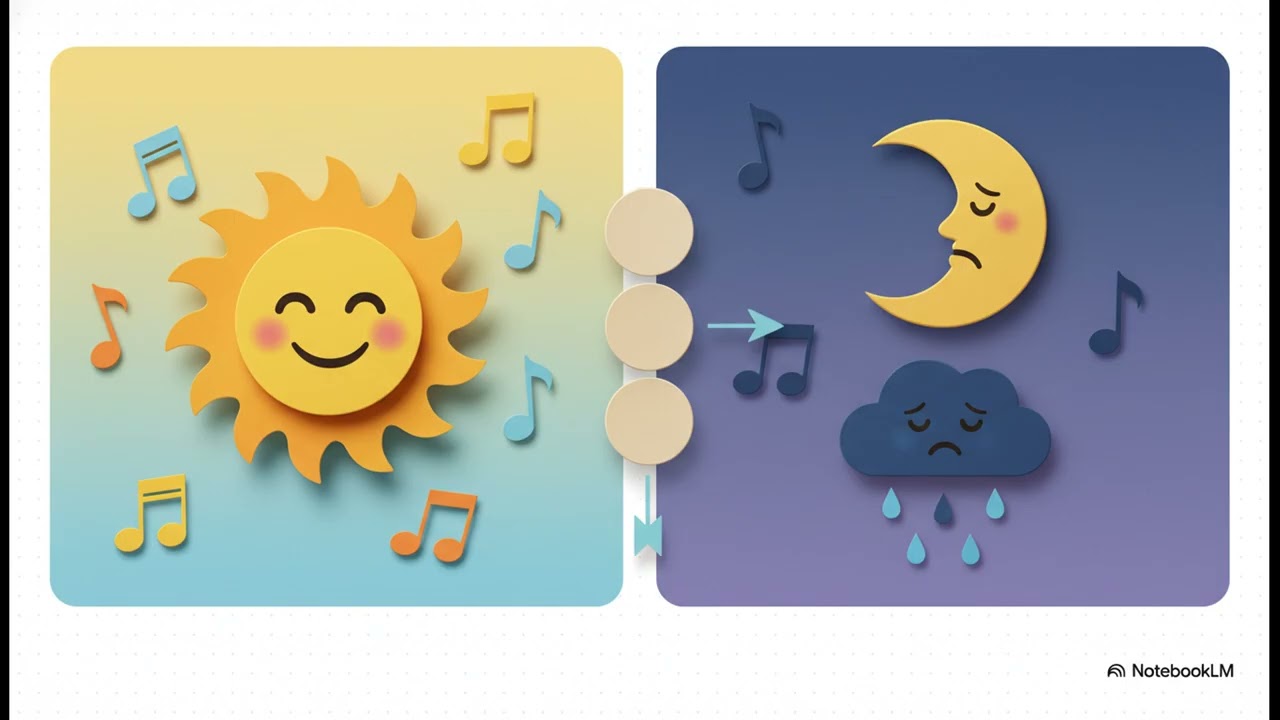
Explain the difference between a major triad and a minor triad based on their semitone formulas. A major triad follows a "4 then 3" formula, meaning there are four semitones between the root and the third, and three semitones between the third and the fifth. A minor triad reverses this relationship with a "3 then 4" formula, creating a "sad" rather than "happy" sound.
What is the specific formula of intervals required to build a major scale? The major scale is constructed using a specific sequence of steps: whole, whole, half, whole, whole, whole, half. This formula can be applied starting on any note to find the seven notes belonging to that specific major key.
How is a "relative minor" scale identified in relation to a major scale? The relative minor scale uses the exact same notes as its relative major scale but begins on the sixth degree of that major scale. For example, A is the sixth degree of C major, making A natural minor the relative minor of C major.
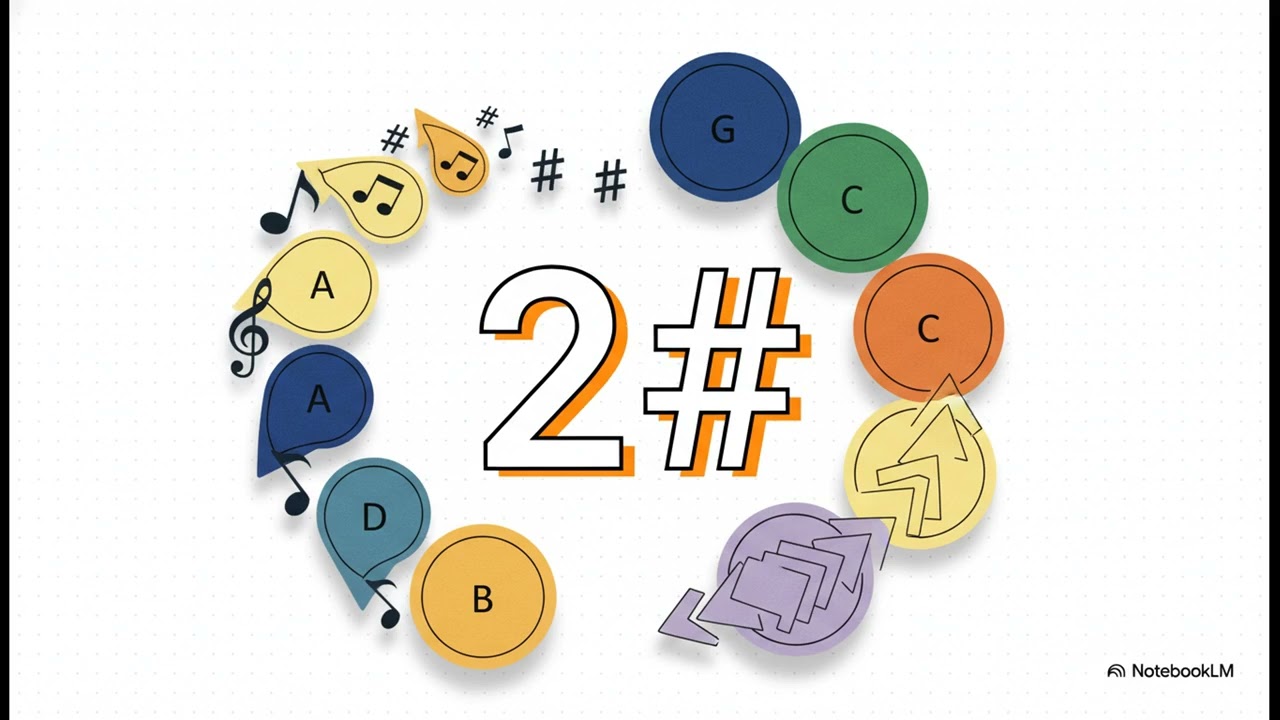
What is the "Circle of Fifths," and how does it assist a musician in understanding keys? The Circle of Fifths is a visual representation of all 12 notes arranged by intervals of a fifth, showing the relationship between different tonalities. It helps musicians identify how many sharps or flats are in a key and determines which keys are "adjacent" or harmonically related.
Define the term "inversion" and explain its practical benefit in a chord progression. An inversion occurs when the notes of a chord are rearranged so that a note other than the root is the lowest sounding pitch. Practically, inversions allow for "voice leading," keeping the notes of consecutive chords closer together to create a smoother, more natural musical flow.
What are "overtones," and how do they determine the "timbre" or tone of different instruments? Overtones are additional frequencies that vibrate along with the fundamental note; any sound in nature is actually a "cocktail" of these frequencies. The specific levels and presence of harmonic and inharmonic overtones are what allow the human ear to distinguish between a piano and a trumpet playing the same note.
Explain the difference between a "simple" time signature and a "compound" time signature. In a simple time signature, such as 4/4 or 3/4, the main beat is divided into two equal parts (quarter notes). In a compound time signature, like 6/8 or 9/8, the beat is divided into three parts, typically felt as dotted quarter notes.
What is a "secondary dominant" chord, and what is its primary purpose in a composition? A secondary dominant is a chord borrowed from another key, specifically the fifth degree (V) of a chord already present in the current key. Its purpose is to create temporary tension that resolves into a specific target chord, adding harmonic color and "accidentals" not found in the home scale.
What is a "polyrhythm," and how does it differ from a "polymeter"? A polyrhythm is the superposition of two different rhythms (like 3 over 4) within the same duration of time. A polymeter involves two different time signatures playing simultaneously where the beats stay the same length, causing the patterns to become offset and eventually resynchronize over several bars.
Accidental
A note that is not part of the key signature, typically indicated by a sharp, flat, or natural symbol.
Authentic Cadence
A conclusive musical "punctuation" created by moving from the fifth degree chord (V) to the first degree chord (I).
Bar (Measure)
A segment of time in music defined by a specific number of beats as determined by the time signature.
Blue Note
A note—often a minor third or diminished fifth—added to a scale to create the characteristic "friction" and tension of blues music.
Chord Progression
A series of chords played in a specific order to tell a musical story or establish an emotional foundation.
Chromatic Scale
A scale consisting of all twelve available semitones within an octave.
Degrees
The numbered positions of notes within a scale (1st, 2nd, 3rd, etc.), often represented by Roman numerals when referring to chords.
Diminished Chord
A dissonant triad consisting of a root, a minor third, and a diminished (flattened) fifth.
Dominant
The fifth degree of a scale, which possesses a strong harmonic pull toward the tonic.
Hertz (Hz)
The unit of measurement for frequency, representing the number of vibrations per second.
Interval
The distance in pitch between two notes (e.g., a semitone, a whole tone, or a fifth).
Key
The group of notes (usually seven) that form the harmonic "home base" for a piece of music.
Mode
A scale derived from a parent scale (like the major scale) by starting on a different note, resulting in a uniq









Информация по комментариям в разработке