Planets Comparison
Pluto (minor-planet designation: 134340 Pluto) is a dwarf planet in the Kuiper belt, a ring of bodies beyond the orbit of Neptune. It was the first and the largest Kuiper belt object to be discovered. After Pluto was discovered in 1930, it was declared to be the ninth planet from the Sun. Beginning in the 1990s, its status as a planet was questioned following the discovery of several objects of similar size in the Kuiper belt and the scattered disc, including the dwarf planet Eris. This led the International Astronomical Union (IAU) in 2006 to formally define the term planet—excluding Pluto and reclassifying it as a dwarf planet.
The Moon is Earth's only natural satellite. At about one-quarter the diameter of Earth (comparable to the width of Australia), it is the largest natural satellite in the Solar System relative to the size of a major planet,the fifth largest satellite in the Solar System overall, and larger than any known dwarf planet. The Moon is a planetary-mass object that formed a differentiated rocky body, making it a satellite planet under the geophysical definitions of the term. It lacks any significant atmosphere, hydrosphere, or magnetic field. Its surface gravity is about one-sixth of Earth's (0.1654 g); Jupiter's moon Io is the only satellite in the Solar System known to have a higher surface gravity and density.
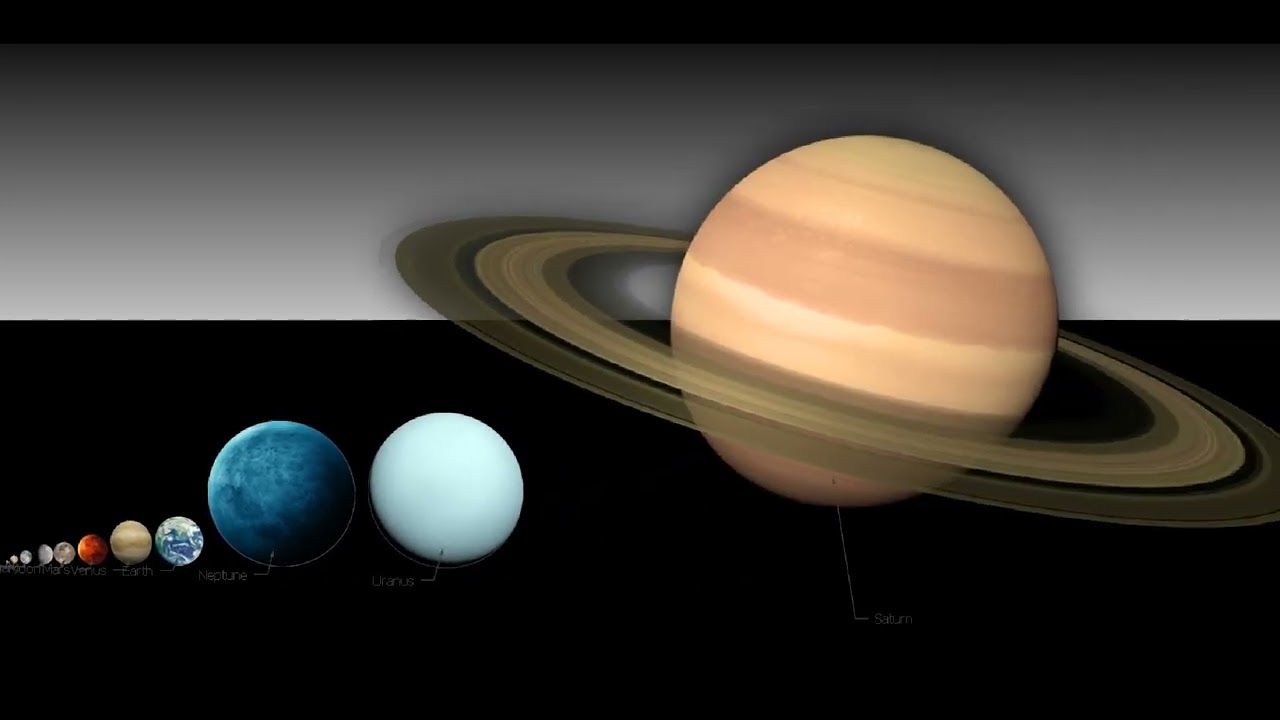
Saturn is the sixth planet from the Sun and the second-largest in the Solar System, after Jupiter. It is a gas giant with an average radius of about nine and a half times that of Earth. It only has one-eighth the average density of Earth; however, with its larger volume, Saturn is over 95 times more massive.
Jupiter is the fifth planet from the Sun and the largest in the Solar System. It is a gas giant with a mass more than two and a half times that of all the other planets in the Solar System combined, but slightly less than one-thousandth the mass of the Sun. Jupiter is the third brightest natural object in the Earth's night sky after the Moon and Venus. People have been observing it since prehistoric times; it was named after the Roman god Jupiter, the king of the gods, because of its observed size.
Venus is the second planet from the Sun. It is named after the Roman goddess of love and beauty. As the brightest natural object in Earth's night sky after the Moon, Venus can cast shadows and can be visible to the naked eye in broad daylight. Venus lies within Earth's orbit, and so never appears to venture far from the Sun, either setting in the west just after dusk or rising in the east a little while before dawn. Venus orbits the Sun every 224.7 Earth days. It has a synodic day length of 117 Earth days and a sidereal rotation period of 243 Earth days. As a consequence, it takes longer to rotate about its axis than any other planet in the Solar System, and does so in the opposite direction to all but Uranus. This means the Sun rises in the west and sets in the east. Venus does not have any moons, a distinction it shares only with Mercury among the planets in the Solar System.
Uranus is the seventh planet from the Sun. Its name is a reference to the Greek god of the sky, Uranus, who, according to Greek mythology, was the great-grandfather of Ares (Mars), grandfather of Zeus (Jupiter) and father of Cronus (Saturn). It has the third-largest planetary radius and fourth-largest planetary mass in the Solar System. Uranus is similar in composition to Neptune, and both have bulk chemical compositions which differ from that of the larger gas giants Jupiter and Saturn. For this reason, scientists often classify Uranus and Neptune as "ice giants" to distinguish them from the other giant planets.
Neptune is the eighth and farthest-known Solar planet from the Sun. In the Solar System, it is the fourth-largest planet by diameter, the third-most-massive planet, and the densest giant planet. It is 17 times the mass of Earth, slightly more massive than its near-twin Uranus. Neptune is denser and physically smaller than Uranus because its greater mass causes more gravitational compression of its atmosphere. It is referred to as one of the solar system's two ice giant planets (the other one being its near-twin Uranus.)

Информация по комментариям в разработке