It is an early summer day somewhere in northern Italy. The sun is still low, the streets are quiet, and a Fiat 500 Topolino C is waiting in front of a narrow townhouse. The driver opens the lightweight door, inserts the key, and pulls the starter: a soft whirring, a brief mechanical clacking, then the small four-cylinder engine roars to life and the Topolino rolls away.
Past market stalls, bicycles, and children on their way to school. It is small enough for narrow streets, economical enough for a tight budget, and reliable enough to do its job every day. Maybe it's going to work, maybe to the countryside to visit relatives, maybe just out of the city - mobility suddenly means freedom.
In the evening, the Topolino returns. Dusty, warmed up, satisfied. It hasn't broken any records, but it has moved people - literally and figuratively. And it is precisely this simplicity that makes it so special to this day.
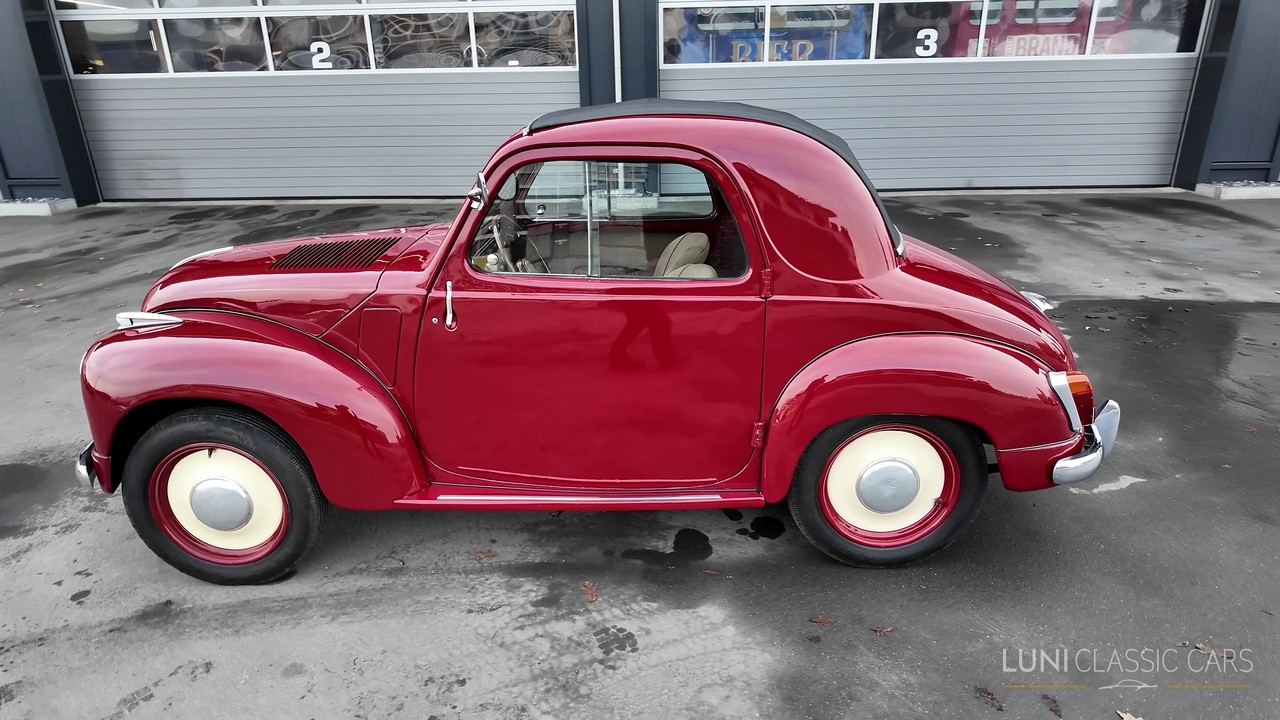
This 1949 Fiat 500 Topolino C is much more than a car - it is a rolling piece of post-war European history. At a time when mobility had to be rethought, the Topolino offered exactly what was needed: reliability, economy, and charm. And all this packaged in a form that still captures hearts today.
The small four-cylinder engine at the front runs smoothly and with astonishing confidence. With its characteristic engine sound, smooth running, and honest mechanics, the Topolino offers a driving experience that slows you down and inspires you at the same time. Every journey becomes a journey through time - no stress, no hustle and bustle, just mechanics, steering wheel, and landscape.
The Topolino C version represents the final and most mature stage of development. Improved body details, optimized technology, and slightly more modern lines made it more suitable for everyday use.
The condition of this Italian classic is surprisingly good. The underbody is clean and both the electrical and mechanical systems work flawlessly. Thanks to a previous restoration, the little car is still in good shape today and has no quirks except for normal signs of wear and a few inconspicuous blisters.
This Fiat is ideal for enthusiasts, collectors, or connoisseurs looking for a vehicle that evokes emotions, starts conversations, and generates sympathy everywhere. The Topolino is not a status symbol - it is a cultural asset.
You can find more data and pictures at:
www.lunicars.com
The full-length 4K video including sound about the vehicle can be found at the following YouTube link:
• 1949 Fiat 500 Topolino C Walkaround, Start...
Model history:
The Fiat 500 Topolino is one of Europe's most important automobiles. Developed in the early 1930s, it was born out of a vision to build an affordable car for the general public. The driving force behind this project was Dante Giacosa, one of the most important engineers in Italian automotive history.
The Topolino was first introduced in 1936. Its name – Italian for “little mouse” – was meant affectionately and reflected both its size and character. Despite its compact dimensions, the Topolino was technically sophisticated: water-cooled four-cylinder engine, independent front suspension, ladder frame, and surprisingly comfortable handling.
After World War II, the Topolino became the mobility solution for an entire generation. While many manufacturers were still struggling with reconstruction, Fiat delivered a functional, reliable vehicle. The Topolino was affordable, economical, and robust – perfect for post-war Italy, but also for the rest of Europe.
The C version, introduced in 1949, marked the peak of its development. Visually, the car was given a modernized front end, more harmonious lines, and revised details. Technically, the engine was further refined, the chassis optimized, and its suitability for everyday use improved. It was the Topolino at its best.
Socially, the Topolino was a symbol of a new beginning. It enabled mobility, independence, and a new attitude towards life. Families drove it on vacation, merchants delivered to markets, and young people discovered their freedom. In films, photographs, and memories, the Topolino became a symbol of European reconstruction.
Acoustically, the little Fiat is just as unique. The purring engine sound, the mechanical clicking of the transmission, and the gentle rolling on narrow tires create an atmosphere that modern vehicles can no longer offer. It is precisely this sound that makes it so popular with classic car fans today.
Compared to contemporary vehicles, the Topolino was revolutionary. While many cars were heavy, thirsty, and expensive, Fiat focused on efficiency and lightness. This concept influenced later models such as the Fiat 600 and the legendary Nuova 500.
Today, the Fiat 500 Topolino C is considered a sought-after classic. It is not a car for fast driving, but for conscious moments. A vehicle that slows down and connects.











Информация по комментариям в разработке