Tracklist
00:00 1. Count Basie – High Tide
Written-By – Count Basie / Freddie Green / Rivers Rutherford
05:24 2. Count Basie – The Peacock
Written-By – Burney Peacock
07:34 3. Count Basie – Swedish Pastry
Written-By – Barney Kessel
10:48 4. Count Basie – Spasmodic
Written-By – George Gershwin / Ira Gershwin
13:01 5. Count Basie – Robbins Nest
Written-By – Illinois Jacquet / Sir Charles Thompson
15:52 6. Count Basie – How High the Moon
Written-By – Nancy Hamilton / Morgan Lewis
18:29 7. Count Basie – Malagueña
Written-By – Ernesto Lecuona
21:11 8. Count Basie – High Tide (Alternate Take)
Written-By – Count Basie / Freddie Green / Rivers Rutherford
25:26 9. Count Basie – San Jose
Written-By – Count Basie
27:45 10. Count Basie – Boot Whip
Written-By – D.R.S.
30:17 11. Count Basie – That’s That
Written-By – D.R.S.
32:34 12. Count Basie – The King
Written-By – Count Basie
35:50 13. Count Basie – Malagueña (Alternate Take)
Written-By – Ernesto Lecuona
38:29 14. Count Basie – What Is This Thing Called Love?
Written-By – Cole Porter
41:10 15. Count Basie – September in the Rain
Written-By – Al Dubin / Harry Warren
Piano, Primary Artist – Count Basie
Guitar – Freddie Green
Trumpet – Harry “Sweets” Edison, Buck Clayton, Emmett Berry, Ed Lewis, Karl George, Jimmy Nottingham, George Matthews, Al Killian
Trombone – Dicky Wells, Bill Johnson, Eli Robinson, Ted Donnelly
Sax (Alto) – Earle Warren, Jimmy Powell, Bernie Peacock
Sax (Tenor) – Buddy Tate, Lucky Thompson, Paul Gonsalves, Wardell Gray
Sax (Bass) – Jack Washington, Rudy Rutherford
Clarinet – Rudy Rutherford
Bass – Curly Russell, Singleton Palmer
Drums – Shadow Wilson, Kenny Clarke
Cover Design – Jean Buzelin
Vocals – Anita O'Day
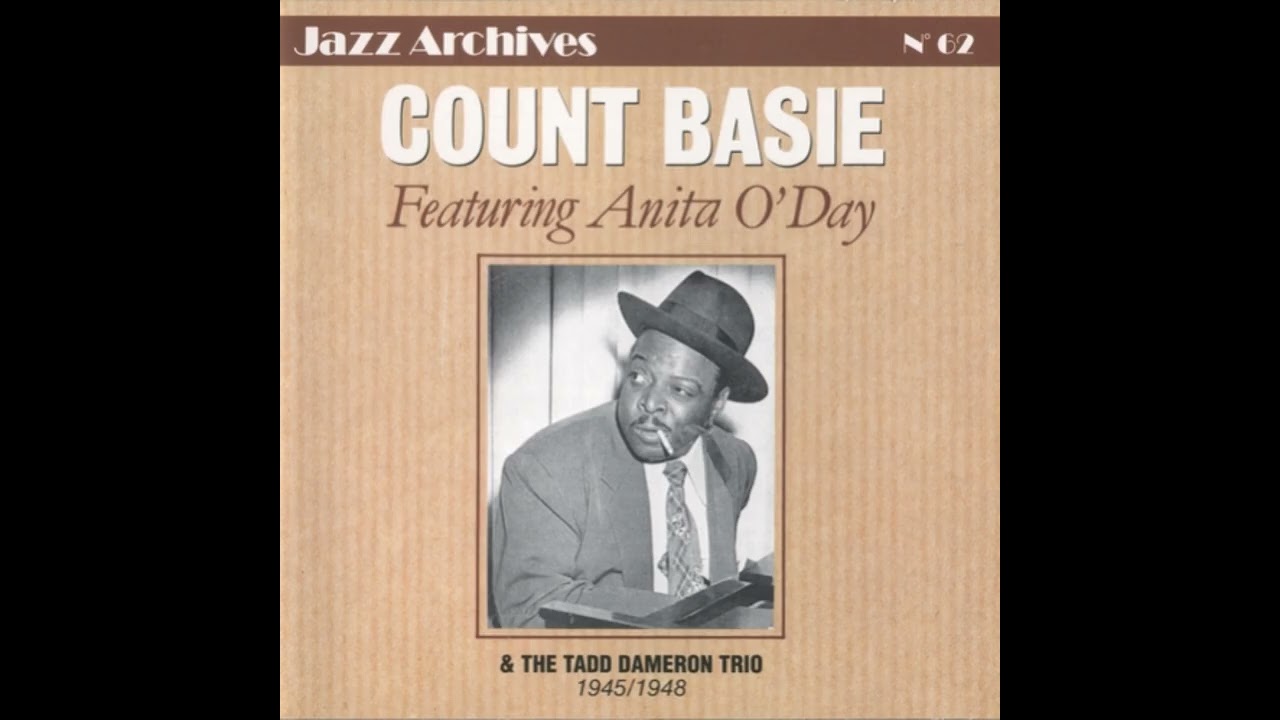
The album Count Basie & The Tadd Dameron Trio – Featuring Anita O'Day 1945/1948 represents an exceptional sonic window into the transition from swing to post-war jazz modernism, documenting two contrasting yet complementary stages in the evolution of Count Basie's orchestral and piano language. Released by EPM Musique as part of its Jazz Archives series, this remastered compilation combines 1945 recordings, dominated by the harmonic lyricism and rhythmic economy of Tadd Dameron's trio, with 1948 recordings that capture Basie's orchestra at its peak, just before the decline of large ensembles. On a technical level, the contrast between the sessions is striking: the former are notable for Dameron's horizontal phrasing, her use of extended chords and tritone substitutions that anticipate bebop, while the latter showcase Basie's dynamic control over riff and ensemble architecture. The sound engineering of the remastered material preserves the characteristic midrange of the Royal Roost radio recordings, with slight compression in the low frequencies but a surprising clarity in the projection of the brass and woodwind instruments. Freddie Green's guitar maintains its function as a harmonic, almost subliminal metronome, while Shadow Wilson's drumming offers a less pronounced ride cymbal than in the pre-bebop era, opting for a more relaxed and conversational swing. The instrumental arrangements emphasize the call and response between the trumpet and saxophone sections, with brief but sophisticated solos by Paul Gonsalves and Wardell Gray that reflect the transition toward a more linear aesthetic less dependent on the rhythmic pattern of Kansas City. Anita O'Day's vocal interventions on tracks such as "Malagueña" and "How High the Moon" provide a highly refined timbral contrast, integrating syncopated phrasing with precise intonation and controlled vibrato, which dialogues with the orchestra without losing spontaneity. Taken together, the album constitutes a technical and stylistic testament to a pivotal era: Basie, in his prime, maintains the structural clarity of swing while assimilating the harmonic sophistication and rhythmic elasticity of modern jazz, in a synthesis that anticipates the orchestral refinement of the following decades.

Информация по комментариям в разработке