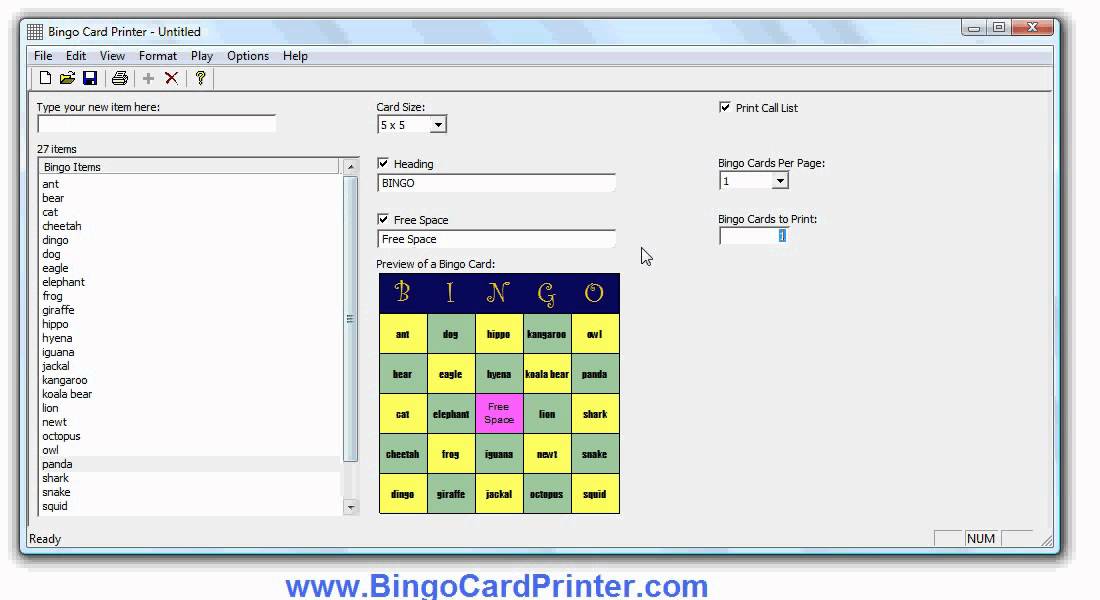
How to use the bingo card creator software from http://www.bingocardprinter.com/ to create your educational bingo cards. Download free trial version to try the software for yourself
Most people tend to think of bingo as either a kids' game or a game played only by senior citizens, but customized versions bingo are also increasingly finding their way into classrooms and being used as educational tools for teaching children, ESL (English As a Second Language) students, and in corporate training.
As you probably know, the standard game of bingo is played using bingo cards printed with a grid of numbers. The player listens out for a bingo caller, checks numbers off their card when they are called out. The winner of the game is the first player to achieve a winning pattern such as a line of five checked-off items, or two intersecting lines of checked-off items (the particular winning pattern required, varies depending on the version of bingo being played).
In educational versions of bingo, with one key exception are basically the same, with the teacher taking the role of bingo caller. The big difference however is that instead of playing with bingo cards printed with a grid of numbers, the bingo cards are instead printed with a grid of items suitable for a particular educational activity. For example, when teaching reading, the items in the grid, might be sight words (words that students must learn to recognize and read by sight rather than sounding out) from the Dolch Sight Word list. Or when teaching a foreign language like French or Spanish, the bingo cards might be words in that language.
Additionally, in educational bingo, the bingo caller (teacher) may choose to call out "clues" to items, rather than the items printed on the cards. For example, in a French lesson, the cards might be printed with French words but the bingo calls can be made in English (or vice-versa), or in a math lesson, answers might be printed on the cards, but the teacher might call out (or write on the blackboard) math problems to be solved.
In short, the beauty of educational bingo, is that it can easily be adapted for any subject and any group, and it's a lot of fun! In language classes, whether they about learning a foreign language such as French, Spanish, German or Italian, or whether they are English as a Second Language (ESL) classes, simply conducting the game, explaining the rules, and so forth, in the particular language, can be an educational activity in itself, over and above any educational benefits gained from playing the game.
Of course, the one essential thing that a teacher needs for this activity is bingo cards printed with words appropriate to the particular lesson. It is possible to buy pre-printed cards from various educational material suppliers, but this can be expensive, and is inflexible - the teacher has no control over the choice of items selected for the card. A better solution is for the teacher to print the cards themselves - this can easily be done using a computer and the right software - http://www.bingocardprinter.com/ - a teacher can easily print an unlimited number of custom bingo cards with minimal effort.

Информация по комментариям в разработке