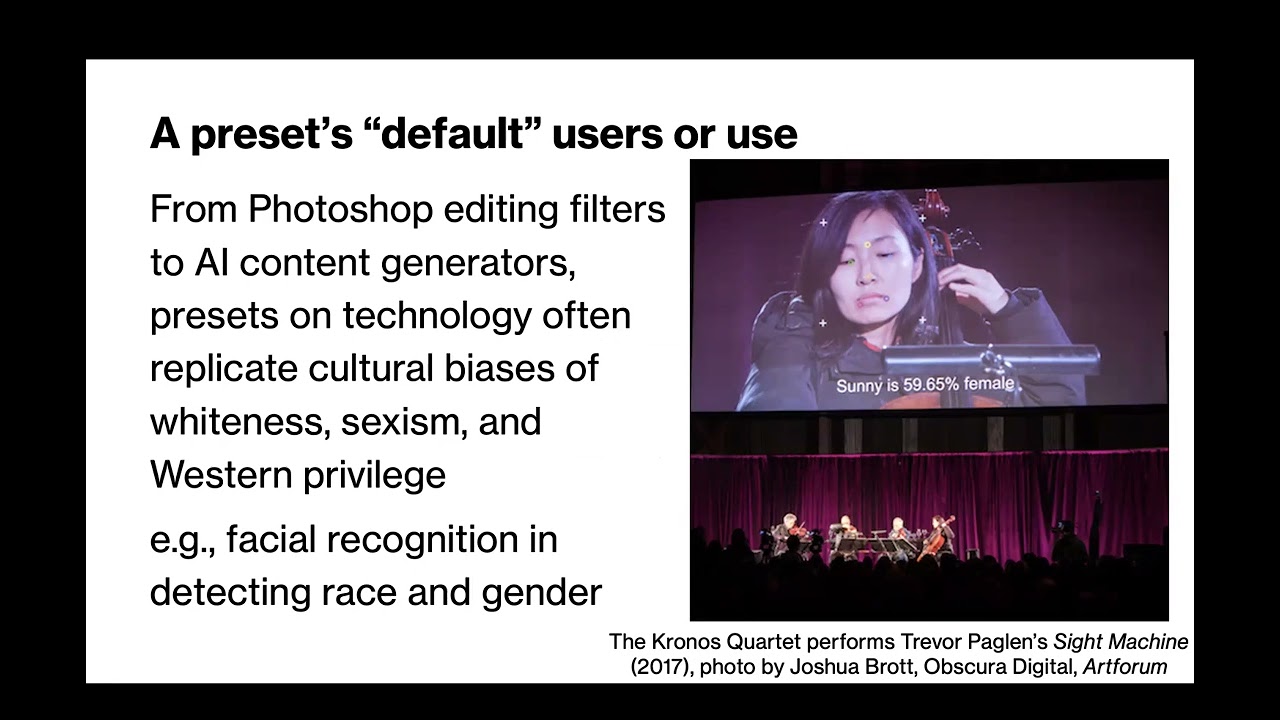
The 2020s have been marked by the moving target of “the new normal,” where rules are overturned and remade seemingly overnight. Artists and musicians have always found ways of working within constraints, from the affordances of certain formats to streaming platforms and TikTok that rewrite trusted formulas for success, to the technical demands of music-making. Amy Skjerseth’s book in progress, Instrumental Presets: The Visible Past of Music Technology, asks how music technologies and their users — whether manufacturers, musicians, or listeners — create and shift the norms of what music looks, sounds, and feels like. Instrumental Presets takes the concept of a preset, a default setting, to explore and reveal how technological and cultural presets shape the meanings and politics of popular music across radio, tape, samplers, Auto-Tune, vocaloids, and deepfakes. The logic of presets is present in everything from music samples and the Instagram grid to editing filters and AI content generators. Skjerseth explores how cultural defaults are also reinforced by these technologies, shoring up power relations tied to whiteness, masculinity, ability, and socioeconomic class. While presets impose technological, industrial, and social norms, artists also develop new forms of expression and resistance within their constraints — often using the very tools that encode bias to expose and expunge it.
Those familiar with Jonathan Sterne’s work will have spotted the homage to The Audible Past (2003) in the title of Skjerseth’s book. This conversation, with fellow music technology scholar Catherine Provenzano, is dedicated to Jonathan, whose work deeply informs our own. In Jonathan’s spirit of demystifying the writing process and interdisciplinary work (here is just one favorite example: https://superbon.net/2021/04/13/on-re..., we invite anyone present to share any reflections about Jonathan brought up by our discussion. Much as Jonathan’s mp3 works through the meaning of a format, Skjerseth’s book thinks through the meaning of a preset—both technological, cultural, and otherwise.
Participants and Links:
Amy Skjerseth
Links:
“Podcast Reenactments and the Sonics of Fictionalization from Cher to Swift,” JPMS, https://online.ucpress.edu/jpms/artic... Ride-Along Listening: Inclusive Modes of Musical Analysis in Switched on Pop,” The Radio Journal: International Studies in Broadcast & Audio Media 20, no. 1 (2022): 33–48. https://intellectdiscover.com/content... Enduring Voice of Yoko Ono” on Phantom Power podcast, March 9, 2021, https://phantompod.org/ep-24-voice-of...
Bio: Amy Skjerseth is Assistant Professor of Popular Music at the University of California, Riverside. Her scholarship focuses on intersections of music, media, material culture, and technology. She is currently working on two books: Instrumental Presets: The Visible Past of Music Technology (under contract with University of California Press) and The Feminist Wall of Sound. Her work has appeared in Spectator; [in]Transition: Journal of Videographic Film & Moving Image Studies; Film Criticism; animation: an interdisciplinary journal; The Radio Journal: International Studies in Broadcast and Audio Media; Music, Sound, and the Moving Image; and Journal of Popular Music Studies, among other venues.
Catherine Provenzano
Links:
“Making Voices: The Gendering of Pitch Correction and the Auto-Tune Effect in Contemporary Popular Music,” JPMS, https://online.ucpress.edu/jpms/artic...
“Autoharps, Chord Organs, and MIDI Packs: Easy-Playing Instruments, Gender, and Classes of Musical Participation,” in Creative Tools and the Softwarization of Cultural Production, https://link.springer.com/chapter/10....
“Hamilton’s Familiar Sound,” Guernica Magazine, https://www.guernicamag.com/hamiltons...
Bio: Catherine Provenzano’s research focuses on voice, instrumentality, labor, and technology as they intersect US popular culture. Her forthcoming book, Emotional Signals: Auto-Tune, Melodyne, and the Cultural Politics of Pitch Correction (University of Michigan Press), is an exploration of the history of pitch correction technologies and their musical and social implications. She is also currently researching the political economy of sound and software in megachurch worship contexts. Her writing appears in Guernica, the Journal of Popular Music Studies, Musicology Now, and several edited collections. She is Assistant Professor of Musicology and Music Industry at UCLA, and is a songwriter and singer.


![David Shumway et al on the World of Leonard Cohen [Popular Music Books In Process - 1-21-26]](https://i.ytimg.com/vi/mOskmeZl8wY/maxresdefault.jpg)








Информация по комментариям в разработке