Why are 21st Century Skills so difficult to teach in school, and why don't they easily translate across contexts?
Hint: It’s the same reason why golfing phenom Tiger Woods struggles to throw a baseball, and why ‘creative genius’ Elon Musk isn’t a particularly compelling public speaker.
---
There’s a popular argument that has been circulating around education for quite some time which goes something like this:
‘Public schooling is a remnant of the Industrial Revolution meant to churn out efficient factory workers. But times have changed. Today, schools must do more than just build effective employees; they must forge holistic, confident citizens of the 21st century. To this end, we must ditch outdated approaches to instruction and instead teach the four competencies (termed C21 skills) most relevant to our modern world: creativity, critical thinking, collaboration and communication.’
Setting aside the specious 'remnant of the Industrial Revolution' argument, let’s take a moment to consider the peculiar origin of the so-called C21 skills.
There's no question that creativity, critical thinking, collaboration and communication are important – but who elevated these specific skills over the countless other ones that are meaningful? Why shouldn’t we instead focus most on teaching skills like health, integrity, morality, kindness, dedication, trustworthiness, loyalty or perseverance?
As it turns out, the idea of C21 skills was conceived at a breakfast meeting held at the Adams Mark Hotel in Dallas, Texas on November 15, 2002. This breakfast was sponsored by the National Education Association, endorsed by the U.S. Department of Education, and included six primary corporate parties: AOL/Time Warner, Apple, Cisco, Dell, Microsoft, and SAP.
Following this breakfast, these corporate parties released a joint document outlining the aforementioned 21st century skills, the very first sentence of which reads:
‘Successful businesses are looking for employees who can adapt to changing needs, juggle multiple responsibilities and routinely make decisions on their own … there is an evolving demand for 21st Century Skills in our economy’.
That’s right – the C21 skills that progressive educators use to rebel against the ‘factory model’ of schooling were first identified and advocated by business interests.
Although this could be interpreted in many ways, here’s the relevant point to this video: seeing as these skills were hand-picked by major corporate interests, and are explicitly emphasized by modern schools, it stands to reason that new graduates should be more ‘workplace ready’ than ever before.
However, this isn’t the case.
For example, an estimated 50% of entry-level hires don’t reach the 18-month mark of employment, while those who do require up to 24-months before they consistently demonstrate those C21 skills that they purportedly mastered in school.
In fact, so frustrated have employers become with entry-level graduates, that many of the world’s top companies (including Apple and Google) no longer require employees to hold four-year degrees, and instead rely upon in-house processes to evaluate and develop C21 skills.
What is going on here? Why aren’t C21 skills automatically transferring from school to the workplace?
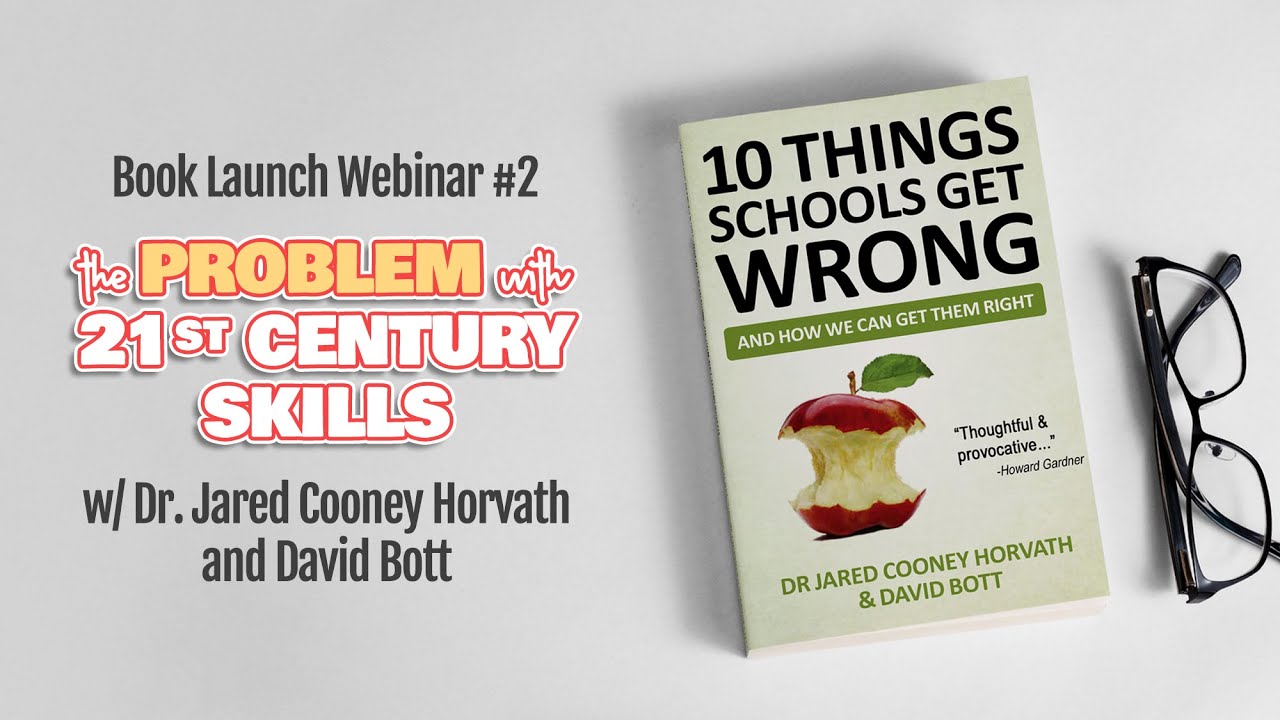
Well, that’s exactly what David Bott and Dr. Jared Cooney Horvath discuss in this video. Give it a watch, and let us know what you think in the comments.
#21stCenturySkills #10ThingsSchoolsGetWrongBook
---
JARED COONEY HORVATH | PhD, MEd
Jared Cooney Horvath is a neuroscientist, educator, and author of the best-selling book 'Stop Talking, Start Influencing: 12 Insights from Brain Science to Make Your Message Stick'.
He has conducted research and lectured at Harvard University, Harvard Medical School, the University of Melbourne, and over 250 schools internationally.
He currently serves as Director of LME Global, a company dedicated to serving teachers, students and schools through applied learning sciences.
https://www.lmeglobal.net/media
---
DAVID BOTT | PGDipEd, PGDipPsych
David Bott is the Associate Director of the Institute of Positive Education.
As an expert in applied wellbeing science, David has supported thousands of educators across the globe in designing and implementing system-level approaches to wellbeing.
David sits on the Dubai Future Council for Education and has published in prominent academic journals and industry periodicals. He currently serves on the board of the Positive Education Schools Association.
/ davidfbott

Информация по комментариям в разработке