Logo video2dn
  • Сохранить видео с ютуба
  • Категории
    • Музыка
    • Кино и Анимация
    • Автомобили
    • Животные
    • Спорт
    • Путешествия
    • Игры
    • Люди и Блоги
    • Юмор
    • Развлечения
    • Новости и Политика
    • Howto и Стиль
    • Diy своими руками
    • Образование
    • Наука и Технологии
    • Некоммерческие Организации
  • О сайте

Скачать или смотреть "The Buddha" by Jules Boissière, read in Occitan and in English translation

  • A.Z. Foreman
  • 2020-12-05
  • 587
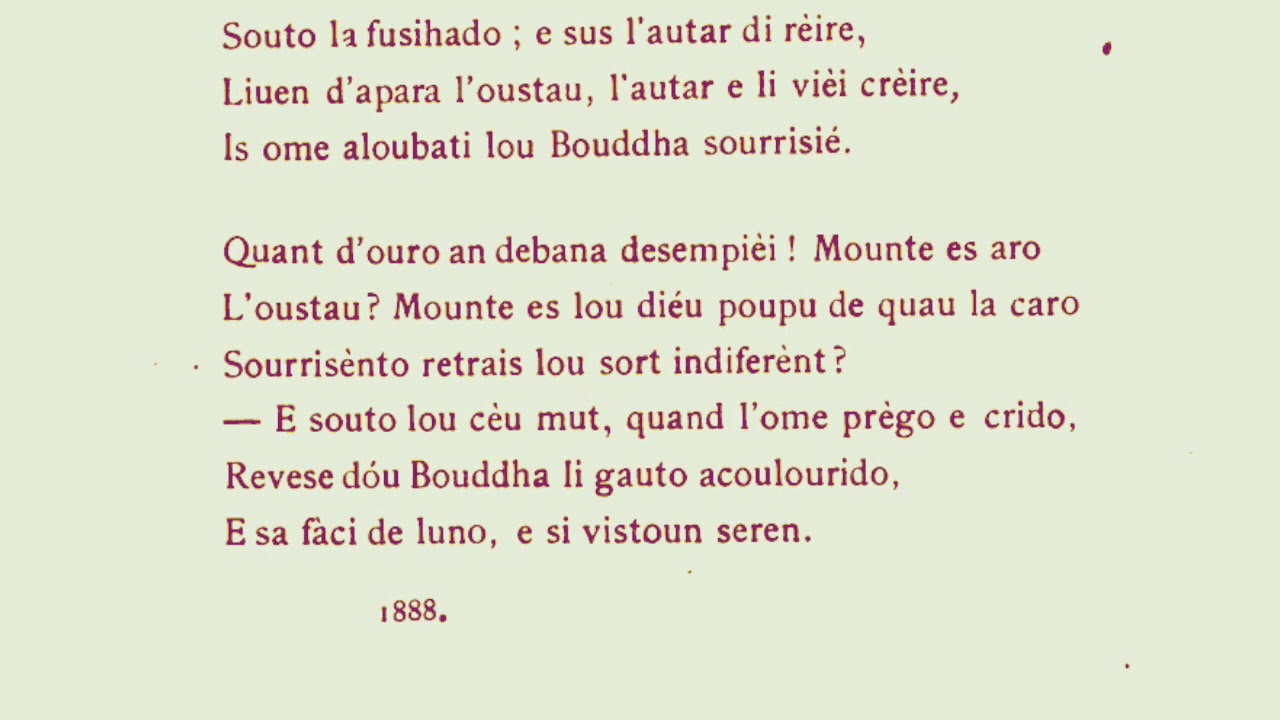
"The Buddha" by Jules Boissière, read in Occitan and in English translation
  • ok logo

Скачать "The Buddha" by Jules Boissière, read in Occitan and in English translation бесплатно в качестве 4к (2к / 1080p)

У нас вы можете скачать бесплатно "The Buddha" by Jules Boissière, read in Occitan and in English translation или посмотреть видео с ютуба в максимальном доступном качестве.

Для скачивания выберите вариант из формы ниже:

  • Информация по загрузке:

Cкачать музыку "The Buddha" by Jules Boissière, read in Occitan and in English translation бесплатно в формате MP3:

Если иконки загрузки не отобразились, ПОЖАЛУЙСТА, НАЖМИТЕ ЗДЕСЬ или обновите страницу
Если у вас возникли трудности с загрузкой, пожалуйста, свяжитесь с нами по контактам, указанным в нижней части страницы.
Спасибо за использование сервиса video2dn.com

Описание к видео "The Buddha" by Jules Boissière, read in Occitan and in English translation

Me reading my translation of Jules Boissière's "The Buddha" in Occitan (specifically literary Rhodanian or "Mistralian" Occitan), and in English translation. Boissière wrote in French and Occitan, but IMO his best work is in Occitan and thus little read.


Born in 1863, Jules Boissière (Juli Boïssièra) spent his early years as a journalist, hobnobbing with the likes of Amouretti and Murras, and writing anemic verse with great virtuosity in two languages. In 1886 he changed careers, and headed for Hanoi, part of the recently consolidated territory of French Indo-China. He served in the 11th Alpine Infantry Battalion, and saw combat in some of the last few battles to conquer the Tonkinese countryside.

Shortly afterward, he began his tenure in the French administrative corps in Saigon and Huế where he learned the language today known as Vietnamese, acquired at leas some knowledge of Classical Chinese, and cultivated the fondness for opium for which he was to become notorious.

He served a long post in Bình Định before returning to France to marry Thérèse Roumanille (Terèsa Romanilha), daughter of Joseph Roumanille the reactionary patriarch of the Provençal Félibre movement.

Boissière returned to Tonkin with his wife in 1892, taking stewardship of the Revue Indochinoise. After another leave of absence in 1895, he was promoted to Vice-Resident 1st Class and died a painful intestinal death two years later.

Boissière wrote prolifically, but published little during his life. He is now best remembered for his collection of French Indo-Chinese short stories titled "Fumeurs d'Opium" (Opium Smokers). He also produced a sizable amount of poetry, both in French and in Occitan, a lot of which — particularly that from his later years — is quite good.

A posthumous collection of his Occitan verse Li Gabian "The Seagulls" was published in 1899 by his wife, who extracted the poems from among his manuscripts. Reading it, I came across quite a few interesting pieces. "Colonial exotic" themes are rare in Occitan literature of this period, which preoccupied itself mostly with Occitania. Like the stories in Fumeurs d'Opium, some of the poems deal with Chinese and Indo-Chinese themes.

Among long odes of nostalgic yearning for his native country and rhapsodies to his fellow félibre activists, I find interwoven e.g. an imaginative sonnet depicting a Chinese Princess reading Li Bai or some lines about stargazing from a boat gliding down the Mekong.

Much of it is of a piece with his best "oriental" verse in French. Then there are a few poems — like the one translated here — where he takes his poetic sensibility to a different level. They are like nothing at all that he wrote in French.

This poem gives a soldiers'-eye view of terrorized civilians running for their lives from a home in flames, followed by a macabre meditation. We are more accustomed to poetry that describes the effect of brutality on those who suffer from it. This poem, though, conveys the effect on a man who inflicts it. The coarsening of the mind, brought on by acceptance of the horrific. There are other poems like this printed in Li Gabian — just a handful.

If you're interested in reading more translations of mine, check out my blog:

http://poemsintranslation.blogspot.com/

Комментарии

Информация по комментариям в разработке

Похожие видео

  • О нас
  • Контакты
  • Отказ от ответственности - Disclaimer
  • Условия использования сайта - TOS
  • Политика конфиденциальности

video2dn Copyright © 2023 - 2025

Контакты для правообладателей [email protected]