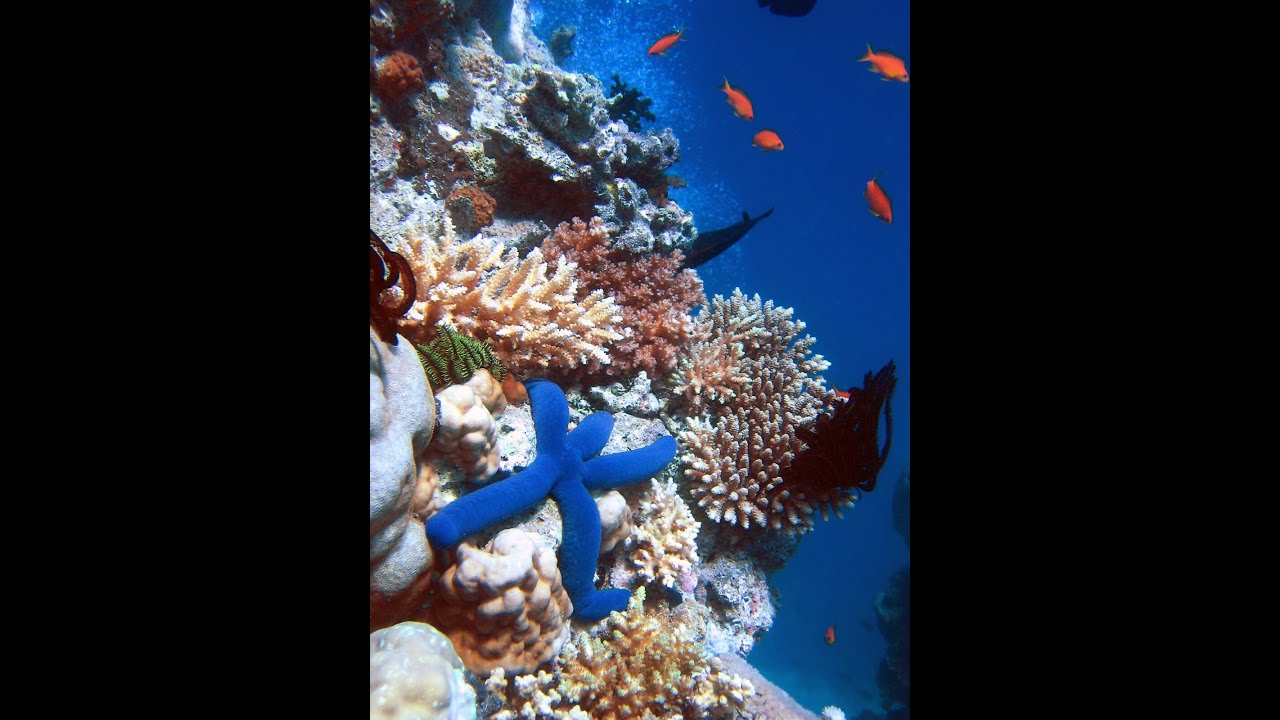
Save The coral Reef ( Under The Sea Part 02 )
#underwater #coral #travel
Coral reefs provide an important ecosystem for life underwater, protect coastal areas by reducing the power of waves hitting the coast, and provide a crucial source of income for millions of people.
A coral reef is an underwater ecosystem characterized by reef-building corals. Reefs are formed of colonies of coral polyps held together by calcium carbonate.[1] Most coral reefs are built from stony corals, whose polyps cluster in groups.
Coral belongs to the class Anthozoa in the animal phylum Cnidaria, which includes sea anemones and jellyfish. Unlike sea anemones, corals secrete hard carbonate exoskeletons that support and protect the coral. Most reefs grow best in warm, shallow, clear, sunny and agitated water. Coral reefs first appeared 485 million years ago, at the dawn of the Early Ordovician, displacing the microbial and sponge reefs of the Cambrian.[2]
Sometimes called rainforests of the sea,[3] shallow coral reefs form some of Earth's most diverse ecosystems. They occupy less than 0.1% of the world's ocean area, about half the area of France, yet they provide a home for at least 25% of all marine species,[4][5][6][7] including fish, mollusks, worms, crustaceans, echinoderms, sponges, tunicates and other cnidarians.[8] Coral reefs flourish in ocean waters that provide few nutrients. They are most commonly found at shallow depths in tropical waters, but deep water and cold water coral reefs exist on smaller scales in other areas.
Coral reefs have declined by 50% since 1950, partly because they are sensitive to water conditions.[9] They are under threat from excess nutrients (nitrogen and phosphorus), rising ocean heat content and acidification, overfishing (e.g., from blast fishing, cyanide fishing, spearfishing on scuba), sunscreen use,[10] and harmful land-use practices, including runoff and seeps (e.g., from injection wells and cesspools).[11][12][13]
Coral reefs deliver ecosystem services for tourism, fisheries and shoreline protection. The annual global economic value of coral reefs has been estimated at anywhere from US$30–375 billion (1997 and 2003 estimates)[14][15] to US$2.7 trillion (a 2020 estimate)[16] to US$9.9 trillion (a 2014 estimate).[17]
Formation
See also: Fringing reef, Atoll, and The Structure and Distribution of Coral Reefs
Most coral reefs were formed after the Last Glacial Period when melting ice caused sea level to rise and flood continental shelves. Most coral reefs are less than 10,000 years old. As communities established themselves, the reefs grew upwards, pacing rising sea levels. Reefs that rose too slowly could become drowned, without sufficient light.[18] Coral reefs are also found in the deep sea away from continental shelves, around oceanic islands and atolls. The majority of these islands are volcanic in origin. Others have tectonic origins where plate movements lifted the deep ocean floor.
In The Structure and Distribution of Coral Reefs,[19] Charles Darwin set out his theory of the formation of atoll reefs, an idea he conceived during the voyage of the Beagle. He theorized that uplift and subsidence of Earth's crust under the oceans formed the atolls.[20] Darwin set out a sequence of three stages in atoll formation. A fringing reef forms around an extinct volcanic island as the island and ocean floor subside. As the subsidence continues, the fringing reef becomes a barrier reef and ultimately an atoll reef.
This is from wikipedia
Thanks for watching Travel With Me 🙏🙏🙏

Информация по комментариям в разработке