Logo video2dn
  • Сохранить видео с ютуба
  • Категории
    • Музыка
    • Кино и Анимация
    • Автомобили
    • Животные
    • Спорт
    • Путешествия
    • Игры
    • Люди и Блоги
    • Юмор
    • Развлечения
    • Новости и Политика
    • Howto и Стиль
    • Diy своими руками
    • Образование
    • Наука и Технологии
    • Некоммерческие Организации
  • О сайте

Скачать или смотреть SAP 1 CPU Logisim Tutorial with Control Unit & Boot Loader

  • Ahsanullah Khalid
  • 2025-08-13
  • 132
SAP 1 CPU Logisim Tutorial with Control Unit & Boot Loader
  • ok logo

Скачать SAP 1 CPU Logisim Tutorial with Control Unit & Boot Loader бесплатно в качестве 4к (2к / 1080p)

У нас вы можете скачать бесплатно SAP 1 CPU Logisim Tutorial with Control Unit & Boot Loader или посмотреть видео с ютуба в максимальном доступном качестве.

Для скачивания выберите вариант из формы ниже:

  • Информация по загрузке:

Cкачать музыку SAP 1 CPU Logisim Tutorial with Control Unit & Boot Loader бесплатно в формате MP3:

Если иконки загрузки не отобразились, ПОЖАЛУЙСТА, НАЖМИТЕ ЗДЕСЬ или обновите страницу
Если у вас возникли трудности с загрузкой, пожалуйста, свяжитесь с нами по контактам, указанным в нижней части страницы.
Спасибо за использование сервиса video2dn.com

Описание к видео SAP 1 CPU Logisim Tutorial with Control Unit & Boot Loader

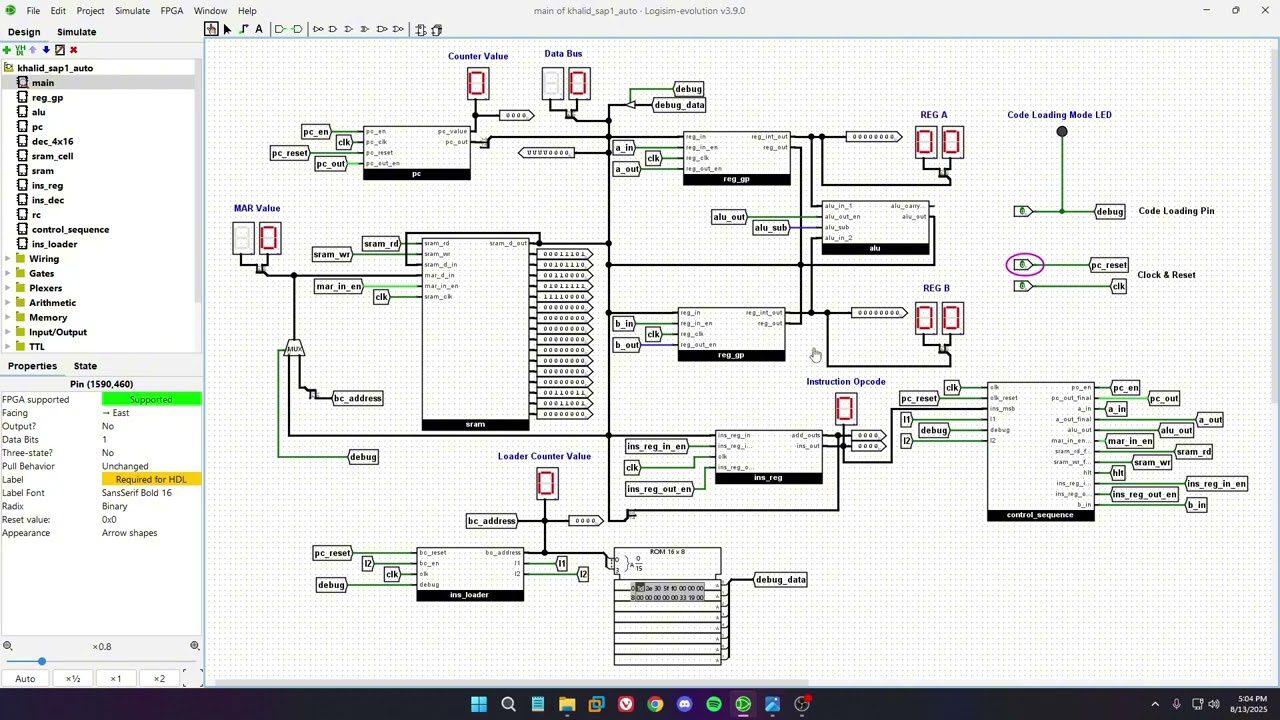
Simple-As-Possible (SAP-1) CPU in Logisim Evolution

This repository contains the Logisim Evolution implementation of a Simple-As-Possible (SAP-1) CPU. The SAP-1 is a foundational computer architecture used to teach the basic principles of CPU design, including the data path, control unit, and instruction set architecture.

This implementation features a fully functional hardwired control unit, which automates the fetch-decode-execute cycle, allowing the CPU to run machine code programs autonomously. The project culminates in successfully executing a simple addition program, loading two pre-defined 8-bit values, adding them, and storing the sum in memory.

SAP-1 Architecture Components
The SAP-1 CPU is composed of several fundamental building blocks:

Program Counter (PC): A 4-bit counter that stores the memory address of the next instruction to be executed. It increments automatically after each instruction fetch.

Program Counter

Random Access Memory (RAM): An 8-bit wide memory unit used to store both machine code instructions and data. Our implementation uses a 16-byte RAM.

RAM

Memory Address Register (MAR): A 4-bit register that holds the address of the memory location currently being accessed (for reading or writing).

Instruction Register (IR): An 8-bit register that temporarily holds the instruction fetched from RAM. It's split into a 4-bit opcode and a 4-bit operand (memory address).

IR

Registers A & B (Accumulator & B-Register): 8-bit general-purpose registers. Register A (Accumulator) is typically used for arithmetic operations and storing results. Register B holds the second operand for ALU operations.

Registers A & B

Arithmetic Logic Unit (ALU): An 8-bit unit capable of performing basic arithmetic (addition, subtraction) and logical operations on data from Registers A and B.

ALU

Output Register: (Implicit in SAP-1, often just Register A or a direct output).

Control Unit: The "brain" of the CPU. It generates the necessary control signals (pin activations) at the correct time to sequence the micro-operations for fetching, decoding, and executing instructions. This project focuses heavily on its hardwired implementation.

Main Control Unit

The Hardwired Control Unit
The control unit is implemented using combinational logic (AND, OR, NOT gates) and a state counter (often called a ring counter in SAP-1 context). It orchestrates the entire CPU operation.

Sub-Components of the Control Unit:
State Counter (RC): A 3-bit counter that cycles through T-states (T1, T2, T3, T4, T5, T6). Each T-state represents a distinct phase within an instruction cycle.

State Counter

Opcode Decoder: A 4-to-16 decoder connected to the most significant 4 bits (opcode) of the Instruction Register. It generates a unique HIGH signal for each recognized instruction (e.g., isLDA, isADD, isHLT).

Ins_Dec

Control Matrix (Logic Gates): This is the network of AND and OR gates that takes the T-state signals from the State Counter and the instruction signals from the Opcode Decoder as inputs. Its outputs are the various control pins that govern data flow and operations across the CPU.

Комментарии

Информация по комментариям в разработке

Похожие видео

  • О нас
  • Контакты
  • Отказ от ответственности - Disclaimer
  • Условия использования сайта - TOS
  • Политика конфиденциальности

video2dn Copyright © 2023 - 2025

Контакты для правообладателей [email protected]